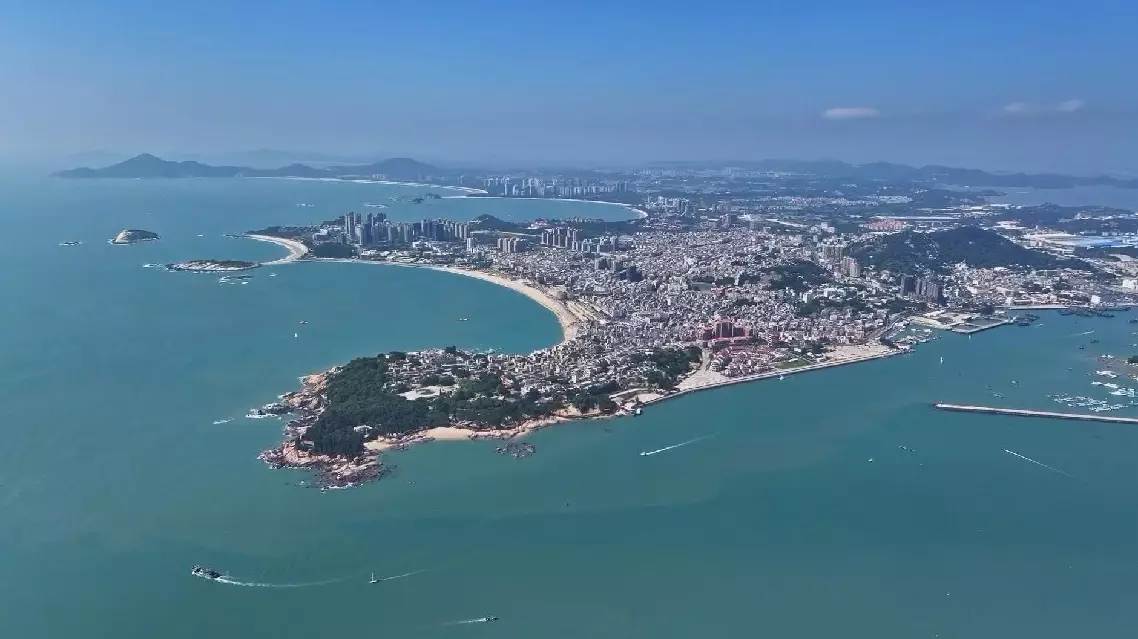
China's gross ocean product reached 5.5 trillion yuan (about 810.09 billion U.S. dollars) in the first half (H1) of 2026, up 5.1 percent year on year, according to data released by the Ministry of Natural Resources on Monday.
The amount accounted for 7.9 percent of the country's gross domestic product, the ministry said, noting that the marine economy is experiencing steady growth with a positive development momentum.
In the first half of the year, China continued to make breakthroughs in key deep-sea technologies, which served as a core engine for the innovation-driven development of the country's marine economy, the ministry said.
For instance, the Wenhai-6000h, a deep-sea heavy-duty unmanned underwater vehicle developed by the Laoshan Laboratory, accomplished a scientific expedition in the Kunlun hydrothermal system, a deep-sea vent field in the western Pacific Ocean.
During the mission, the vehicle completed 16 dives with a success rate of 100 percent and a maximum diving depth of 6,523 meters.
Located in Qingdao City, east China's Shandong Province, the Laoshan Laboratory is a national marine research institution. It's now testing robotic arms of the Wenhai-6000h to prepare it for another ocean expedition.
"This unmanned underwater vehicle is like a strong deep-sea assistant that enables us to conduct high-precision in-situ detection and efficient seabed strategic resource exploration in extreme deep-sea environments," said Wu Nengyou, a researcher at the lab.
China's shipbuilding industry maintained strong growth during the January-June period. The industry saw its new shipbuilding orders, completed deliveries and order backlog increase by 105.2 percent, 34.8 percent and 37.1 percent year on year, respectively. The global market shares for these three indicators reached 73.9 percent, 55.4 percent and 63.3 percent, respectively, maintaining a leading position worldwide.
The sector continues to optimize product structure, achieving improvements in both quantity and quality of deliveries, the ministry said. In the first half of the year, more than 40 large vessels such as container ships exceeding 10,000 TEUs, ultra-large crude oil carriers and large liquefied natural gas (LNG) carriers were delivered.
Meanwhile, the transformation toward green and intelligent manufacturing accelerated in the sector.
In Fuzhou City, east China's Fujian Province, the Mawei shipbuilding company is about to deliver a 4,200 CEU (car equivalent units) LNG dual-fuel pure car and truck carrier (PCTC).
Equipped with an intelligent power system integrating photovoltaics, energy storage and shaft power generation devices, the ship can connect to shore power when berthed, achieving low-carbon navigation.
"This ship is our new-generation 4,200 CEU LNG dual-fuel ro-ro vessel. It's truly a hybrid ship," said Tian Xianpen, deputy head of designers of Fujian Shipbuilding Industry Group, the parent company of Mawei shipbuilding.
China's marine economy posts steady growth in H1