Skip to Content Facebook Feature Image

U.N.-Habitat chief calls for reinventing cities to tackle climate, housing crises

HotTV

HotTV

HotTV

U.N.-Habitat chief calls for reinventing cities to tackle climate, housing crises

2026-08-04 14:20 Last Updated At:14:59

Cities are on the front line of the climate emergency and must be rebuilt to meet both emission reduction and housing needs, Anaclaudia Rossbach, executive director of the United Nations Human Settlements Programme (U.N.-Habitat), said at a recent interview with China Global Television Network (CGTN).

"The evidence in the data is clear: cities are on the front line. They are responsible for 70 percent of the emissions, [with] the built environment [accounting for] 40 percent. They are highly responsible for energy consumption. [When] you talk about heat, you know, we need to cool the houses. So, there are many, many challenges today we see more clear," she said.

Rossbach warned that the urban heat burden is unevenly distributed, deepening social and spatial inequalities.

"In terms of heating, we have data that first of all comparing [compare] the heat in cities versus rural areas. Cities are hotter than rural areas. And then within the cities, there is a big injustice because in informal settlements in Rio de Janeiro, for example, we're talking about in Brazil. In the slums, the temperature can be eight degree Celsius higher than in the rest of the city. So you have this social spatial injustice that are happening in cities. So we have to overcome and have to be aware of that," she said.

To address both the climate challenge and the global housing crisis, Rossbach called for reinventing cities through sustainable, balanced densification rather than continuing past patterns of sprawl.

"So we need to rebuild cities, we need to reinvent cities to address the global housing crisis. And we have to make it in a way that is environmentally friendly and sustainable. We do have technology for that. We still have to close the gap between affordability and sustainability. Sometimes the entry point is more expensive, but the maintenance is okay. We cannot keep the sprawling rhythm that we had in the past, we have to contain cities and therefore we have to look at balanced densification. We have to go up, but in a way that is balanced, in a way that is also enabling the expansion of green and blue water surfaces," she said.

U.N.-Habitat chief calls for reinventing cities to tackle climate, housing crises

U.N.-Habitat chief calls for reinventing cities to tackle climate, housing crises
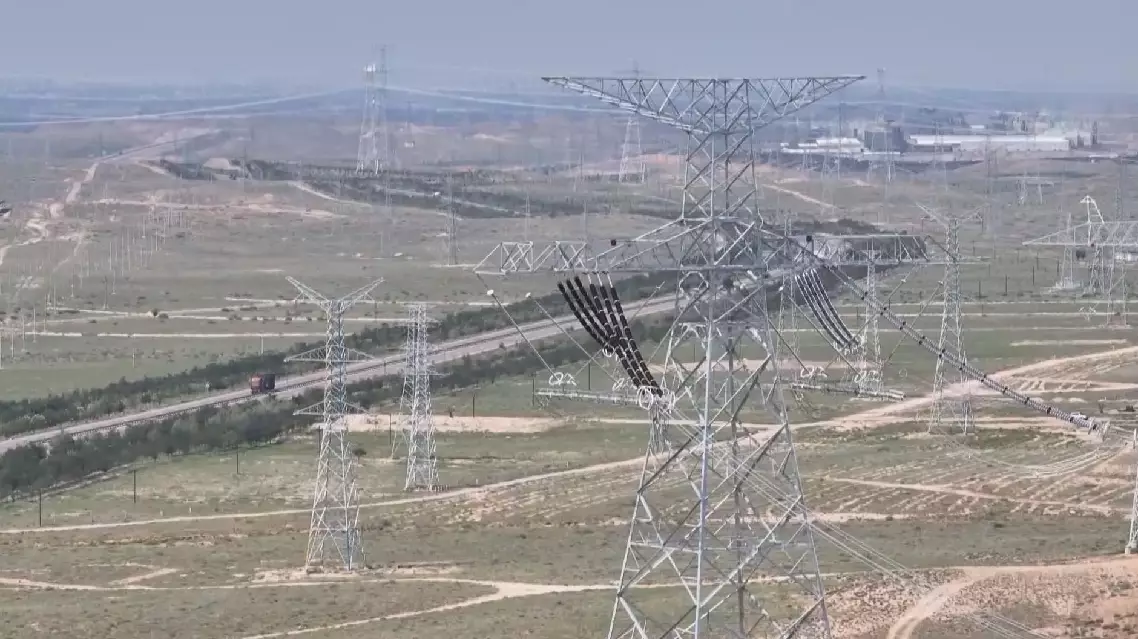
China has unveiled an ambitious plan to scale up its new energy storage capacity to 300 million kilowatts by 2030, a cornerstone target of the newly released "15th Five-Year Plan for New Power System Construction".

The 15th Five-Year Plan for New Power System Construction was released on Monday, which charts the course for China's power development from 2026 to 2030.

The plan calls for accelerating the construction of pumped hydro storage stations, promoting large-scale development of new energy storage facilities, diversifying application scenarios for new energy storage, and advancing the upgrade of new-generation coal-fired power plants.

By 2030, the installed capacity of pumped hydro storage stations nationwide is expected to reach approximately 160 million kilowatts, while new energy storage capacity is targeted at 300 million kilowatts. The scale of vehicle-to-grid interactive aggregated adjustable charging is expected to reach 50 million kilowatts.

"We will innovatively apply new energy storage and other supply guarantee measures and use virtual power plants as an important means for aggregating demand-side resources. By 2030, the national power supply adequacy ratio will reach 1.1 or higher, ensuring safe and abundant power supply," said Du Zhongming, director general of the Department of Electricity under the National Energy Administration.

During the period of the 15th Five-Year Plan (2026-2030) for national economic and social development, China will also tap the potential of interregional power mutual aid, strengthening cross-regional power surplus-deficit mutual aid and emergency support capabilities to enhance resource optimization across a wider scope, the plan said.

By 2030, more than six mutual aid projects will be completed nationwide, adding approximately 40 million kilowatts of interregional power mutual aid capacity, according to the plan.

China targets 300 mln kilowatts of new energy storage by 2030

China targets 300 mln kilowatts of new energy storage by 2030

Recommended Articles