Displaced residents in the Gaza Strip have spoken of their anguish after their resettlement site was hit amid another Israeli airstrike, with the terror of these attacks and the repeated upheaval leaving many families in dismay.
An Israeli airstrike early Saturday destroyed a medication depot at Al-Aqsa Martyrs Hospital in Deir al-Balah, and flattened a nearby displacement camp.
Witnesses say that more than 200 tents were damaged, with 20 of them razed, while a giant crater has been left at the site following the strike.
A mother who was fortunate to survive the incident shared her experience of being forced to flee with her children.
"We were living in this destroyed tent. We were asleep. We heard someone shouting, 'Get out, get out, there is going to be a strike!" Within half an hour, or even less. We ran out barefoot and woke the children from their sleep. We carried them and started running, not knowing where to go. We didn't even have time to take any of our belongings. When we returned, we found that the tent had been destroyed," said Umm Yahya Hassouna, a mother.
The latest Israeli airstrikes have again raised widespread international condemnation, with many saying they undermine efforts to implement the second phase of a ceasefire agreement and threaten ongoing diplomatic efforts to end the conflict.
The attacks also fly in the face of the fragile October 2025 ceasefire between Hamas and Israel which was supposed to bring an end to such tragedies, with long-suffering residents like Hassouna saying that while they have heard of an apparent ceasefire, nothing has changed on the ground.
For others, the continuing cycle of destruction it becoming an endless torment. Another mother at the camp named Fatima said she had been displaced more than a dozen times amid the war, and lamented that her children have only ever known a life of suffering.
"This is the 15th time I have been displaced. I have no one to support me. What is happening to us? And why? I can no longer make the decisions I used to make on my own. I need someone to make the decision for me and say, 'Fatima, come to this place. There is shelter for you.' Because I don't even have a mattress to sleep on. There aren't even diapers for my daughter, or anything else. I have a one-and-a-half-year-old daughter and a 13-year-old son. Sadly, all they have known in their lives is this misery, and I have no provider. What am I supposed to do?"
Humanitarian workers from the United Nations said on Monday that the weekend attacks in Gaza reportedly killed dozens of people, including children and other civilians.
More than 150 fatalities, including dozens of civilians, were documented in July, the deadliest month so far this year, according to Gaza health authorities.

Desperate mothers in Gaza tell of constant anguish amid latest Israeli airstrikes

Desperate mothers in Gaza tell of constant anguish amid latest Israeli airstrikes
The Republic of Korea (ROK)'s consumer price inflation eased in July, breaking a multi-month accelerating trend amid stabilizing energy prices and lower farm goods prices, statistical ministry data showed Tuesday.
The consumer price index (CPI) rose 2.8 percent in July from a year earlier, falling below 3.0 percent in three months, according to the Ministry of Data and Statistics.
It marked a noticeable deceleration from 3.2 percent in June, after accelerating from 2.0 percent in February to 2.2 percent in March, 2.6 percent in April and 3.1 percent in May.
Headline inflation, however, stayed above the central bank's mid-term inflation target of 2 percent for 11 straight months since September 2025.
The Bank of Korea raised its benchmark interest rate by 25 basis points to 2.75 percent in July, turning toward monetary tightening in about three and a half years since January 2023.
Oil products price gained 15.5 percent last month, after spiking 24.7 percent in the previous month. The price lifted overall inflation by 0.60 percentage points.
Price for gasoline and diesel jumped 12.6 percent and 21.5 percent each, while computer price shot up 25.1 percent amid soaring semiconductor price. Price for industrial products, including oil products and processed food, advanced 3.7 percent in July compared to the same month last year, slower than an expansion of 4.4 percent in the previous month.
Processed food price added 1.0 percent in July from a year earlier, faster than a growth of 0.9 percent in the previous month.
Price for agricultural, livestock and fishery products climbed 0.9 percent in July from a year earlier, after picking up 3.2 percent in June.
Agricultural products price slipped 2.2 percent last month, turning downward from an increase of 1.1 percent in the prior month. Those for livestock and fishery products swelled 4.4 percent and 3.9 percent each.
Rice price mounted 7.9 percent, but those for napa cabbage, watermelon, spinach, cucumber and zucchini retreated in double figures. Those for beef, imported beef, pork, egg and mackerel increased in single digits.
Price for electricity, natural gas and tap water was up 0.4 percent in July on a yearly basis.
City gas charge and waterworks fee added in single digits, but heating cost dipped 0.2 percent.
Services price surged 2.6 percent last month, hiking up the headline inflation by 1.46 percentage points.
Public service price rose 1.4 percent, while private service price, including eating-out costs, expanded 3.5 percent.
The eating-out expense gained 2.6 percent, and the private service price excluding the dining-out cost jumped 4.1 percent.
Affected by a spike in fuel surcharges from rising oil prices, international airfares soared 21.7 percent last month.
Housing rent, including Jeonse and monthly rent, was up 1.1 percent in July from a year earlier.
Jeonse is the country's unique contract between two households where a landlord grants two-year residential rights to a tenant, who in turn lends a certain amount of money, or a deposit, to the landlord.
The livelihood items index, which gauges prices for daily necessities, climbed 2.5 percent, while the fresh food index, which measures prices for fish, shellfish, fruit and vegetables, declined 2.3 percent.
Demand-side inflationary pressure lingered. Core consumer price index, which excludes volatile agricultural and oil products, appreciated 2.5 percent last month.
The OECD-method core price, excluding volatile food and energy costs, went up 2.6 percent in the cited month.
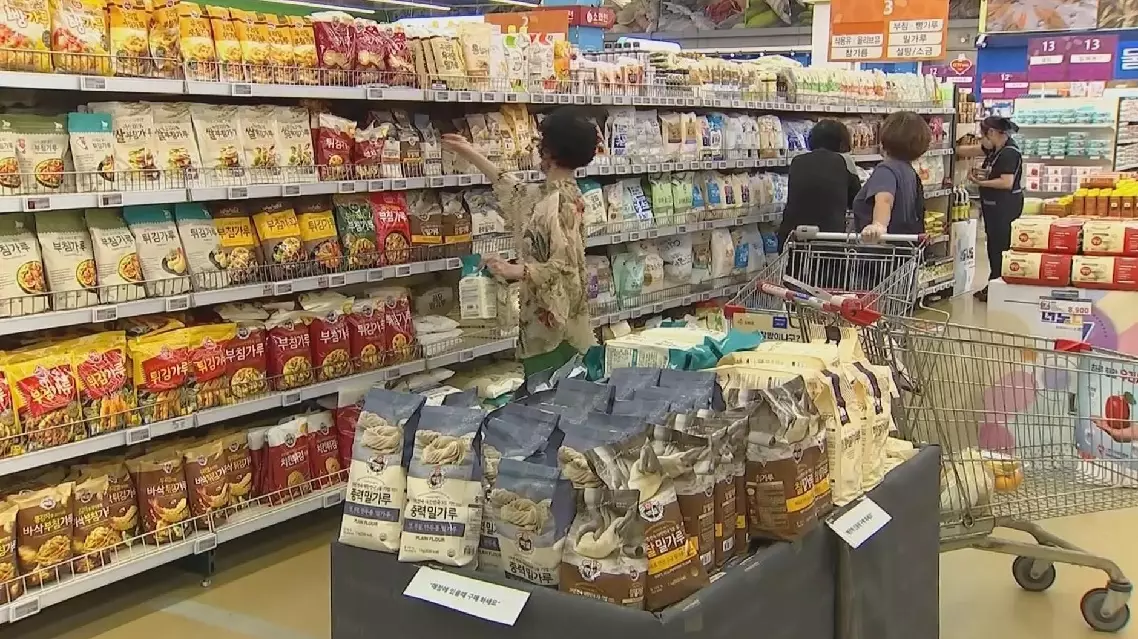
ROK's consumer price inflation eases to 2.8 pct in July