Nestled in southwest China's Yunnan Province, the ancient city of Lijiang is attracting a growing number of international travelers eager to move beyond classic sightseeing and explore local culture through hands-on culinary workshops.
Led by local guide Wu Fanzi, these food-focused experiences begin each morning with a tour of a bustling neighborhood farmers' market, where visitors are introduced to local ingredients, traditional flavors and the stories behind Yunnan's diverse cuisine.
"It was great, because we discovered some fruits we don't know in France, for example. And we discovered a lot of flavors. It was beautiful," said Ludovic Dupuy, a French traveler taking part in the program.
For many visitors, the market walk offers an unscripted look at daily life in Lijiang, far removed from conventional sightseeing routes.
"It's a very good environment. People are very nice and there are nice smells everywhere. It's super clean but it's very typical, local. I liked it very much," said traveler Caroline Gutmann.
The market exploration serves as a prelude to the core experience: a hands-on cooking session where guests turn the ingredients they have just discovered into authentic local dishes from scratch. Wu launched the class in 2020, blending her lifelong passion for food with her language skills to share her hometown's culture with visitors worldwide.
"I've always really loved food. That's where the idea started. And since I can speak foreign languages, I thought, why not share the best part of my hometown's culture with people from the outside world?" Wu said.
Participants learn to prepare signature Yunnan specialties, including the Jingpo ethnic group's famous "ghost chicken" salad and fresh rice noodles, a beloved daily staple across the province.
The class goes far beyond following a recipe, often becoming a heartfelt channel for cross-cultural connection.
"It was amazing! We did by ourselves with the kids. We did chicken salad, and another soup and a really beautiful dessert," Dupuy said.
For family travelers, the interactive format turns cultural exposure into a shared, memorable activity, offering a window into everyday local life that standard tourist attractions cannot match.
"It's very good to see, like to enter a bit into local area, the local life, what people are doing here, instead of just passing by, visiting. And it was the most important thing for us to show the life of Chinese people for our kids," Gutmann said.
Wu's workshop has grown steadily in popularity since its launch, having hosted roughly 2,000 participants from nearly 30 countries.
Demand has climbed further this year as more overseas travelers prioritize in-depth, experience-driven trips over rushed, surface-level sightseeing.
"Whenever they recreate Yunnan's rice noodles at home and send me photos, I feel really happy. Because when they cook that dish again, they're probably recalling the most wonderful moments from their trip to Yunnan. So that's my happiest moment," Wu said.
Though many guests are visiting China for the first time, few expect it to be their only trip. As experience-focused travel continues to gain traction worldwide, a growing number of international visitors are seeking out similarly immersive ways to explore the country beyond its well-known landmarks.
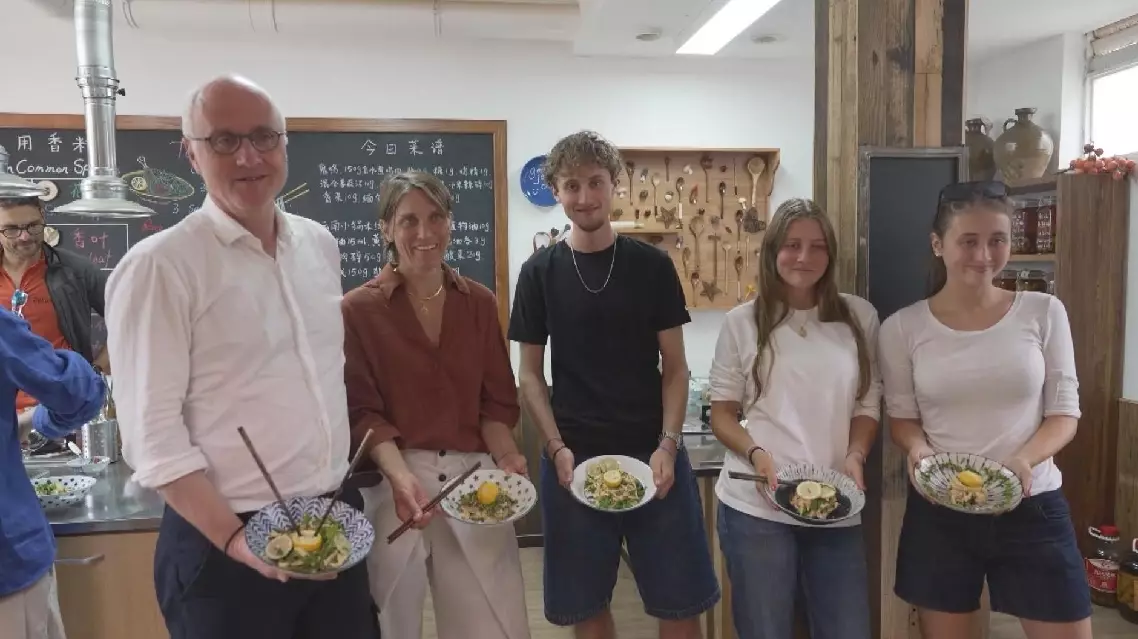
Global visitors explore Yunnan’s culinary traditions through hands-on experiences
The Republic of Korea (ROK)'s consumer price inflation eased in July, breaking a multi-month accelerating trend amid stabilizing energy prices and lower farm goods prices, statistical ministry data showed Tuesday.
The consumer price index (CPI) rose 2.8 percent in July from a year earlier, falling below 3.0 percent in three months, according to the Ministry of Data and Statistics.
It marked a noticeable deceleration from 3.2 percent in June, after accelerating from 2.0 percent in February to 2.2 percent in March, 2.6 percent in April and 3.1 percent in May.
Headline inflation, however, stayed above the central bank's mid-term inflation target of 2 percent for 11 straight months since September 2025.
The Bank of Korea raised its benchmark interest rate by 25 basis points to 2.75 percent in July, turning toward monetary tightening in about three and a half years since January 2023.
Oil products price gained 15.5 percent last month, after spiking 24.7 percent in the previous month. The price lifted overall inflation by 0.60 percentage points.
Price for gasoline and diesel jumped 12.6 percent and 21.5 percent each, while computer price shot up 25.1 percent amid soaring semiconductor price. Price for industrial products, including oil products and processed food, advanced 3.7 percent in July compared to the same month last year, slower than an expansion of 4.4 percent in the previous month.
Processed food price added 1.0 percent in July from a year earlier, faster than a growth of 0.9 percent in the previous month.
Price for agricultural, livestock and fishery products climbed 0.9 percent in July from a year earlier, after picking up 3.2 percent in June.
Agricultural products price slipped 2.2 percent last month, turning downward from an increase of 1.1 percent in the prior month. Those for livestock and fishery products swelled 4.4 percent and 3.9 percent each.
Rice price mounted 7.9 percent, but those for napa cabbage, watermelon, spinach, cucumber and zucchini retreated in double figures. Those for beef, imported beef, pork, egg and mackerel increased in single digits.
Price for electricity, natural gas and tap water was up 0.4 percent in July on a yearly basis.
City gas charge and waterworks fee added in single digits, but heating cost dipped 0.2 percent.
Services price surged 2.6 percent last month, hiking up the headline inflation by 1.46 percentage points.
Public service price rose 1.4 percent, while private service price, including eating-out costs, expanded 3.5 percent.
The eating-out expense gained 2.6 percent, and the private service price excluding the dining-out cost jumped 4.1 percent.
Affected by a spike in fuel surcharges from rising oil prices, international airfares soared 21.7 percent last month.
Housing rent, including Jeonse and monthly rent, was up 1.1 percent in July from a year earlier.
Jeonse is the country's unique contract between two households where a landlord grants two-year residential rights to a tenant, who in turn lends a certain amount of money, or a deposit, to the landlord.
The livelihood items index, which gauges prices for daily necessities, climbed 2.5 percent, while the fresh food index, which measures prices for fish, shellfish, fruit and vegetables, declined 2.3 percent.
Demand-side inflationary pressure lingered. Core consumer price index, which excludes volatile agricultural and oil products, appreciated 2.5 percent last month.
The OECD-method core price, excluding volatile food and energy costs, went up 2.6 percent in the cited month.
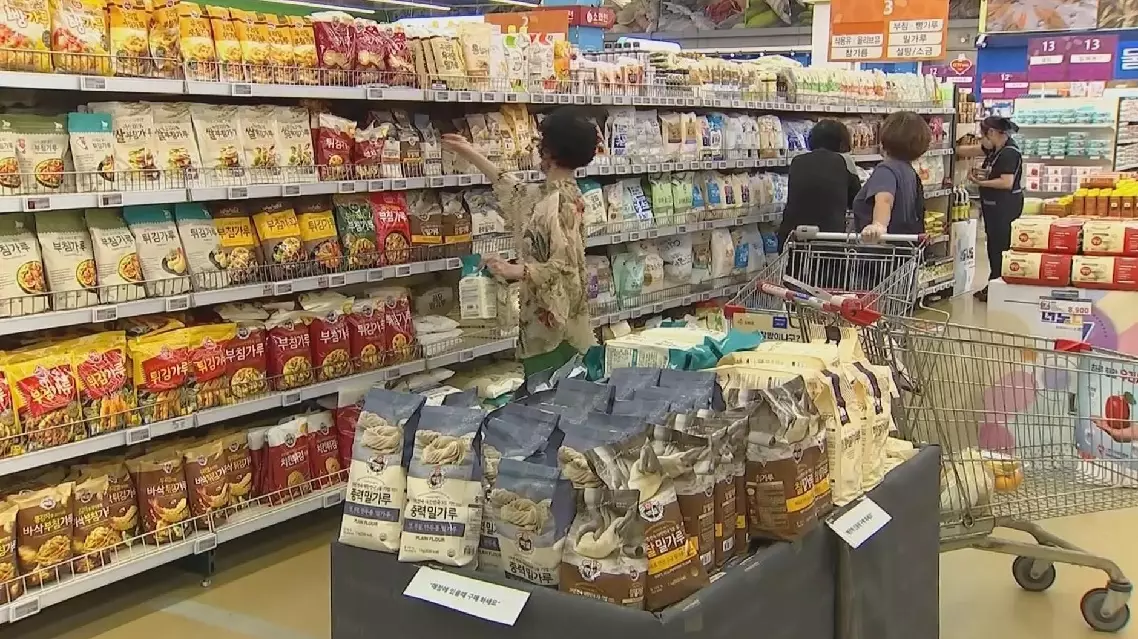
ROK's consumer price inflation eases to 2.8 pct in July