Artificial intelligence (AI) has emerged as a strong driving force for China's gaming industry, lowering creation barriers, speeding up production, and empowering more people to turn game ideas into reality.
At China's largest annual gaming expo, ChinaJoy, which lowered the curtain on Monday, cutting-edge AI technologies, from AI-driven game development workflows to lifelike humanoid robots, amazed crowds of game lovers.
"The character is incredibly lively. It feels just like a real person talking," said a game lover, marveling at how natural the interaction felt.
Many industrial insiders also pointed out that AI has entered the game development industry. By describing an idea in ordinary language, creators can use the system to generate code, lower the entry barrier for game developers.
"This year marks my 10th year in game development, but I only started using AI last year," said Xiao Hana, a project team member of MEOWNTAIN.
She also stated that the first batch of games built from the AI platforms have already debuted on the Chinese market.
"This time we introduced AI agents so that players can freely talk to them. But behind this, we've trained a data volume of about 100,000 words per character," she explained.
The role-playing game, for example, having just released on Thursday, was built with the AI agents developed by the Chinese tech giant Tencent. The rapid advancement of generative AI has made players' interactions with game characters feel more natural and fluid.
"Ideas can be validated at a very early stage, and the cost of trial and error is greatly reduced. But lowering the barrier does not mean the barrier disappears – it merely shifts from 'can it be made' to 'is the idea good enough.' Creativity and judgment will only become more scarce in the future. So, AI reallocates developers' energy to where it truly matters," said Zhang Jian, General Manager of Ecosystem Development Department at Tencent Games.
AI is helping developers create and update games faster, while bringing down production costs. At the same time, Chinese titles are reaching far beyond the domestic market: self-developed games generated more than 12 billion U.S. dollars overseas in the first half of this year, up more than 30 percent year on year.
Games are also becoming a testing ground for general-purpose AI tools. Their complexity allows developers to see whether an agent that performs well in game development can handle other demanding tasks.
"We consider games to be an industrial-grade application with high integration and complexity among internet applications. If it can perform well in such a complex industrial environment, I believe it can also perform better in other daily work and general tasks," said Deng Zhidong, Product Operation Specialist of WorkBuddy, a full-scenario AI workbench from Tencent.
Getting more game developers onto the platform is also beneficial for the AI developer, to expand its applications. So, the company is for the first time hosting a game development competition for college students this year.
"Many of our student teams don't actually come from traditional backgrounds – like computer science or art – yet they are making games. Many of them, for instance – and this impressed me – include civil engineering majors and landscape design majors. They bring their own professional perspectives," said Deng.
From more responsive characters to tools that help newcomers build their first game, AI is becoming a power-up for both player experience and the development process. It is changing who can create a game, and how quickly an idea can become something people can play.
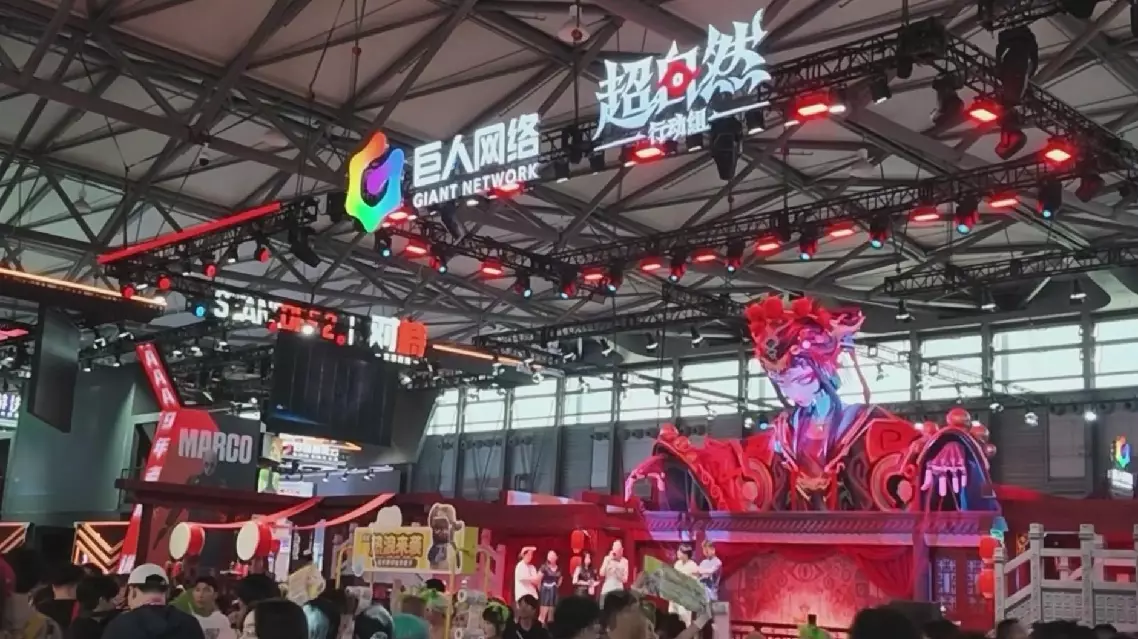
AI emerges as game changer for game developers, players