Swiss bank UBS has revised up its 2026 economic growth forecast for China's Hong Kong Special Administrative Region to 4.5 percent from a previous projection of 3.3 percent, citing steady growth momentum.
The bank said on Monday that Hong Kong's high-value-added exports are expected to continue taking the lead through the rest of the year, while financial market activity will remain resilient and domestic investment will improve.
Private consumption will expand at a steady pace, with further recovery in tourism supporting services exports, UBS added.
Noting that Hong Kong is formulating its first five-year plan, UBS said the blueprint will be key to unlocking new growth potential.
Successful planning and implementation of the plan will help stabilize growth across business cycles and enhance its underlying trend growth over the medium to long term, the bank said, adding that support from the Chinese central authorities will also continue to bolster Hong Kong's growth going forward.
Official data showed that Hong Kong's gross domestic product grew 5.1 percent year on year in the first half of 2026, beating market expectations.
UBS revises up Hong Kong's 2026 GDP growth forecast to 4.5 pct
The unique operating mechanism of Zhejiang Lab, characterized by extensive consultation, joint contribution, and shared benefits, has successfully attracted private investment to fuel its space computing development, according to Wang Jian, director of the lab.
Zhejiang Lab is a research institution in the space computing domain based in Hangzhou, east China's Zhejiang Province. It focuses on frontier technology and represents a formidable force.
The 2026 World Artificial Intelligence Conference has just concluded late July in Shanghai, with space computing power emerging as one of the hottest topics. How can artificial intelligence be sent from the ground into space?
Wang, also an academician of the Chinese Academy of Engineering, has proposed the "Three-Body Computing Constellation" project, with the goal of deploying 1,000 general-purpose computing satellites by 2032, making AI accessible to every corner of the globe as ubiquitously as water and electricity.
On May 14, 2025, the first batch of 12 computing satellites of the "Three-Body Computing Constellation" successfully entered orbit. However, back in 2023 when Wang first proposed the concept of a computing constellation, no one in the international community had publicly raised such an idea.
The computing constellation was named "Three-Body." Wang explained that it was not a reference to writer Liu Cixin's sci-fi novel, but rather to Newton's "three-body problem", where the addition of a third celestial body makes precise calculation impossible. From its very inception, the project was destined to be something no single person could accomplish alone.
Zhejiang Lab is supported by Zhejiang Province, yet launching over 1,000 satellites would require at least 20 to 30 billion yuan (around 2.9 to 4.4 billion US dollars). Instead of seeking government financial support, Wang chose to pioneer a unique "extensive consultation, joint contribution, shared benefits, and common development" model at the lab, binding together a group of private enterprises in what appeared to be a relatively "loose" partnership.
"In the [space] industry, the biggest fear is that everyone becomes too loosely organized. That is why the command structure is very strict, isn't it? If you talk nonsense, no one will follow you. That's why we emphasize extensive consultation, joint contribution, and shared benefits. I would say consultation is the most important. People often want to skip consultation and jump straight to contribution and sharing, some even want to skip everything and go directly to sharing. Without proper consultation, there should be no contribution; without proper contribution, there should be no talk of sharing. You know it's difficult, but if you're willing to go all in, there's still a chance to make it happen. But if you're hesitant, if you're opportunistic, thinking you'll jump in only if it seems feasible and profitable, then no one will follow you," said Wang.
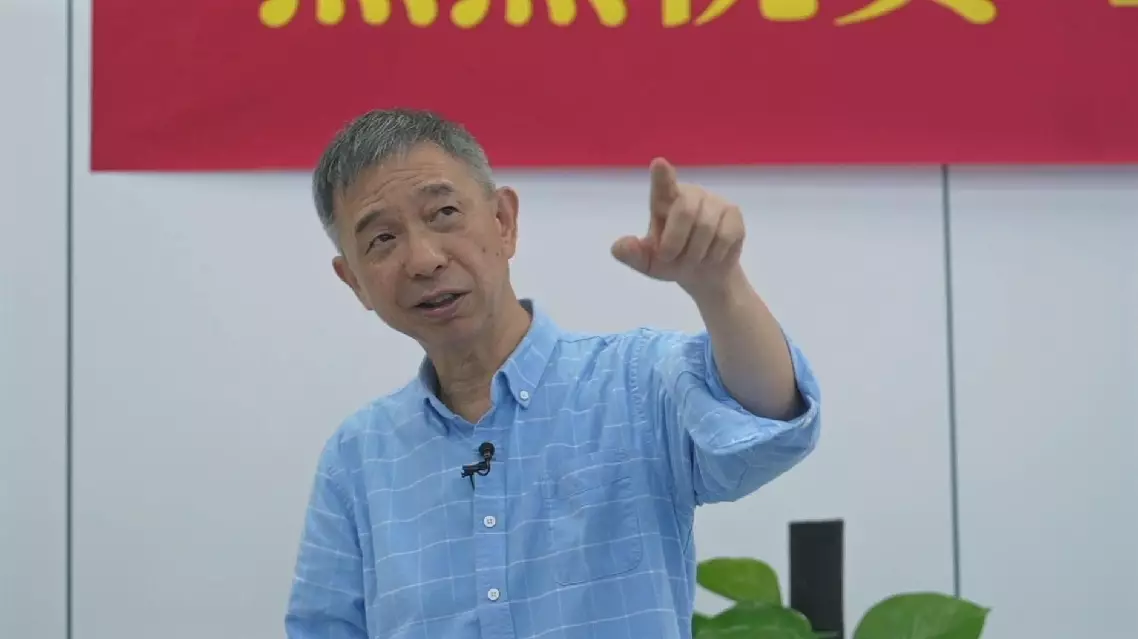
Unique operating mechanism of Zhejiang Lab attracts private investment for space computing development