SAN DIEGO--(BUSINESS WIRE)--Aug 5, 2026--
As pharmacies expand their role in immunizations, preventive care, specialty medication therapies, and other clinical services, they are encountering new opportunities to improve patient access — and greater complexity in billing and reimbursement, particularly for services and therapies covered under the medical benefit. At NACDS Total Store Expo (booth #1823), XiFin, Inc., a leader in AI-driven revenue cycle management (RCM), will showcase XiFin Empower CareALERTS®, Empower RCM, Empower AI, and the new Empower AI Appeals Agent, demonstrating how pharmacies can strengthen patient engagement, improve reimbursement performance, and scale clinical services more sustainably.
This press release features multimedia. View the full release here: https://www.businesswire.com/news/home/20260805789964/en/
This transformation is poised to accelerate as federal policymakers work to enact legislation such as the Main Street Pharmacy Access Act, which would expand opportunities for pharmacists to provide and receive reimbursement for covered clinical services. In addition, specialty pharmacies in particular face growing medical billing and reimbursement complexity, as many specialty therapies and related services are covered under medical rather than pharmacy benefits. Together, these developments are increasing the need for sophisticated medical billing, revenue cycle management, and appeals capabilities.
The upcoming vaccination season illustrates one immediate opportunity for pharmacies to expand their impact. According to XiFin’s 2026 Pharmacy Transformation Outlook Survey, 98% reported offering immunizations, making vaccinations the most widely delivered clinical service among participating pharmacies. Immunizations also ranked among the strongest-performing clinical services from a reimbursement perspective.
To help pharmacies identify and engage eligible patients while addressing these growing reimbursement challenges, XiFin will showcase XiFin Empower CareALERTS. The solution uses prescription and state immunization registry data to identify care opportunities and deliver actionable smart clinical messaging within pharmacy workflows. By helping pharmacists proactively engage patients who may be eligible for recommended vaccinations based on CDC and ACIP guidelines, CareALERTS supports efforts to close immunization gaps, improve access to preventive care, and strengthen community health outcomes. In 2025, CareALERTS technology successfully increased companion immunizations by 17% among participating pharmacies, while increasing operational efficiency and freeing up pharmacists to deliver more patient care.
“The impact on our patients and our team members was immediate. The solution eliminated 1.7 million workflow vaccination tasks, dramatically improving our operational efficiency and freeing up valuable staff time,” said Whitney DuBois, Systems Manager of Data Operations at Kroger. “These early results have exceeded our expectations,” she added.
Beyond immunizations, the continued expansion of pharmacy-based clinical services and specialty pharmacy is increasing pharmacies’ exposure to medical billing requirements, complex coverage policies, documentation demands, denials, and appeals. XiFin Empower RCM for Pharmacy and Empower AI help organizations manage these workflows across the revenue cycle, while the new Empower AI Appeals Agent addresses one of the most labor-intensive components of revenue management.
The Appeals Agent evaluates payor requirements, analyzes supporting documentation, identifies applicable coverage criteria, assembles supporting evidence, and generates customized appeal packages and submits them to payors. By automating complex appeals workflows, the Empower AI Appeals Agent helps pharmacies reduce manual effort, improve operational efficiency, accelerate revenue recovery, and manage the growing reimbursement complexity associated with medical benefit services and specialty drug therapies.
The Empower AI Appeals Agent is part of XiFin’s broader Empower AI ecosystem, which helps streamline administrative tasks, improve reimbursement accuracy, prioritize work based on financial impact, reduce manual touches, and enable pharmacies to scale clinical services more efficiently while navigating increasingly complex payor requirements.
“Pharmacies are entering one of the most exciting periods of transformation in the industry’s history,” said David Pope, PharmD, Chief Pharmacy Officer at XiFin. “As pharmacists take on a larger role in delivering vaccinations, preventive services, and other clinical care, they have an opportunity to improve health outcomes for more patients than ever before. XiFin Empower solutions are designed to help pharmacies confidently seize that opportunity — connecting more patients to care, simplifying reimbursement complexity, improving operational efficiency, and supporting long-term financial sustainability.”
Visitors to booth #1823 at NACDS Total Store Expo can learn more about how CareALERTS works within pharmacists’ existing workflows to highlight vaccination opportunities and see live demonstrations of Empower AI Appeals Agent. To learn more or to schedule a meeting with XiFin during NACDS TSE, visit the XiFin event page.
About XiFin
XiFin is a healthcare information technology company that empowers organizations to navigate an evolving and increasingly complex healthcare landscape. The XiFin Empower AI RCM ecosystem and trusted data employ active intelligence and automation to reduce manual touches, coordinate workflows, accelerate customer innovation, and improve financial outcomes. Our comprehensive set of solutions — spanning revenue cycle management, clinical workflow enablement, laboratory information systems, and patient engagement — deliver The Power to Do Good ® so that healthcare organizations can do more good for more patients. Visit www.XiFin.com, follow XiFin on LinkedIn, or subscribe to the XiFin blog to learn more.

XiFin Empower: Advancing Patient Engagement, Clinical Services, and Financial Performance
WASHINGTON (AP) — Tennessee’s senior U.S. senator eyes a job change in a state primary on Thursday while Memphis voters will choose their first U.S. House nominees under a new Republican-drawn congressional map that forced their longtime Democratic representative into retirement.
Republican Gov. Bill Lee is term-limited, and the GOP primary to replace him has attracted U.S. Sen. Marsha Blackburn, four-term U.S. Rep. John Rose and state Rep. Monty Fritts. The outcome of the Republican primary has additional significance in Tennessee, which hasn’t elected a Democratic governor in 20 years.
Blackburn won reelection to a second U.S. Senate term in 2024 and launched her campaign for governor in August 2025. Rose launched his gubernatorial bid in March 2025 and has loaned his campaign about $13 million since mid-June. Aside from candidate loans, Blackburn has outraised Rose in terms of campaign contributions. She also has the support of an outside group that has spent roughly $5.1 million backing her and opposing Rose.
President Donald Trump backed Blackburn and Rose in their previous campaigns, but he has not endorsed a candidate in the gubernatorial primary.
Five candidates are running in the Democratic primary for governor, including Memphis City Councilwoman Jerri Green.
Memphis was a prime target among state Republican lawmakers who in May enacted new congressional boundaries that split the heavily Democratic city into three Republican-dominated congressional districts. Democratic U.S. Rep. Steve Cohen has represented the current Memphis-based 9th District for 20 years, but he ended his reelection bid shortly after the new map was adopted.
One of the Democrats running to replace him in the new 9th District is state Rep. Justin Pearson, who originally planned to challenge Cohen for the nomination. Pearson was one of two Democratic state lawmakers expelled from office in 2023 over his role in a gun control protest in the chamber. Both won back their seats four months later. Also running are state Sen. London Lamar and former healthcare and nonprofit executive Jim Torino.
Running for the Republican nomination in the new 9th District are state Sen. Brent Taylor, state Rep. Todd Warner, retired Army sergeant and volunteer firefighter Jeremy Thompson and conservative activist Charlotte Bergmann. Taylor has outraised the rest of the combined field and has Trump’s endorsement.
Voters in the new 9th District supported Trump for president in 2024 with about 60% of the vote, compared with the current 9th District, which Democratic then-Vice President Kamala Harris won with about 71% of the vote.
Tennessee’s junior U.S. senator, Bill Hagerty, seeks a second term and is the only candidate named on the Republican primary ballot. Five Democrats are running to challenge him in November. The last Democrat to win one of Tennessee’s U.S. Senate seats was Al Gore in 1990.
The key counties in statewide elections are Shelby, Davidson and Knox, which are home to the population centers of Memphis, Nashville and Knoxville, respectively. In recent statewide elections, candidates from both major political parties won their primaries by posting a large margin in one of the three counties and losing the other two narrowly while also winning the bulk of the state’s rural areas. Lee won his Republican gubernatorial primary in 2018 by posting a big win in Davidson, while his opponents split Shelby and Knox. Hagerty won his 2020 primary carrying Shelby by a large margin and losing Knox, Davidson and Hamilton, home to Chattanooga. Blackburn carried every county in both her 2018 and 2024 U.S. Senate primaries.
About half of Tennessee’s 33 state Senate seats and all 99 state House seats are up in 2026. Republicans hold overwhelming majorities in both chambers.
Here are some of the key facts about the election and data points the AP Decision Team will monitor as the votes are tallied:
Although Tennessee is in two time zones, all polls in both the Eastern and Central time zones are coordinated to close at 8 p.m. ET.
The Associated Press will provide vote results and declare winners in contested primaries for governor, U.S. Senate, U.S. House, state Senate and state House.
Tennessee does not register voters by party, which in other states usually means that any registered voter may choose to vote in any party’s primary. However, a 2023 law requires local elections officials to post signs at polling places with language from a 1972 law stating that primary voters must be “bona fide” members of a political party or “declare allegiance to” the party to participate in that party’s primary. The language was also added recently to absentee ballot applications. Neither law specifies what it means to be a “bona fide” member of a party.
As of June 1, there were about 4.7 million registered voters in Tennessee.
There were about 411,000 Republican primary voters and about 205,000 Democratic primary voters in the last U.S. Senate primaries in 2024. In the last primaries for governor in 2022, the Republican contest had about 494,000 voters, while the Democratic contest had about 258,000 voters.
About 55% of the 2024 state primary vote and about 54% of the 2022 state primary vote was early in person or by mail.
As of Saturday, about 397,000 Republican primary ballots and about 225,000 Democratic primary ballots had already been cast in Thursday’s election.
In previous elections, nearly all counties tended to release the bulk of their results from mail and early in-person voting in the first report of the night, usually before releasing in-person Election Day results.
In the 2024 state primary, the AP first reported results at 8:02 p.m. ET, or two minutes after polls closed. The last vote update of the night was at 11:19 p.m. ET, with more than 99.9% of total votes counted.
The AP does not make projections and will declare a winner only when it’s determined there is no scenario that would allow a trailing candidate to close the gap. If a race has not been called, the AP will continue to cover any newsworthy developments, such as candidate concessions or declarations of victory. In doing so, the AP will make clear that it has not yet declared a winner and explain why.
In Tennessee, recounts are held only as part of a legal challenge in the courts. There are no automatic recounts, and losing candidates may not request recounts. The AP may declare a winner in a race that is subject to a recount if it can determine the lead is too large for a recount or legal challenge to change the outcome.
As of Thursday, there will be 89 days until the 2026 midterm elections.
Follow the AP’s coverage of the 2026 election at https://apnews.com/projects/elections-2026/.
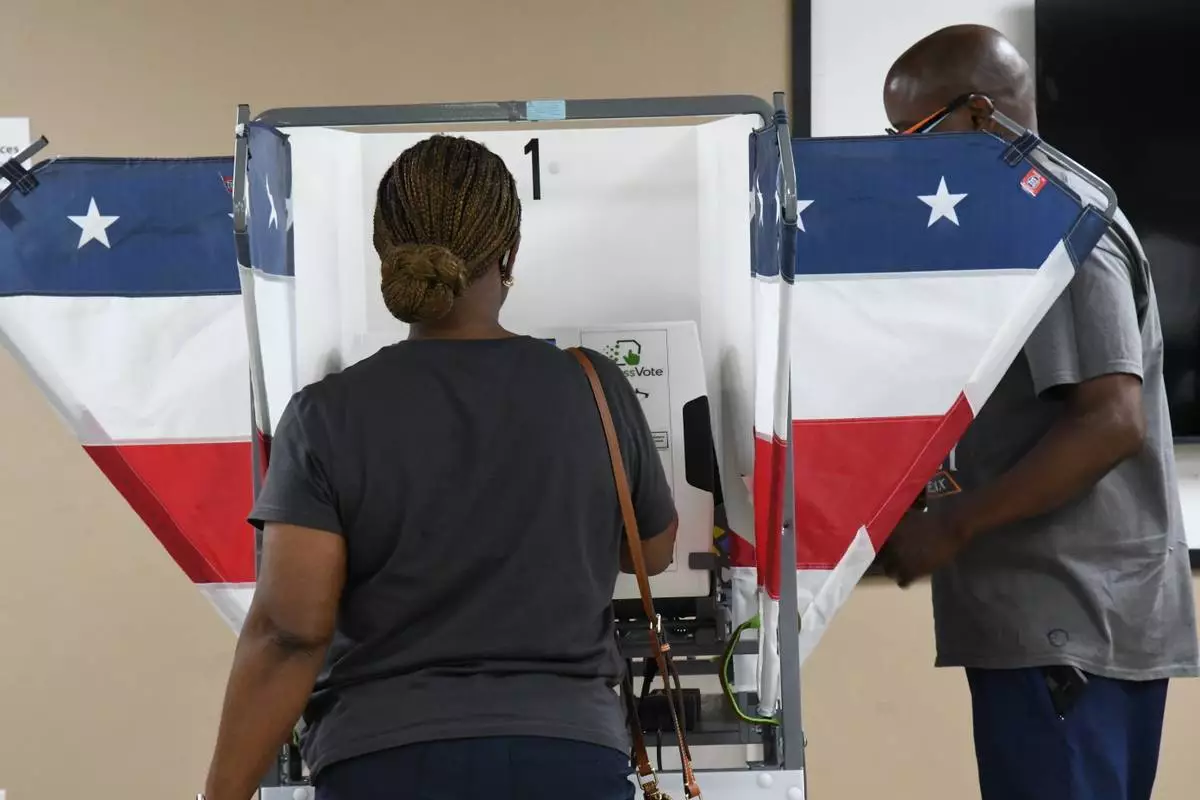
Two voters fill out their ballots in Memphis, Tenn., Wednesday, July 22, 2026. (AP Photo/Kristin M. Hall)