New cognitive linguistic entropy measurement finds Claude Shannon's communications paper surpasses both the Turing Machine (1936) and the Turing Test (1950) — LingEQ Engine launched globally August 1
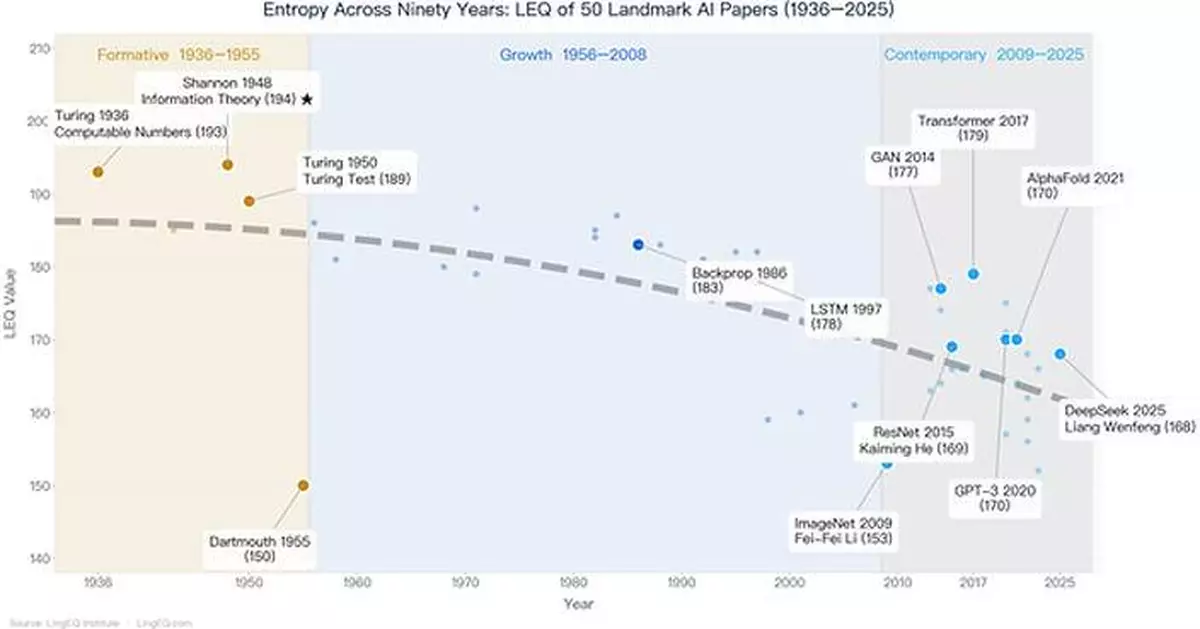
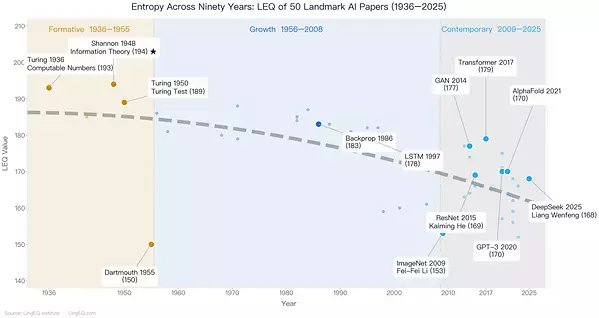
SILICON VALLEY, Calif., Aug. 6, 2026 /PRNewswire/ -- A study applying linguistic entropy measurement to 50 landmark AI papers — spanning 1936 to 2025 — has produced a counterintuitive result: the text with the highest measured cognitive density was not written about AI. Claude Shannon's 1948 A Mathematical Theory of Communication registers the highest LEQ (194, Linguistic Entropy Quotient) value in the entire corpus — surpassing Turing's 1936 On Computable Numbers (LEQ 193) and Turing's 1950 Turing Test paper (LEQ 189). GPT-3, AlphaFold, and DeepSeek-R1 cluster between 168 and 170. The 1955 Dartmouth Proposal, which named the field of artificial intelligence, registers the lowest early-period value at 150. Early AI texts created new conceptual objects and theoretical boundaries; recent landmark work, however transformative, builds within established frameworks.
The study, 90 Years Engraved by Entropy: LEQ Analysis of 50 Landmark AI Papers, is the inaugural release of the LingEQ Curation Series. Conducted using the LingEQ Engine, the study uses multiple language models as analytical instruments, calibrated against an anchor corpus to produce reproducible linguistic entropy values. Its measurements are derived entirely from the text itself, independent of authorship, publication venue, or citation history. The theoretical framework is presented in The Scale of Language, forthcoming from Springer Nature.
The research addresses a structural gap in scientific publishing. arXiv now receives over 20,000 preprints each month, while papers can spend one to two years in peer review. AI can generate increasingly polished texts, making originality and reliability harder to assess. Each submission is evaluated by two or three reviewers, introducing sampling bias and the limits of individual expertise. Foundational work may disappear into an unread database, while papers aligned with current trends can accumulate citations despite limited lasting value. Peer review measures consensus, citation counts measure influence - neither measures what a text actually contains.
LingEQ Engine opened for global public beta on August 1, 2026.
About LingEQ Technologies:
LingEQ Technologies (LingEQ.com) is an independent language measurement platform quantifying the cognitive depth of written text in the age of AI, operating across Silicon Valley, Brisbane, Hong Kong, and Shenzhen.
Media contact:
lingeqcs@lingeq.com
** This press release is distributed by PR Newswire through automated distribution system, for which the client assumes full responsibility. **
LingEQ Study Finds: The Most Cognitively Dense Paper in 90 Years of AI History Was Not Written About AI
LingEQ Study Finds: The Most Cognitively Dense Paper in 90 Years of AI History Was Not Written About AI
SAN FRANCISCO, Sept. 23, 2026 /PRNewswire/ -- ScamAdviser, a leading brand in global enterprise scam prevention solutions, concluded its successful participation at the Global Anti-Scam Summit (GASS) America 2026 in San Francisco, organized by the Global Anti-Scam Alliance (GASA). Bringing together global leaders across tech, finance, and cybersecurity, the summit addressed pressing digital scam challenges, highlighted by ScamAdviser's product Watchmen's recognition with the prestigious Scam Fighter Award for its outstanding contributions to global impersonation protection.
ScamAdviser Addressing New Vulnerabilities in Agentic AI
During the summit, ScamAdviser's CEO Aaron Chiou led a featured panel discussion titled "The Agent Is the New Victim – From Social Engineering to Agent Engineering." The session brought together industry experts from Google, Gen, AIM Intelligence, and Adyen, to examine how autonomous AI agents are becoming primary targets for digital fraudsters.
As consumers increasingly rely on AI agents to find deals, compare products, and complete transactions, scammers are shifting their tactics. Panelists highlighted that because AI operates probabilistically, static prompt rules can fail when encountering dynamic web content, hidden malicious code, or spoofed online storefronts designed to hijack AI logic.
"As AI agents increasingly make autonomous decisions on behalf of consumers, fraudsters are adapting by targeting the AI's logic directly rather than human eyes," said Aaron Chiou, CEO of ScamAdviser. "Static prompts defined before deployment are simply no longer enough against modern edge-case exploits. To foster trusted autonomous commerce, the industry must implement active, real-time runtime safeguards that verify every link, site, and transaction before action is taken."
To tackle this challenge head-on, ScamAdviser introduced AgentLooker.ai, a real-time security guard built specifically to keep AI agents from getting scammed during dynamic web interactions. ScamAdviser and its solution partners are continuously testing and tracking evolving threat patterns to ensure security guardrails stay ahead of bad actors and safeguard autonomous commerce.
Watchmen Honored with GASA Scam Fighter Award for AI-Powered Scam Defense
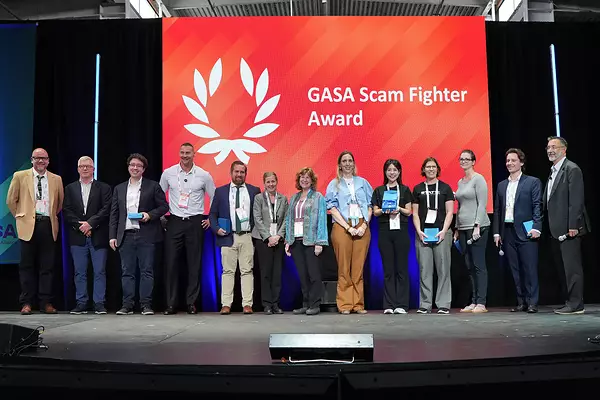
At GASS America, it also announced the winner of The Scam Fighter Award, which recognizes ScamAdviser's Watchmen solution for its outstanding impact in combating real-world digital scams, especially social media impersonation. As a cross-domain Fraud Early Warning System, Watchmen continuously monitors and analyzes corporate communication channels, mainly social media platforms, to instantly detect brand impersonation, mitigate cyber threats, and initiate automated anti-scam mechanisms. Powered by multi-layered filtering, expert rule engines, and Large Language Model (LLM) semantic analysis, Watchmen delivers real-time monitoring and proactive takedown capabilities for businesses and regulatory bodies.
In proven deployments with financial regulators, law enforcement agencies, and municipal governments, Watchmen demonstrated national-level impact, such as contributing to a 38% drop in the share of investment scam financial losses and cutting detection-to-takedown times from weeks to under 8 hours. By turning raw threat intelligence into actionable defense, Watchmen was celebrated at GASS as a benchmark solution for public-private anti-scam collaboration.
** This press release is distributed by PR Newswire through automated distribution system, for which the client assumes full responsibility. **
ScamAdviser Showcases Agentic AI Safeguards at GASA Global Anti-Scam Summit America 2026