LONDON--(BUSINESS WIRE)--Aug 6, 2026--
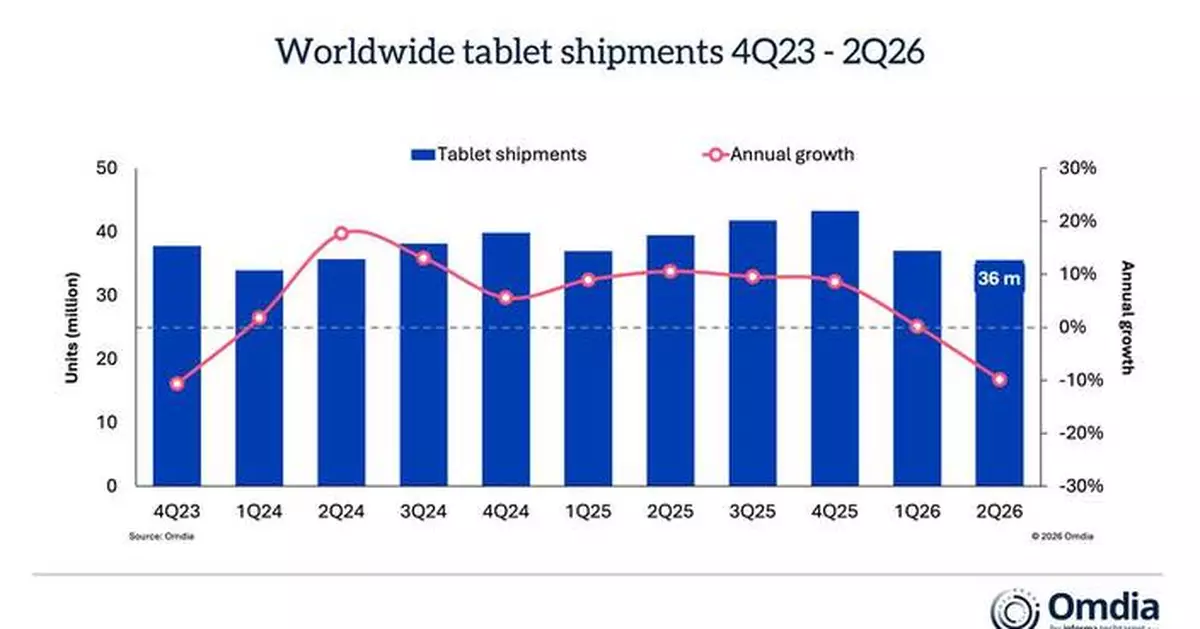
The global tablet market entered an expected period of decline in Q2 2026, with shipments falling 10% year on year to 36 million units, according to the latest research from Omdia. For the first time in years, tablet shipments also defied the typical seasonal pattern of sequentially higher Q2 shipments driven by back-to-school demand.
This press release features multimedia. View the full release here: https://www.businesswire.com/news/home/20260806999460/en/
Global tablet market enters expected downturn
"The past quarter saw one of the steepest declines in the tablet market over the past two years," said Himani Mukka, Research Manager at Omdia. "While the slowdown was anticipated, the market had remained more resilient than expected in prior quarters. Tablets have become an integral part of many households, and in several consumer use cases, detachable tablets are increasingly replacing traditional PCs for everyday computing. Relative affordability, the growing availability of larger-screen models, and tablets’ established role in education and field-based commercial environments continue to support important pockets of demand despite the broader market weakness.”
Premium tablets become a greater focus amid supply constraints
“Looking ahead, vendors are unlikely to broadly prioritize the tablet category in the current component supply-constrained environment,” added Mukka. “Instead, they will focus their limited resources on flagship and premium models, further shifting their portfolios toward premium devices.”
Beyond hardware, tablet vendors will increasingly rely on services, refined AI strategies and use-cases and renewed go-to-market strategies to drive revenue and differentiate their offerings. Omdia’s forecast of market decline in the rest of 2026 reflects both constrained availability of lower-priced tablets and consumers delaying purchases in response to rising prices.
Apple retains market leadership as Lenovo posts strongest growth
In Q2 2026, Apple retained its leading position despite an 8% year-on-year decline in shipments, shipping 13.5 million iPads worldwide and capturing a 38% market share. The standard iPad accounted for the majority of shipments, with the Air and mini models contributing a smaller share of the total.
Samsung remained the second-largest vendor, shipping nearly 6 million tablets despite a 13% annual decline. As component supply constraints persist, the company is expected to dynamically adjust its product mix throughout the year, prioritizing higher-margin models to protect margins and profitability.
Among the leading vendors, Lenovo was the only company to record shipment growth, with volumes increasing 27% year on year. While part of the growth was driven by genuine end-user demand, it was also supported by channel sell-in ahead of anticipated price increases and major retail promotional events.
Xiaomi ranked fourth, shipping 2.8 million tablets and recording a relatively modest 7% year-on-year decline. Its performance continued to be supported by strong domestic demand alongside steady momentum across the rest of the Asia Pacific region.
Huawei rounded out the top five, shipping 2.7 million units, representing a 16% year-on-year decline during the quarter.
Chromebook shipments continue to decline as education demand softens
The Chromebook market recorded yet another decline in Q2 2026. With memory now accounting for a disproportionately large share of the bill of materials for budget and education-tier devices, Chromebooks have become one of the hardest-hit device categories in the current supply-constrained environment.
Lenovo maintained its leadership position, recording a comparatively modest 3% year-on-year decline in shipments to 1.76 million units. The decline was largely driven by the completion of the first phase of Japan's GIGA 2.0 School Program, for which Lenovo had been the primary supplier.
Acer moved into second place, shipping 1.18 million units despite a 4% year-on-year decline. Its resilient performance was supported by steady demand in North America and incremental share gains from HP in the region.
HP ranked second with 1.15 million units shipped, down 13% year on year, as relatively weaker institutional demand in the education segment continued to impact shipments.
Asus was the standout performer, with shipments growing 66% year on year to 749k units, more than doubling its market share from 8% to 16% in Q2 2026. The growth was driven by its role as a key supplier for GIGA 2.0, the US K–12 education refresh cycle, and back-to-school inventory stocking.
Dell recorded the second-steepest decline, with shipments falling 47% year on year to 465K units.
More broadly, the decline can be attributed to vendors deprioritizing the Chromebook category due to its relatively low profitability, as well as elevated shipments in Q2 2025, when education deployments were at their peak. Even pre-agreed Chromebook deployments have experienced delays this year, further weighing on shipment volumes.
ABOUT OMDIA
Omdia, part of TechTarget, Inc. d/b/a Informa TechTarget (Nasdaq: TTGT), is a technology research and advisory group. Our deep knowledge of tech markets grounded in real conversations with industry leaders and hundreds of thousands of data points, make our market intelligence our clients’ strategic advantage. From R&D to ROI, we identify the greatest opportunities and move the industry forward.
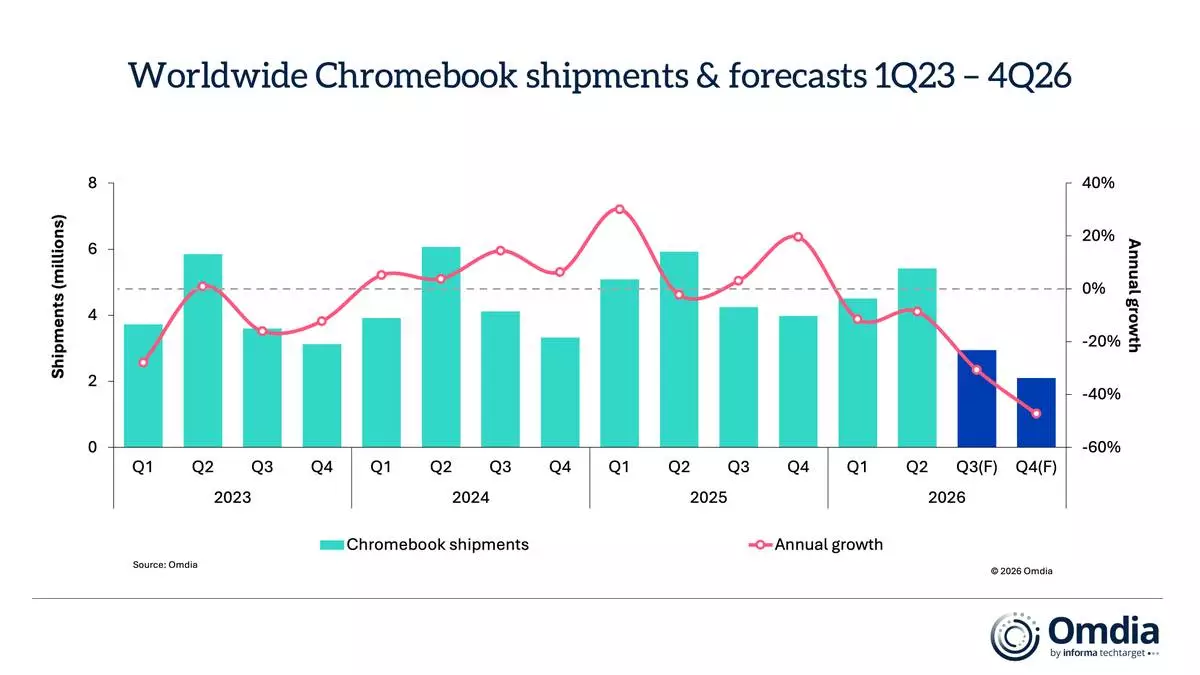
Worldwide Chromebook shipments & forecasts 1Q23 – 4Q26
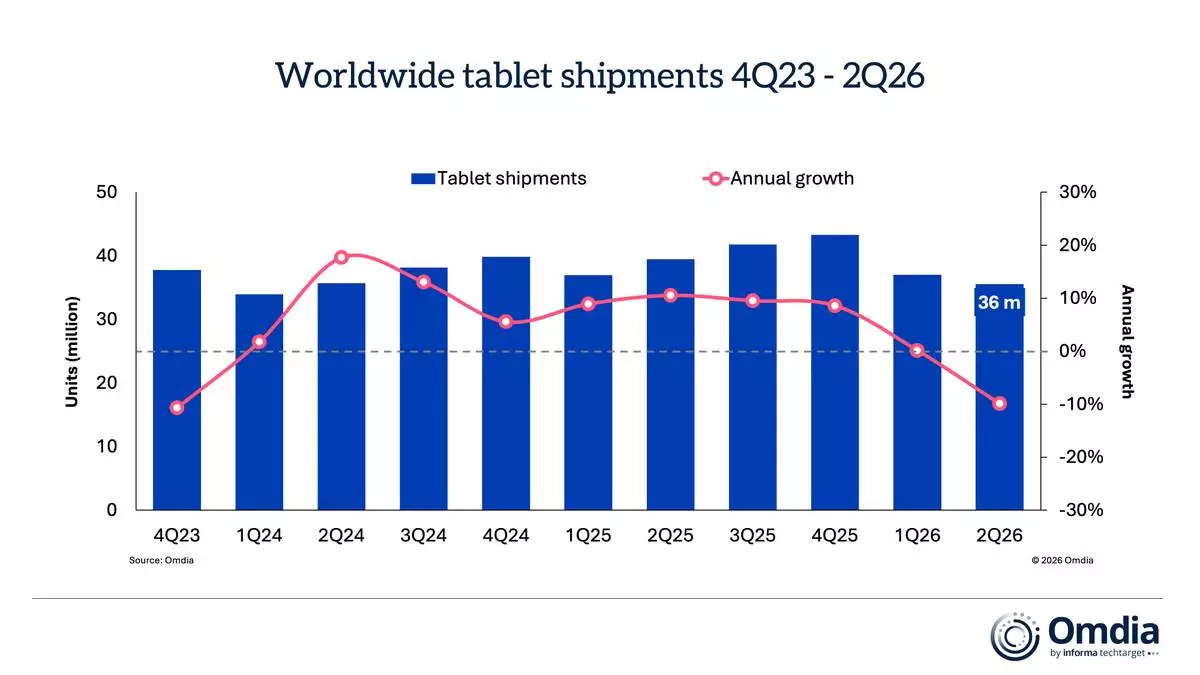
Worldwide tablet shipments 4Q23 - 2Q26
BANGKOK (AP) — The head of Myanmar’s military-backed government arrived in Thailand on Thursday for an official visit that could serve as a major steppingstone in his effort to win political legitimacy more than five years after seizing power from an elected civilian government.
President Min Aung Hlaing's two-day visit with members of his Cabinet included meetings with Thai Prime Minister Anutin Charnvirakul and other officials at Government House, where several memorandums of understanding were signed covering Myanmar migrant workers, water quality management in rivers shared by the two countries and space technology for Earth observation.
Following the meetings, the two leaders were scheduled to deliver speeches at a Thailand-Myanmar Business Forum.
At the meeting with Anutin, Min Aung Hlaing sought to reassure Thailand that his government was restoring stability and steering Myanmar toward democracy.
“Myanmar has now reestablished itself on the path to democracy and is moving toward a better future,” Min Aung Hlaing said. “As the new government, we have now begun working on national stability, peace, and national reconciliation.”
The visit has drawn criticism from activist groups such as Justice For Myanmar, which stated that the trip lends “false legitimacy” to Min Aung Hlaing and the ruling generals.
Min Aung Hlaing took a significant step toward would-be political rehabilitation in April when he was sworn in as president following an election held in phases in December and January. Critics dismissed the polls as a sham designed to consolidate the military’s grip on power while ostensibly restoring civilian rule.
The diplomatic outreach is the latest in a series of moves to reengage with countries in the region and the international community after relations became frayed or frosty following Min Aung Hlaing's ousting of Aung San Suu Kyi’s government in February 2021 while serving as army chief.
Western governments have shunned and sanctioned Min Aung Hlaing and his associates for overthrowing Suu Kyi's government. Subsequent serious rights violations followed a deadly military crackdown on protests, which subsequently triggered a nationwide armed resistance movement and a bloody civil war.
The visit is among Min Aung Hlaing’s most significant diplomatic engagements and the latest in a series of trips to neighboring countries, including China, India and Laos, as he seeks to strengthen regional ties since assuming the presidency in April. Despite visits to those countries and close relations with Russia, he has remained largely isolated internationally.
While he attempts to refurbish his image, Myanmar's military continues to wage a brutal war across much of the country against pro-democracy resistance fighters and armed ethnic minority groups seeking greater autonomy.
According to the Assistance Association for Political Prisoners, an independent organization that keeps detailed tallies of arrests and casualties linked to the civil war, more than 8,200 civilians have been killed and 31,645 arrested by Myanmar's security forces as of Wednesday.
Chit Seng, a senior human rights specialist at Fortify Rights, argued last month that changing from a military uniform into a “presidential robe” after fake elections does not alter the fundamental nature of the military government. She described it as a “brutal regime” that kills its own people and should not be legitimized.
Only about a dozen people turned up for a protest of the visit outside the U.N.’s regional headquarters in Bangkok, where they chanted in support of the resistance forces in Myanmar and to wish for Min Aung Hlaing’s downfall.
In another effort to placate critics, the regime allowed a representative of the International Committee of the Red Cross to visit 81-year-old Suu Kyi this week, the first known contact with an outside international independent humanitarian organization since her detention. The ICRC confirmed the visit but disclosed no details about her health or the contents of the meeting.
She was originally sentenced to 33 years in prison in late 2022, on what her supporters and rights groups said were bogus charges intended to prevent her return to politics.
On April 30, she was moved from prison to house arrest and her sentence was reduced to 18 years, with more than 13 years left to serve. The United Nations, Western governments and international human rights organizations have repeatedly called for her immediate release.
Min Aung Hlaing's visit to Thailand is part of a broader series of trips to neighboring countries as the 70-year-old Min Aung Hlaing seeks to restore his standing within the Association of Southeast Asian Nations. He faced years of diplomatic isolation following his 2021 takeover and was barred from top-level ASEAN meetings for failing to comply with a peace plan agreed upon in April 2021.
Bangkok has maintained close ties with Myanmar’s military leadership and has emerged as the strongest advocate within ASEAN for renewed engagement with Naypyitaw.
Although the visit officially concerns bilateral relations, Anutin declared during a visit to Indonesia on Tuesday that a peaceful and stable Myanmar is essential to ASEAN unity and regional stability. He acknowledged that Thailand has advocated for a “calibrated re-engagement approach” that keeps dialogue open and responds to “realities on the ground,” and suggested that the recent ICRC visit to Suu Kyi validated this position.
Thanida Piyachot, another human rights specialist at Fortify Rights, disagreed, saying that recognizing Min Aung Hlaing as a legitimate leader and “shaking the bloodied hands of a war criminal” sends the wrong message to civilians suffering under an “illegitimate military dictatorship.”
She urged Thailand and ASEAN to stop hiding behind non-interference policies and to take proactive roles in promoting human rights in Myanmar.
This story has been updated to correct the gender of Chit Seng, a senior human rights specialist at Fortify Rights.
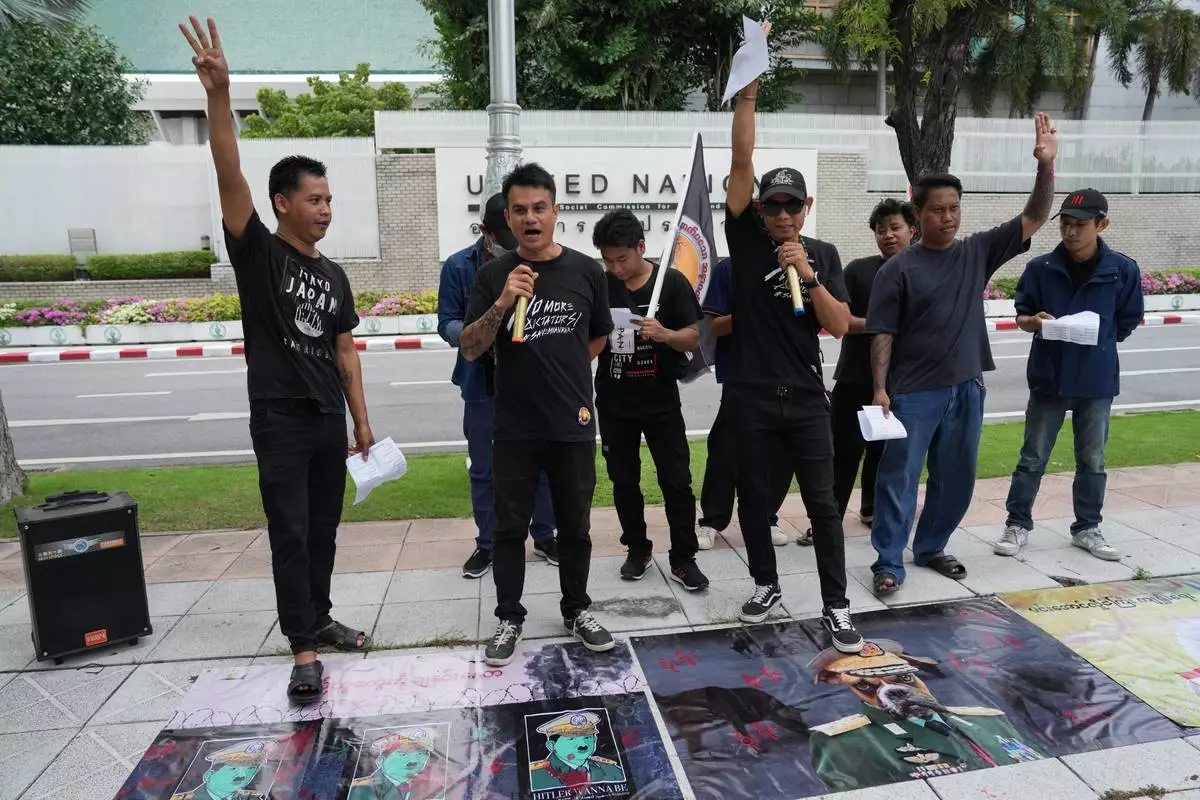
Myanmar nationals living in Thailand protest against Myanmar's President Min Aung Hlaing during his visit in Bangkok, Thailand Thursday, Aug. 6, 2026. (AP Photo/Sakchai Lalit)
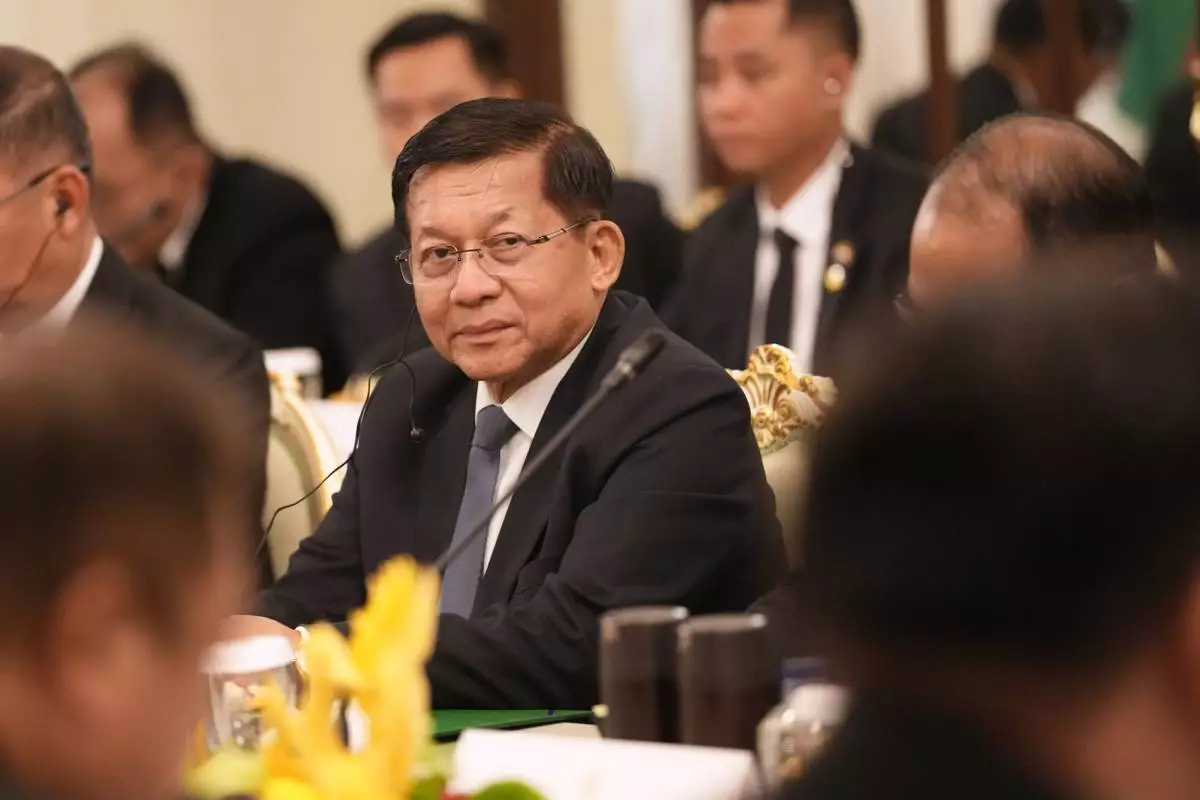
Myanmar President Min Aung Hlaing attends a meeting with Thailand Prime Minister Anutin Charnvirakul, not in picture, at the Government House in Bangkok, Thailand, Thursday, Aug. 6, 2026. (AP Photo/Sakchai Lalit, Pool)
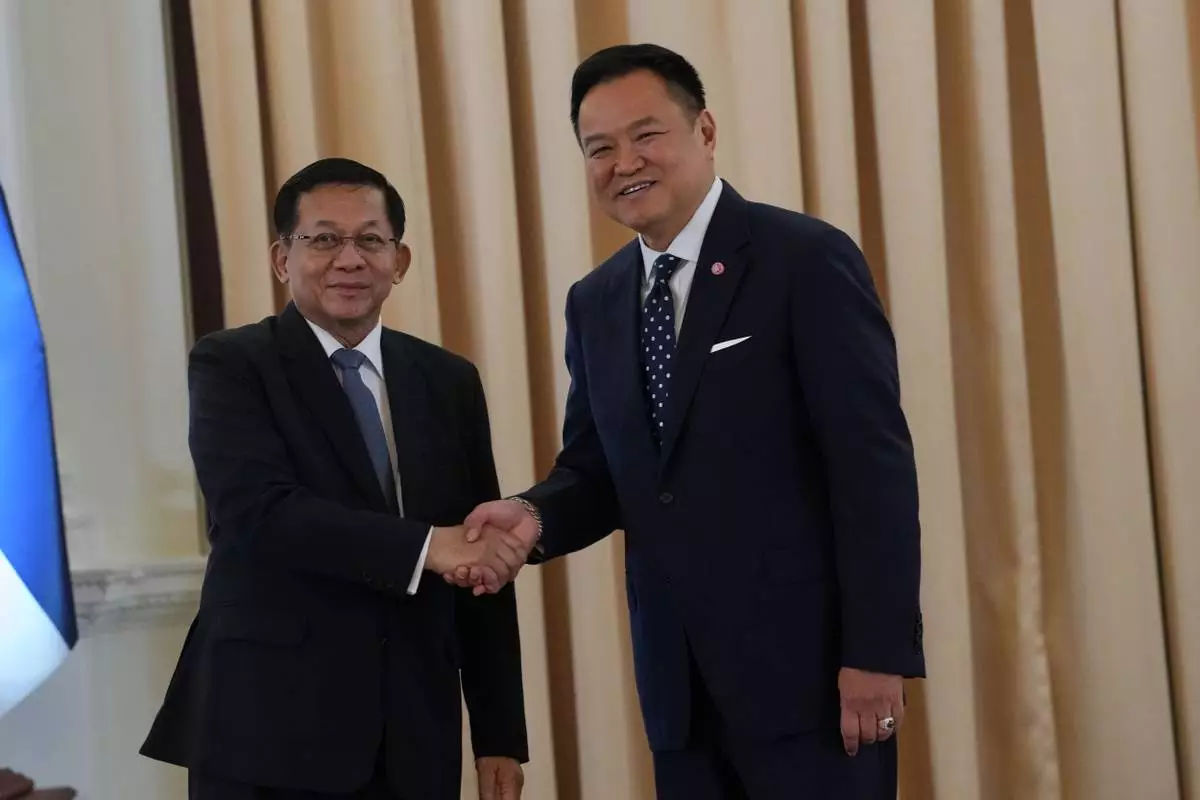
Myanmar President Min Aung Hlaing, left, shakes hands with Thailand's Prime Minister Anutin Charnvirakul at the government house in Bangkok, Thailand, Thursday, Aug. 6, 2026. (AP Photo/Sakchai Lalit)
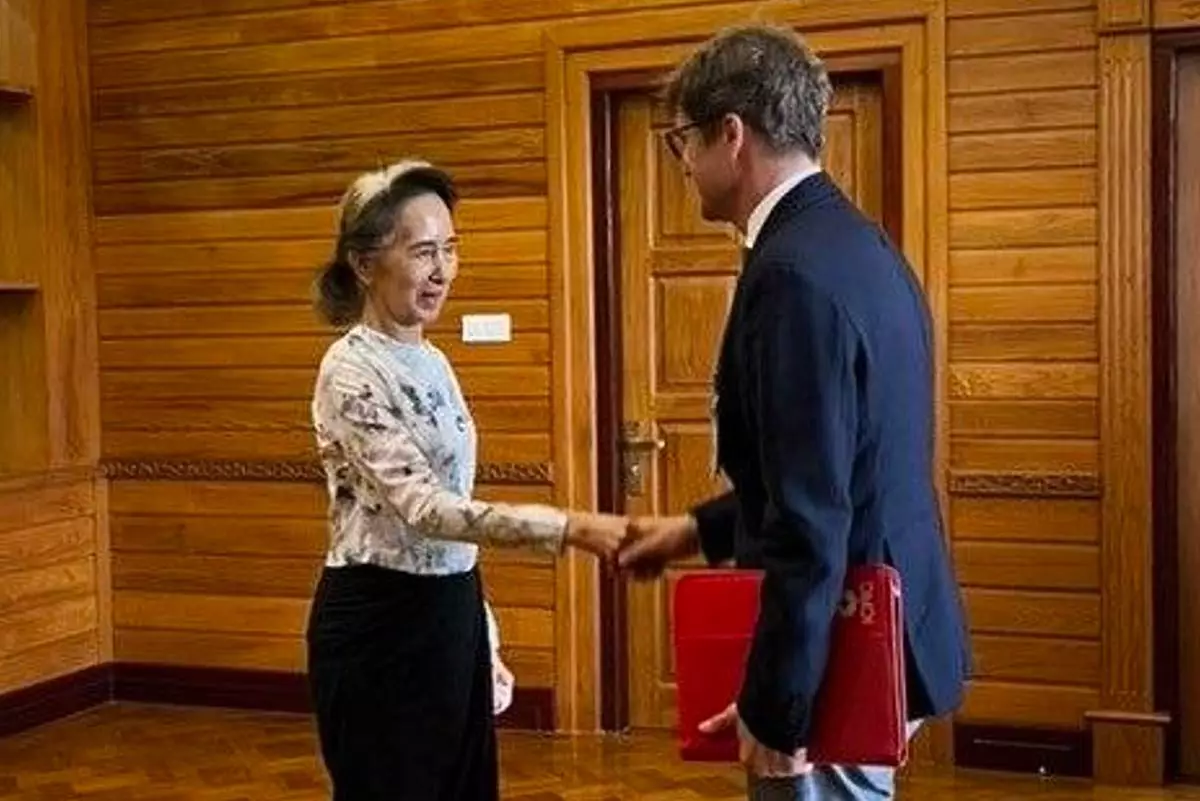
In this photo released by Myanmar President Office on Monday, Aug. 3, 2026, Myanmar's ousted leader Aung San Suu Kyi, left, shakes hands with Arnaud de Baecque, resident representative of the International Committee of the Red Cross, during their meeting in Naypyitaw, Myanmar. (Myanmar President Office via AP)
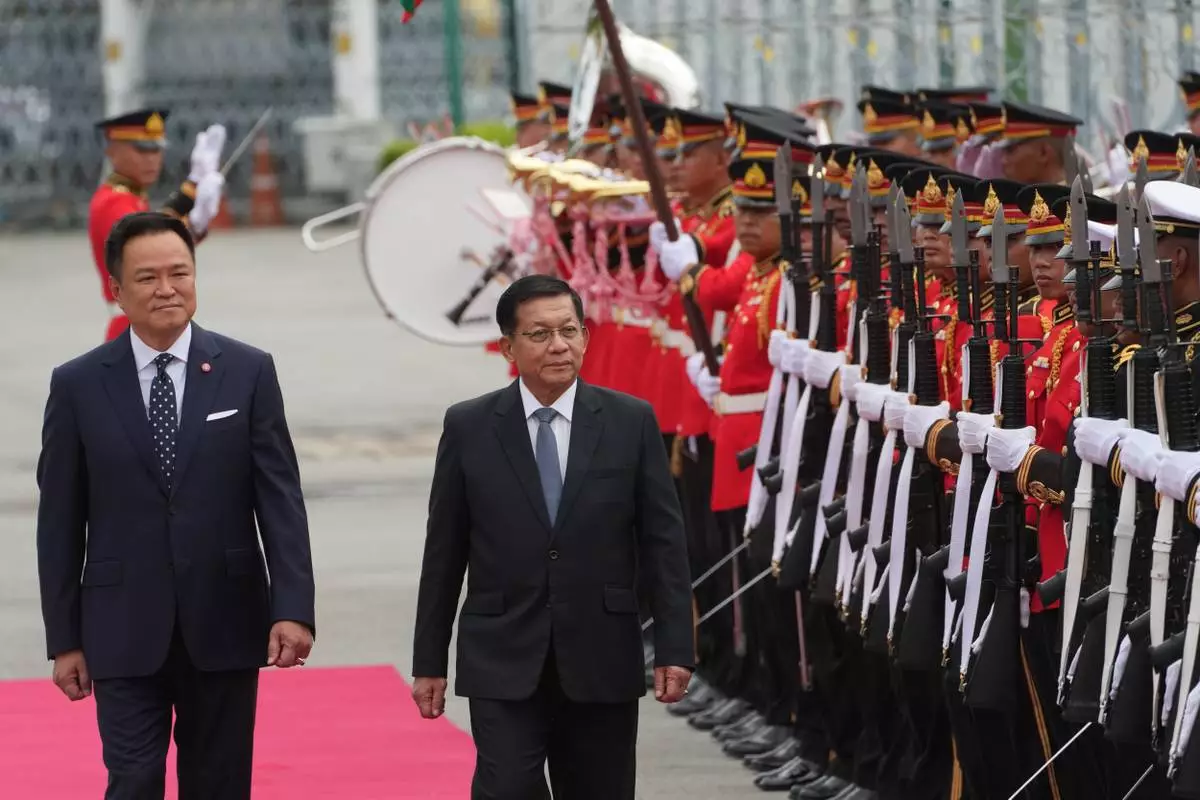
Thailand's Prime Minister Anutin Charnvirakul, left, and Myanmar's President Min Aung Hlaing review an honor guard during a welcome ceremony at the Government House in Bangkok, Thailand Thursday, Aug. 6, 2026. (AP Photo/Sakchai Lalit)