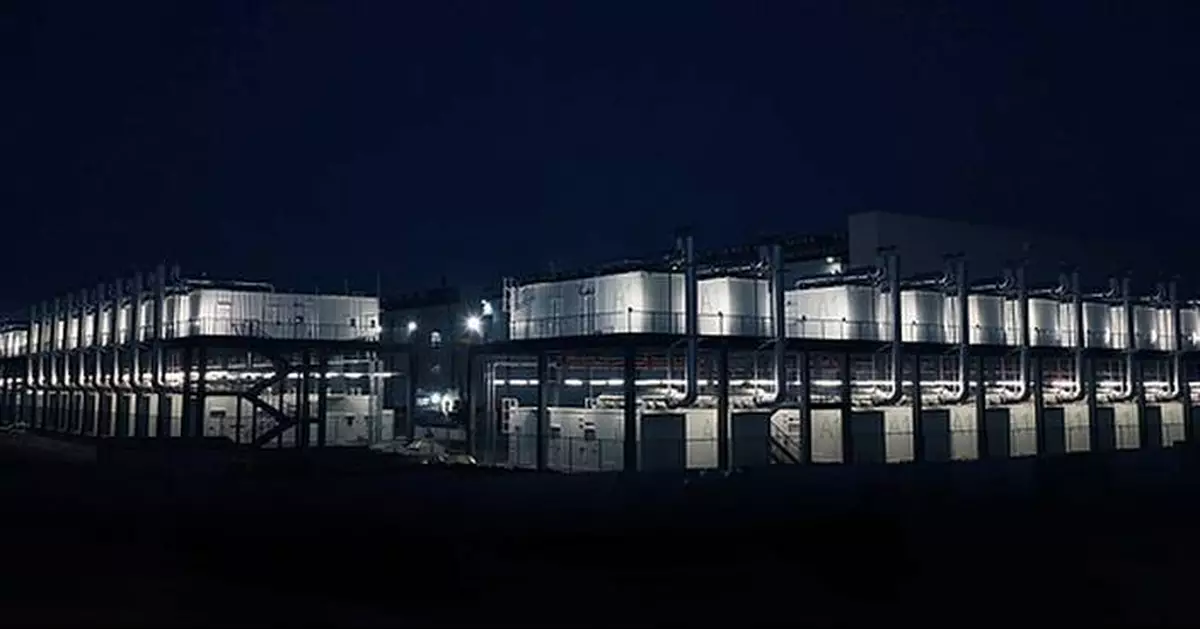
Featuring the world's largest single AI data center building, Galaxy Campus integrates renewable energy, intelligent power management and high-density computing at unprecedented scale.
ULANQAB, China, Aug. 6, 2026 /PRNewswire/ -- Envision, a global leader in green technology, today announced the commissioning of the Envision Galaxy Campus in Ulanqab, Inner Mongolia, a next-generation AI infrastructure campus designed to accelerate the deployment of large-scale artificial intelligence. Powered directly by renewable energy and designed to scale to over 2GW of capacity, the campus in Ulanqab introduces a new approach to meeting the growing energy and infrastructure demands of AI.
At the heart of the campus is a 120,000-square-meter AI supercomputing facility, equivalent to 20 standard football pitches. Once fully operational, it is designed to deliver industry-leading token-generation capacity within a single structure, supported by directly connected renewable electricity and Envision's proprietary AI Power System.
At full build-out, the facility is designed to deliver one million PFLOPS of AI computing and support up to one million AI accelerators, setting a new benchmark for compute density in AI infrastructure.
"Supporting a million accelerators requires a purpose-built AI Power System that integrates renewable generation, dedicated transmission infrastructure, and large-scale energy storage to deliver stable, low-cost green power," said Ricky Zheng, General Manager of Envision's AIDC (AI Data Center). "This enables the facility to deliver up to ten times more compute output per square meter than conventional data centers."
Beyond power, Envision Galaxy Campus addresses another critical requirement for large-scale, low-latency connectivity. Ulanqab's position as a major digital infrastructure hub provides the network performance required for AI clusters containing hundreds of thousands of accelerators.
The region's abundant wind and solar resources provide a complementary advantage. By combining dedicated renewable energy assets, transmission infrastructure and AI-optimized power management, Envision has created a new model for gigawatt-scale AI infrastructure powered directly by green electricity.
"The next frontier of AI is infrastructure," added Zheng. "As AI models become larger and more compute-intensive, the limiting factors are increasingly power availability, network performance and energy efficiency. Envision Galaxy Campus combines energy, networking and physical infrastructure at unprecedented scale, enabling hyperscalers, technology companies and AI innovators to deploy and scale the next generation of AI workloads."
The Galaxy Campus serves as the first flagship project under Envision's global Mission Gobi initiative, which was unveiled at VivaTech in Paris in June 2026. The initiative aims to build 5GW of green AI computing capacity in desert and arid regions worldwide by 2030.
** This press release is distributed by PR Newswire through automated distribution system, for which the client assumes full responsibility. **
Envision Commissions Galaxy Campus in Ulanqab, Establishing a New Model for Gigawatt-Scale AI Infrastructure
Culture: Deal signed for joint protection
BEIJING, Aug. 6, 2026 /PRNewswire/ -- A news report from China Daily:
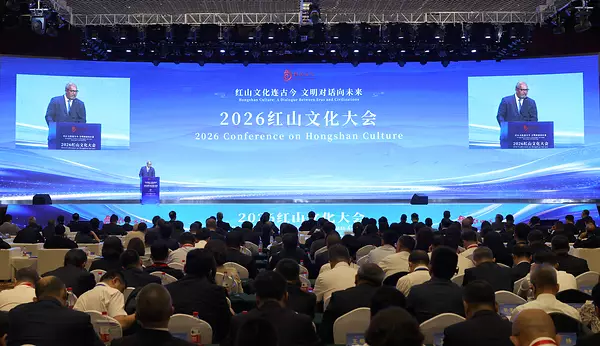
Cultural heritage is a living dialogue connecting the past, the present and a shared future, participants at a cultural event said on Wednesday, highlighting the importance of further deepening cooperation to enhance the reach and appeal of Chinese civilization and promote mutual learning among civilizations.
The remarks came as archaeologists, heritage experts, civilization researchers, diplomatic envoys to China and governmental officials gathered for the 2026 Conference on Hongshan Culture in Chaoyang in Northeast China's Liaoning province, from Wednesday to Thursday.
Hongshan culture, a major Neolithic culture dating back 5,000 to 6,500 years, once spanned what is now Liaoning and Hebei provinces and the Inner Mongolia autonomous region.
Xu Kunlin, secretary of the Communist Party of China Liaoning Provincial Committee, said the province actively participates in the national project to trace the origins of Chinese civilization, prioritizes the protection and inheritance of Hongshan culture in its drive to build a culturally strong province, and strives to continuously enhance the influence of Hongshan culture.
"We have strengthened legislative protection for Hongshan culture's Niuheliang site in Chaoyang and stepped up academic research by setting up the Hongshan Culture Research Institute, and promoted Hongshan culture beyond Liaoning to the world through a youthful tone and digital forms," said Xu.
Furthermore, Liaoning is cooperating with other regions to promote a joint bid for World Heritage status, Xu said.
Under the theme of "Hongshan Culture: A Dialogue Between Eras and Civilizations", participants delivered remarks on the culture's historical and civilizational significance.
Rao Quan, head of the National Cultural Heritage Administration, called for continued efforts to advance the transformation and utilization of archaeological achievements, upgrade the construction and operation of archaeological site parks and thematic museums, launch more high-quality exhibitions and public education activities, and offer diverse public cultural products.
Rao also advocated deeper integration of culture and tourism, calling for using cultural relic resources to develop study tours, travel routes and cultural experience programs, in order to boost public cultural confidence.
"It's important to build a robust global communication network for Hongshan culture, leveraging platforms including international archaeological cooperation, overseas thematic exhibitions and high-level academic dialogues," he said.
Qu Yingpu, publisher and editor-in-chief of China Daily, said, "The rose patterns of Yangshao culture, the octagonal star patterns of Lingjiatan culture and the dragon-scale patterns of Hongshan culture symbolize the distinct cultural characteristics of the civilizations in the basins of the Yellow, Yangtze and Liaohe rivers."
He said that, like many stars shining together, the early Chinese cultures of different regions interacted across vast distances and eventually formed a diverse yet unified Chinese civilization.
"We should jointly tell the stories of Hongshan culture and Chinese culture to the world, helping global audiences better understand Chinese civilization and gain a deeper insight into China in the new era," Qu said.
Khaled Nazmy, ambassador of Egypt to China, said, "Our gathering today is proof that our ancient heritage and civilization are not only a chapter in history, but also a living legacy that continues to inspire us, bring us together and remind us of our shared responsibility to preserve our cultural heritage and deepen our friendship."
Shahbaz Khan, director and representative of the UNESCO Regional Office for East Asia, said in a video speech: "Hongshan culture represents a foundational chapter in human development. Its ritual architecture and extraordinary jade craftsmanship reveal humanity's early spiritual and social evolution. For UNESCO, protecting these roots is about safeguarding the unique human genius that grounds our collective identity."
Wang Wei, a member of the Chinese Academy of Social Sciences' Academic Divisions, noted that Hongshan culture demonstrates that Chinese civilization did not originate from a single center, but rather emerged from the independent development and mutual influence among multiple regional cultures.
Wang noted that in the past, Chinese as well as Western archaeologists defined civilization by the presence of writings, cities and metallurgy. Hongshan culture lacked all three, yet it formed a complex society organized around belief systems, ritual structures and shared spiritual identity, showing that there is more than one path to civilization, he said.
Media representatives from Liaoning, Hebei and Inner Mongolia shared stories behind iconic Hongshan relics: the Hongshan goddess statue, the jade dragon in ring-like shape known as jue and the C-shaped jade dragon.
At the conference, a special tribute was paid to those who have made outstanding contributions to the preservation and research of Hongshan heritage. Su Shenzhi, daughter of the late archaeologist Su Bingqi, accepted the honor on her father's behalf, together with archaeologist Guo Dashun and Sinologist Elizabeth Childs-Johnson from the United States. The three were presented with commemorative certificates.
At the event, heads of the cultural heritage administrations of Liaoning, Hebei and Inner Mongolia signed the Liaoning-Hebei-Inner Mongolia Cooperation Agreement on Archaeological Research into Hongshan Culture, a move seen as a key step toward coordinated protection and cross-regional collaboration.
** This press release is distributed by PR Newswire through automated distribution system, for which the client assumes full responsibility. **
Dialogue highlights Hongshan culture protection