Skip to Content Facebook Feature Image

Lioness steps in as surrogate mom for newborn tiger triplets

China

China

China

Lioness steps in as surrogate mom for newborn tiger triplets

2026-08-06 17:40 Last Updated At:20:47

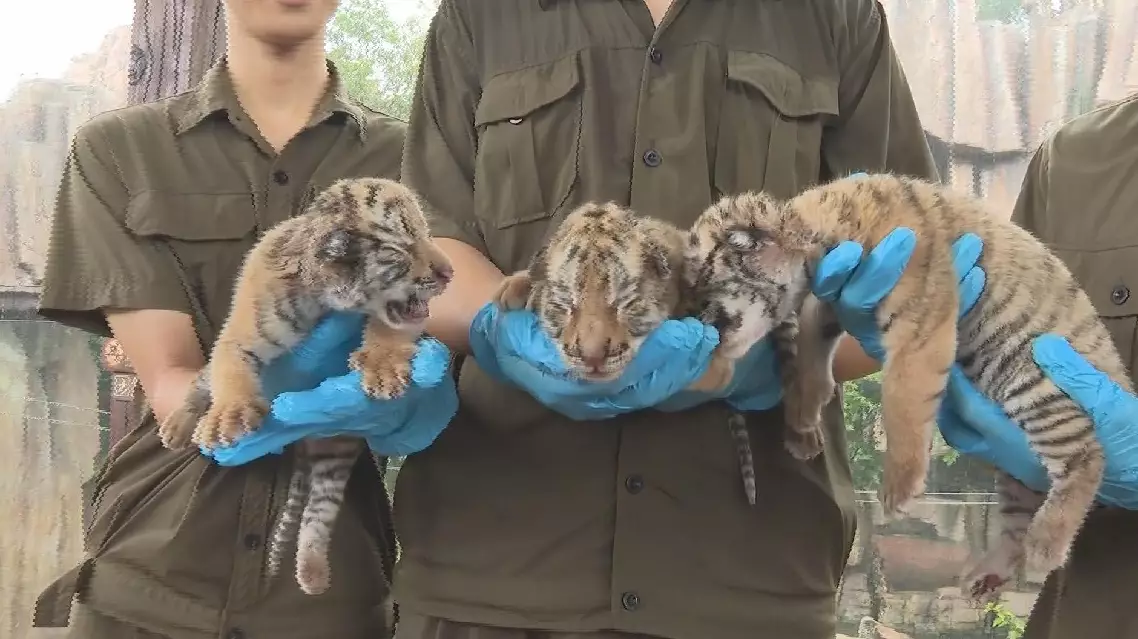
A heartwarming interspecies friendship has captured public attention at a wildlife park in southern China's Guangdong Province, where a female African lion was spotted caring for a newborn tiger cub after its mother gave birth to triplets on Saturday.

The unusual scene unfolded at the Lion and Tiger House of the Changlu Tourism and Leisure Expo Park in Foshan City, where visitors witnessed a lioness licking a tiny tiger cub while the tigress was seen tending to another cub elsewhere. The sight sparked initial concerns among onlookers about whether the lioness might harm the cub.

According to the park, the tigress gave birth slightly earlier than expected. Keepers quickly stepped in after discovering the first cub in the shared enclosure. A keeper at the park reassured the public that the cubs were never in danger.

"The tigress was frightened during labor and moved to a different spot after giving birth to her first cub. The lioness picked up the cub and licked its umbilical cord," explained Gan Hongping, the keeper.

"The cub was never at risk. As soon as we realized what had happened, we separated the adult lions and tigers and placed the newborns in an incubator for proper care," Gan said.

Visitors who witnessed the scene found it deeply touching.

"Animals have maternal love, just like humans. I've seen dogs take care of kittens sometimes. It should be the same. Maternal instinct crosses species," said Mr. Chen, a tourist.

According to the park, the four African lions and five adult Siberian tigers in the enclosure have been living harmoniously for six to seven years, all raised together since infancy.

"They grew up together like siblings. They treat each other as family. There's no fighting between them," Gan said.

Veterinary checks have confirmed that all the three tiger cubs are developing normally and are in stable, healthy condition. The park said the cubs are currently under the care of keepers and will eventually be introduced to the shared Lion and Tiger House when they grow older.
Lioness steps in as surrogate mom for newborn tiger triplets


Lioness steps in as surrogate mom for newborn tiger triplets

China's top court on Thursday issued a set of provisions, marking the first judicial interpretation supporting the country's Ecological and Environmental Code.

The provisions are designed to ensure a smooth legal transition between old and new laws and the full and accurate implementation of the Code.

The provisions will take effect simultaneously with the Code on Aug. 15, according to the Supreme People's Court.

Consisting of 13 articles, the provisions clarify the general standards and specific rules for courts to apply old and new laws when hearing environmental cases after the Code takes effect.

They stipulate that, in principle, cases based on the facts that occurred before the Code takes effect will generally be handled under the laws and judicial interpretations then in force, while those arising afterward will be governed by the Code.

"For illegal acts such as environmental pollution and ecological damage that occurred before the code becomes effective, where the offender has taken the initiative to eliminate or mitigate the harmful consequences, effectively implemented ecological and environmental restoration measures, promptly paid compensation, or taken other similar measures, the provisions of the code may be applied to impose a lighter or mitigated penalty. This aims to actively encourage offenders to voluntarily fulfill their ecological restoration and compensation responsibilities, thereby better protecting the ecological environment," said Yang Linping, vice president of the Supreme People's Court.

The Ecological and Environmental Code was adopted by China's top legislature in March.

The 1,242-article Code has five chapters, covering areas including pollution control, ecological protection, and green and low-carbon development.

The Code is aligned with China's pledges to peak carbon emissions before 2030 and achieve carbon neutrality before 2060.

China issues judicial interpretation on Ecological and Environmental Code

China issues judicial interpretation on Ecological and Environmental Code

Recommended Articles