A Chinese research team has completed an updated geologic map of the entire moon featuring a scale of 1:5 million, the Institute of Geology, Chinese Academy of Geological Sciences (IGCAGS), said on Thursday.
Representing a significant scientific iteration from the 2024 version, this map effectively rewrites the moon's geologic history based on the latest research findings.
Specifically, a primary achievement of this update is the recalibration of the moon's ancient geologic eras. The new map systematically updates the age boundaries of the moon's three ancient geologic periods, namely the Aitkenian, Nectarian and Imbrian periods, drawing on recent advances in international chronology.
Crucially, Chang'e-5 samples confirmed volcanic activity on the moon as recently as 2 billion years ago, extending its geologic lifespan by 1 billion years from the previously accepted 3 billion years. This independent dating data has now become a cornerstone of the global lunar geologic timescale.
Highlighting these spatial discoveries, the new global lunar geologic map is the first comprehensive canvas to bear exclusive findings from the Chang'e-6 mission.
The map details the age of young mare basalts on the lunar far side obtained from the Chang'e-6 samples, recording the region's volcanic history. Furthermore, it reveals that KREEP rocks, enriched with rare earth elements and other strategic resources, are far more continuous and abundant in the Oceanus Procellarum than previously estimated. This discovery, achieved by eliminating spectral noise, prompts a systemic reevaluation of the moon's early magma ocean crystallization and internal thermal evolution.
Beyond its scientific data, the 2.8-by-1.2-meter map introduces a proprietary cartographic standard. Identifying over 13,500 impact craters and 81 basins, it employs a unique color scheme rooted in geologic logic and traditional Chinese aesthetics, following a "lighter for younger, darker for older" principle.
Furthermore, this standard will also be applied to future geologic mapping of Mars and asteroids, ending reliance on foreign standard systems.
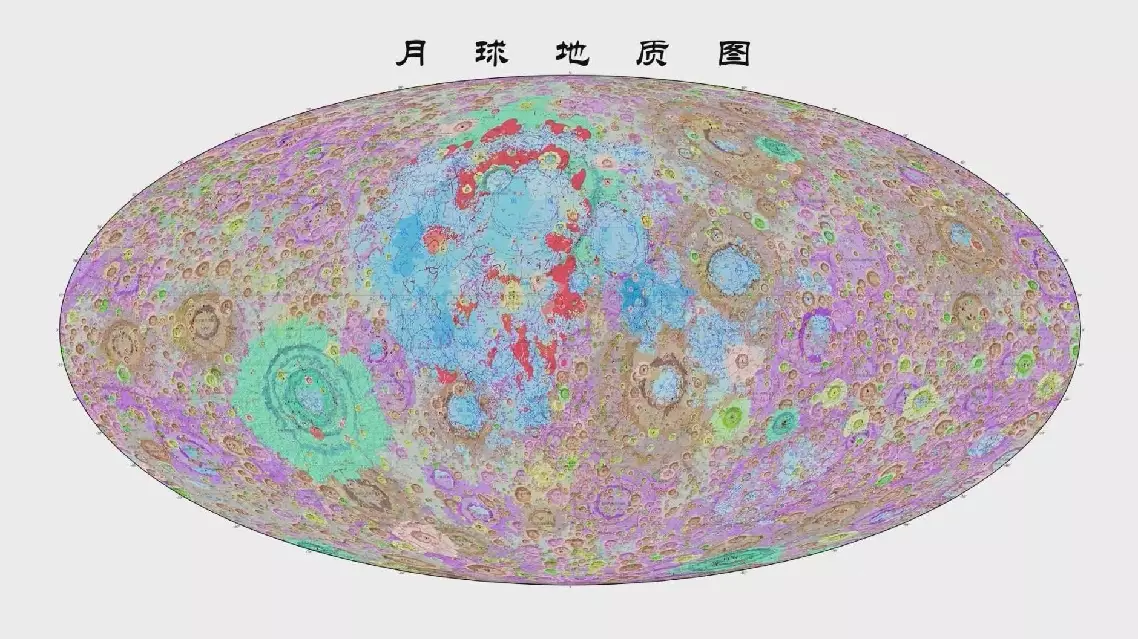
China unveils refined lunar map, empowering future moon exploration