VIENNA--(BUSINESS WIRE)--Aug 7, 2026--
An ICC Arbitral Tribunal has awarded AOP Orphan Pharmaceuticals GmbH (“AOP Health”) a total of about EUR 112 Mio in a quantum award issued in the ongoing arbitration proceedings with PharmaEssentia Corp. (“PharmaEssentia”) concerning BESREMi® (ropeginterferon alfa-2b). The award quantifies AOP Health’s damage claims for PharmaEssentia’s intentional breaches at ca. EUR 82 Mio. It also awards AOP Health ca. EUR 31 Mio plus interest as reimbursement for AOP Health overpayments made to PharmaEssentia as a result of excessive pricing in the years 2019-2022. The Tribunal thereby confirmed that PharmaEssentia has been overcharging AOP Health by up to 900% over these years. The Tribunal affirmed AOP Health's valid set-off of the profit-sharing payments amount owed to PharmaEssentia of approximately EUR 17 Mio against AOP Health's substantially exceeding damages claims. This means that AOP Health shall not make any payment to PharmaEssentia. Interest on AOP Health’s claims will continue to accrue until PharmaEssentia has made payment. All of PharmaEssentia’s remaining claims of the quantum stage of the proceedings were dismissed.
This press release features multimedia. View the full release here: https://www.businesswire.com/news/home/20260807889741/en/
The decision follows the partial final award received in February 2025, in which the ICC Arbitral Tribunal found, among other things, that PharmaEssentia had intentionally breached its contractual obligations and was liable for several claims arising out of the parties’ licensing agreement. The quantum award now determines the amounts due in relation to these claims.
Tribunal confirms PharmaEssentia’s excessive pricing of up to 900%
Applying the Tribunal’s reasoning in the quantum award to the product deliveries for the years 2023-2025, PharmaEssentia has overcharged AOP Health by another ca. EUR 65 Mio. After set-off with profit sharing amounts for these years, PharmaEssentia will still owe a substantial amount to AOP Health. In short, AOP Health owes no payment to PharmaEssentia. Meanwhile, PharmaEssentia’s liability towards AOP Health is currently in the three-digit EUR million range.
Safeguarding Patient Access
AOP Health welcomes the decision, which the company sees as a further confirmation of its position and its conduct in the proceedings. The company remains focused on ensuring stable and sustainable access to BESREMi® for patients in need. In its seventh year after its approval by European Medicines Agency (“EMA”), AOP Health has successfully made BESREMi® available to an estimated 12,600 patients in AOP Health’s licensed territory.
Dr. Rudolf Widmann, one of the two founders of AOP Health, says: “After eight years of legal dispute, we welcome the tribunal’s decision because it reduces uncertainty. This award gives us a stronger basis to continue our mission: developing and making available medicines that address high unmet medical needs.”
As with the previous award, PharmaEssentia may seek a limited review of the quantum award before the competent German courts. Proceedings concerning the review of the February 2025 merit award which was confirmed by the Higher Regional Court of Frankfurt in April 2026 are still pending before the German Federal Court of Justice.
Background to the dispute
The conflict concerns BESREMi®, a treatment for rare blood cancers, particularly polycythemia vera. AOP Health acquired the rights for the development and commercialization of BESREMi® in the European, Commonwealth of Independent States (CIS), and Middle Eastern markets from PharmaEssentia in 2009.
Since 2017, PharmaEssentia has repeatedly attempted to terminate its agreement with AOP Health regarding BESREMi®. In October 2020, an ICC Arbitral Tribunal rejected these attempts and awarded AOP Health damages, while dismissing PharmaEssentia’s counterclaims. Subsequent set-aside proceedings confirmed the award in its essentials, while identifying procedural issues relating to the quantification of damages.
In November 2020, PharmaEssentia initiated a further legal action against AOP Health, alleging damage claims. AOP Health in turn claimed damages for delays in BESREMi®’s European approval caused by PharmaEssentia and for the use of AOP Health’s clinical trial data in connection with PharmaEssentia’s U.S. marketing authorization. In February 2025, the ICC Arbitral Tribunal issued a partial final award in AOP Health’s favor on liability and dismissed PharmaEssentia’s liability claims in its entirety. The newly received quantum award now specifies the amounts due for the claims upheld in the partial final award.
About BESREMi®
BESREMi® is the first interferon that was approved for polycythemia vera, a myeloproliferative neoplasm (MPN), indicated in the European Union as monotherapy in adults for treatment of polycythemia vera without symptomatic enlarged spleen. Its overall safety and efficacy were demonstrated in multiple clinical studies.
BESREMi® (ropeginterferon alfa-2b) is a long-acting, mono-pegylated proline interferon (ATC L03AB15). It is administered once every 2 weeks initially, or up to every 4 weeks after stabilization of blood values. BESREMi® is designed to be self-administered subcutaneously with a pre-filled pen.
Please visit: European Medicines Agency Summary of Product Characteristics for:BESREMi®
About AOP Health
AOP Health Group is a global pharmaceutical enterprise with headquarters in Vienna. Its mission is to address high unmet medical needs through impactful, science-driven therapies and care models. Since 1996, AOP Health has pioneered research where limited therapies exist, to develop solutions for patients with rare diseases and severe conditions in niche therapeutic areas. Guided by the principle "Needs. Science. Trust.” the AOP Health Group demonstrates its strong commitment to patients and healthcare professionals through innovation and long-term partnerships, to improve patient outcomes worldwide.

Dr. Rudolf Widmann, Founder of AOP Health, Photo credit: AOP Health/Studio Koekart
WASHINGTON (AP) — The Senate overwhelmingly approved a punishing Russian sanctions package Friday, the result of a year-long campaign by the late Sen. Lindsey Graham to reinforce U.S. support for Ukraine and try to force President Vladimir Putin’s hand as the grinding war drags on.
The bipartisan legislation, which passed the Senate 86-11, would penalize countries that continue to buy Russian oil, gas and other exports seeking to deprive Putin of revenues fueling the war. It comes after Ukrainian President Volodymyr Zelenskyy visited the Capitol hours after Graham’s funeral, met with senators from both parties and watched from the gallery as the Senate took the first procedural votes last week on the sweeping legislation.
“Today, President Zelenskyy is watching from Ukraine — and Putin is watching from Moscow,” said Sen. Richard Blumenthal, D-Conn., who had worked with the late South Carolina senator on the package.
“I would like to think Lindsey Graham is watching, too,” he said. “Today we say to the people of Ukraine: You are not alone. And today we say to Vladimir Putin: You will not conquer Ukraine.”
The sweeping show of force from the Senate is the most substantial move yet during President Donald Trump’s second term to shift the dynamic of the more than four-year war, which has now churned longer than World War I. Congress has struggled to ensure U.S. funding and munitions flows to Ukraine, but Trump has given a nod to the sanctions package, putting pressure for the House to take it up for a vote and send it to the White House for his signature.
Graham and Blumenthal had announced a deal with the White House on the sanctions legislation on July 10 after more than a year of negotiations with the White House. Graham, who had just returned from Ukraine, died suddenly the next day, likely from an aortic tear.
The bipartisan package that carries Graham’s name allows the president to impose tariffs on the world’s top five purchasers of Russian oil or natural gas, including China and India. It provides exceptions for countries that import less than 15% of their natural gas from Russia and are taking steps to reduce those imports.
The legislation also includes sanctions on Putin, senior Russian political and military leaders, Russian financial institutions and Russian energy projects. It would expand U.S. sanctions to target older, reflagged oil tankers that Russia uses to circumvent existing U.S. sanctions on Russian oil and energy revenues.
Democrats and some Republicans have been wary of giving Trump broad authority to slap tariffs on imports that have spiked prices for goods, worried about inflation and high costs of living for Americans. Those voting against the final package were mostly progressive Democrats.
The negotiated bill also includes waiver authority for the president, allowing the White House to waive sanctions or restrictions if the president certifies to Congress that the waiver is in the national interest.
Sen. Darline Graham, R-S.C., who was appointed by the state’s governor to fill her brother’s seat, said he was determined to bring an end to the Ukraine war, and she was honored to carry on his work. “This legislation hits Putin where it hurts,” she said.
Zelenskyy told senators during last week’s private meeting at the Capitol that Ukraine is making gains in the war, but still needs more help from the U.S. He publicly thanked them for the sanctions package and said it would send a “big signal” to Ukraine and its allies of U.S. support.
Republican Sen. Todd Young of Indiana, who attended the meeting, said the sanctions legislation “is important as a moral signal to a country that is weary and tired, though holding its own.”
New Hampshire Sen. Jeanne Shaheen, the top Democrat on the Foreign Relations Committee, said advancing the legislation now, ahead of Russia’s own elections, will put pressure on Putin to seriously revisit prospects for a peace deal. And she warned that every time the U.S. backs away from tough actions, Russia ramps up its attacks.
“If we can’t shut down the funding for the war machine that Russia is using against Ukraine, then they’re going to keep at it,” she said.
The Senate defeated an amendment by Republican Sen. Rand Paul of Kentucky and Democratic Sen. Ron Wyden of Oregon that would have removed the new tariff authority for Trump. Paul says it would be too costly for taxpayers, while Wyden and other Democrats say they don’t want to give Trump any new authority to impose tariffs.
“We’ve got folks who are walking an economic tightrope here in America,” Wyden said.
Sen. Raphael Warnock, D-Ga., who had held up passage of the package over the tariff authority, said he received a written commitment from the Trump administration through U.S. Trade Representative Jamieson Greer that ensures guardrails. The tariffs would be lifted once the countries are no longer on the lists of those purchasing Russian oil and gas, or helping to evade sanctions, he said.
“We should not have to choose between putting a check on Putin’s aggression and putting a check on this president’s tariffs regime,” Warnock said. If Trump “oversteps his power, we will see him in court.”
Other Democrats say that while they are wary of giving Trump any new powers, they don’t want to jeopardize the help for Ukraine.
“Weighing that against the boost for Ukraine, I think it’s important to support Ukraine right now,” said Connecticut Sen. Chris Murphy, D-Conn.
The momentum from the Senate is expected to press the House to act swiftly on the Russia sanctions package when lawmakers return to session at the end of the month.
The House had already passed a separate measure in June that would provide security and reconstruction aid to Ukraine and sanction key segments of the Russian economy.
That package pushed by Democrats drew bipartisan support from Republicans, overriding objections from GOP leaders who warned the bill would undermine negotiations designed to achieve a comparable but stronger result.
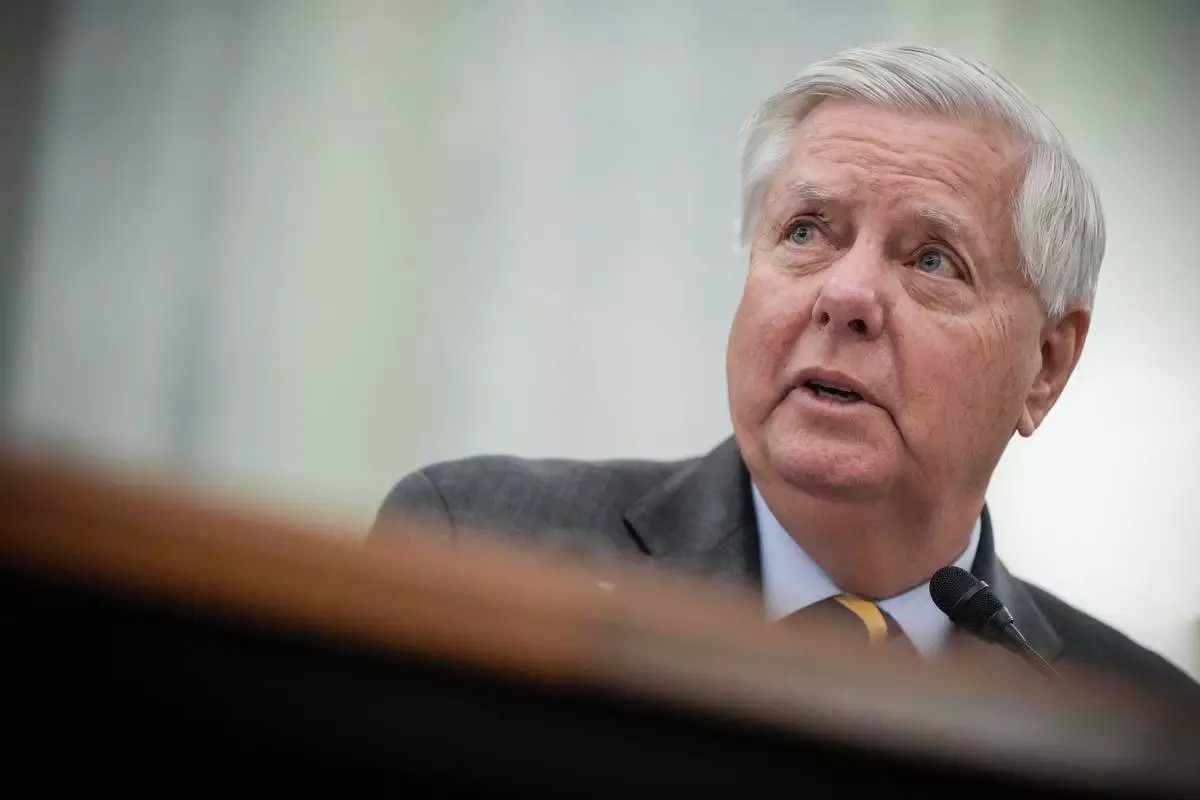
FILE - Sen. Lindsey Graham, R-S.C., introduces Adm. Kevin Lunday, acting commandant of the U.S. Coast Guard, during a Senate Commerce, Science and Transportation Committee hearing on the nomination Lunday for Commandant of the Coast Guard, Nov. 19, 2025, on Capitol Hill in Washington. (AP Photo/Julia Demaree Nikhinson, File)