Skip to Content Facebook Feature Image

China launches massive homegrown AI supercomputer cluster

China

China

China

China launches massive homegrown AI supercomputer cluster

2026-08-09 09:48 Last Updated At:14:07

China has officially launched its first fully homegrown 100,000-card artificial intelligence (AI) supercluster, marking a major leap in national computing infrastructure, according to the National Development and Reform Commission (NDRC).

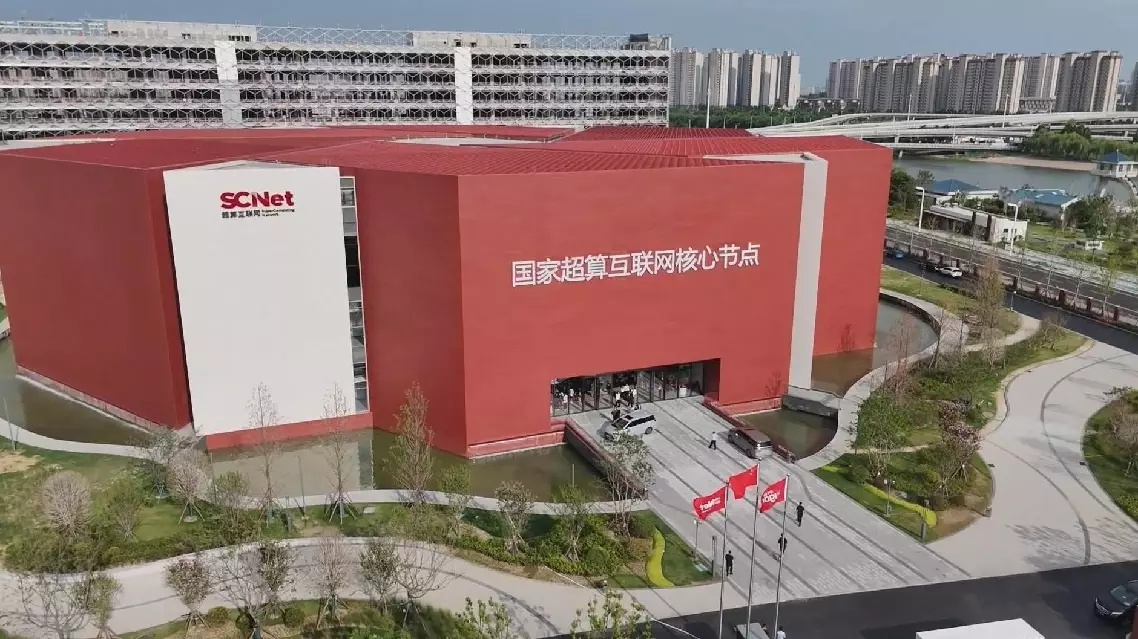
The system, known as the Dawning 8000 (Dengfeng), links to the Zhengzhou core node of the national supercomputing internet and combines scientific and intelligent computing power to meet emerging demands such as advanced materials, drug development, and AI model training.

The national supercomputing internet is a nationwide computing network which now aggregates over 3.5 million CPU cores and 250,000 GPU cards, serving more than 1.4 million registered users with over 7,300 applications, 1,500 adapted large language models and over 11.3 million visits per month on average.

Combining scientific computing and intelligent computing, the cluster represents a forward-looking deployment for potential new computing needs in the future.

"The new computing cluster delivers peak performance equal to humanity computing nonstop for 200 years. It now supports more than 300 tasks across 26 fields, including new materials, drug innovation, and artificial intelligence," said Bu Jingde, chief engineer of high-end computing at the National High-Performance Computer Engineering Technology Research Center.

China has designated eight national computing power hub nodes and plans to build 10 data center clusters under its East–West Computing Resources Transmission Project, or East Data, West Computing.

Alongside Zhengzhou, several other nodes are also undergoing a new round of capacity expansion.

The national computing power hub node in the Guangdong-Hong Kong-Macao Greater Bay Area has put a new domestically produced 10,000-card cluster into use to meet the intelligent computing needs for next-generation large language model development.

"Domestic large models are moving from hundreds of billions of parameters to trillions of parameters. Our new intelligent computing cluster can cut the training time for trillion-parameter large models from one year to around six months, while also providing full-chain checking and testing environments for large models," said Liu Zhijun, head of the planning and construction of China Telecom's Guangdong-Hong Kong-Macao Greater Bay Area Integrated Data Center.
China launches massive homegrown AI supercomputer cluster

China launches massive homegrown AI supercomputer cluster

The box‑office sensation "Dear You" is not only winning hearts worldwide — it's also fueling a tourism boom in the Chaoshan region of Guangdong, with searches and bookings for filming locations skyrocketing and international visitors, especially from Southeast Asia, making the journey home.

The film, known as "Love Letters to Grandma" in Chinese, was shot entirely in the Chaoshan, or Teochew, dialect. It centers on "qiaopi", a unique form of correspondence that combined letters and remittances sent home by earlier generations of overseas Chinese in the 19th and 20th centuries.

Set against the distinct backdrop of Teochew Chinese culture, the narrative highlights the historic diaspora experience, capturing universal themes of displacement, nostalgia, and memories passed down through generations.

Since its initial April 30 release in the Chinese mainland, the low-budget drama has grossed over 2.1 billion yuan (about 310 million U.S. dollars) at the global box office.

Hou Yinan, an overseas Chinese from Spain, watched the film during her summer visit to China. She was deeply touched by the heartfelt stories behind those old overseas Chinese letters.

"Before I saw this movie, I thought of 'qiaopi' as nothing more than museum pieces. But the letters in the film — each one of them — told a story of a relationship that lasted almost 50 years," said Hou.

Hou's trip didn't end at the cinema. She made her way to Longhu Ancient Village in Chaozhou's Chao'an District, where scenes of a Thai Teochew association hall and ancestral temple were filmed. And she wasn't alone.

"I felt like I'd traveled through time. The movie showed us all these old Teochew homes and traditions, and how the Chinese who left here spread across the globe. And now here we are, coming back from everywhere to this very place — it's a homecoming, a roots trip," said Hou.

The small park in Shantou, which served as the backdrop for the film's scenes of early emigrants heading south, is now packed with tourists strolling among its century‑old arcades.

Local shops are cashing in on the film's popularity with movie‑themed offers. Among the visitors was Yu Shiyang, who had traveled all the way from Canada with her family to explore the filming site.

"A few days ago we went to see that bridge from the movie, checked out the 'qiaopi' museum, and caught a Yingge dance performance. The kids were all really into it," said Yu.

At Shantou's old post office, children were busy writing and sending letters to friends abroad.

"This one's for Jaden and this one's for Albert. They live in Canada," said Yu Jiaqi.

"I want them to be happy," added Zhang Jiaying.

"I want our traditions to live on in them. I don't want them to lose it just because they grow up abroad," said Yu.

The growing fusion of film and tourism is putting overseas Chinese hometowns on the map.

Xu Zihui, a local guide, said he has so far hosted 10 groups of overseas Chinese travelers — around 50 to 60 people in total.

"Thanks to the film, places that were off the radar are suddenly packed with tourists. I'm getting tons of requests — families, groups of friends, and we already have over a hundred people lined up for next month," said Xu.

The film has given a major boost to tourism in the Chaoshan region. Online searches for Shantou, Chaozhou, and Jieyang have stayed strong since the movie hit theaters, and bookings for the Chen Cihong Former Residence, a key filming site, have jumped 1.2 times year on year.

Overseas visitors to Shantou — particularly from Malaysia, Singapore, and Thailand — have risen sharply, with flight bookings from Malaysia climbing 67 percent.

Movie sparks homecoming tourism boom among overseas Chinese

Movie sparks homecoming tourism boom among overseas Chinese

Recommended Articles