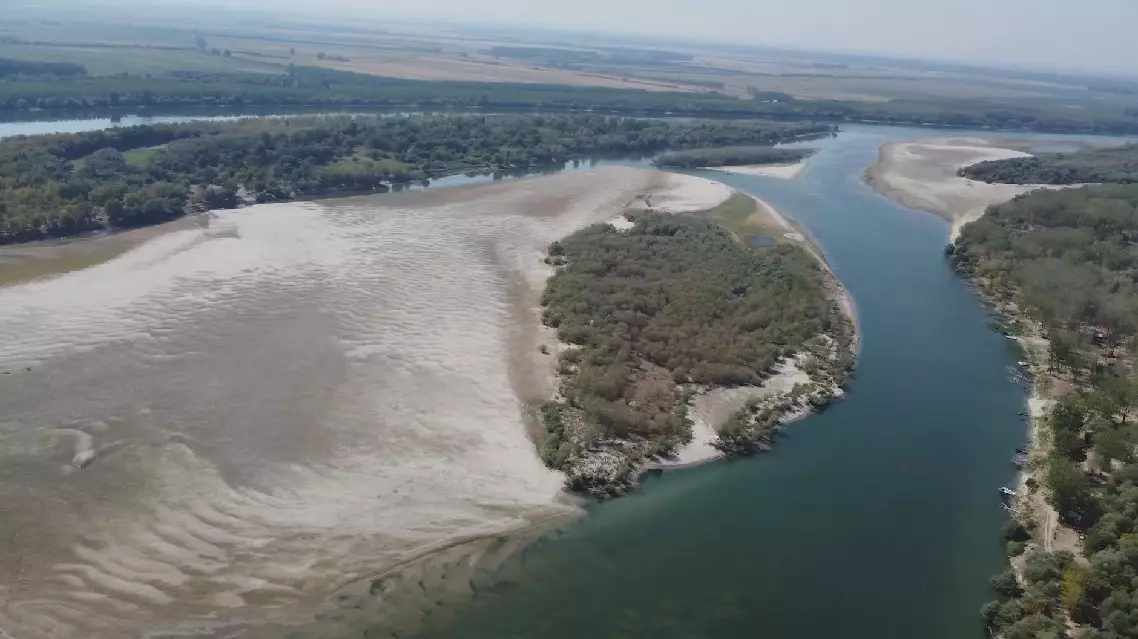
The Danube River has recently dropped to its record-low water level at the Serbian entry point of Bezdan, falling 20 centimeters below the historical low in 1909.
It is triggered by an intense, multi-week heatwave and the severe summer drought, threatening local shipping, power generation, and river ecosystems, with some areas declaring a state of emergency. The Danube River has served as a vital artery for Serbia's refined oil imports, but low water level has forced barges to slash cargo loads, reducing oil transport volume to just 25 percent of normal levels and straining local energy supplies.
"We are already facing actual problems. Right now, ships cannot sail fully loaded and are forced to reduce cargo. If the water level continues to drop, it could trigger a bigger crisis in the future," said Dragan, a local resident.
The reduced flow has also affected Serbia's largest hydro station Iron Gate, which normally accounts for about 20 percent of the country's total electricity generated. The station's output has fallen to roughly 40 percent of normal capacity as the heatwave pushes domestic power demand to winter-peak levels.
The Serbian government has convened an emergency meeting, urging businesses, public institutions, and citizens to use electricity rationally.
Experts note that the Danube River typically reaches its annual minimum in August, but forecasts show no significant rainfall expected across Serbia or upstream countries throughout the month, suggesting the crisis will deepen further.
Danube River in Serbia drops to record-low water level, crippling energy grid, river transport
Technology-focused tourism is emerging as a new driver of international tourism in China, injecting new momentum into the country's summer travel boom.
In Beijing, a popular robotics exhibition gives visitors an up-close look at cutting-edge technologies and how they are increasingly being integrated into everyday life.
"I find it very fun. I think it's an amazing thing that China has developed such incredible technology. We in Mexico don't have this many robots, so I think it changed my perspective on how technology can probably change the world in the future," said Juan Pablo, a teenage boy from Mexico.
"The advance of humanity in robotics and robots -- it's incredible and super futuristic," said Ana Paula, a teenage girl from Mexico.
Some visitors are stepping inside production facilities to see first-hand how technology is reshaping modern manufacturing.
At Xiaomi's electric vehicle factory in Beijing E-Town, visitors can watch hundreds of robots carry out precision tasks along the production line.
"They can see a lot of interesting things that maybe they wouldn't be able to see back home in terms of the sophistication and probably more than anything, just the scale. I think the scale and the level of advancement would be pretty staggering," said Kyle Mullin, a Canadian living in Beijing.
"People want to understand more and more how things are made, and that allows us to get a better grasp of how the world we live in now is evolving," said Hugo Quitton, a French tourist.
The summer's travel surge was initially driven by China's expanded visa-free policies, advanced transportation network, and profound culture. Yet, word has spread quickly about opportunities to witness world-leading technologies up close.
As the inbound tourism trend evolves, travel agencies and tourism destinations in China are now offering customized tech tourism services.
"As 'China Travel' heats up during the summer holiday, we have seen increasing bookings on our online platform from individual travelers, international organizations, and international study tour groups," said Zhang Kejing, head of government affairs and public relations of the Beijing E-Town Robotics Technology Industry Development Corporation.

Tech tourism gains popularity among international travelers in China