Award-winning mathematician Shing-Tung Yau has thrown his weight behind China to host a future edition of the International Congress of Mathematicians (ICM), believing the recent successes of Chinese math whizzes points to a promising outlook for the years ahead.
Professor Yau became the first recipient of Chinese origin to land the prestigious Fields Medal, often referred to as "the Nobel Prize of Mathematics," when he scooped the award back in 1982.
Alongside a fulfilling academic career, one of Yau's great legacies saw him launch the annual International Congress of Basic Science (ICBS), which was inaugurated in 2023, with this year's edition kicking off in Beijing this week.
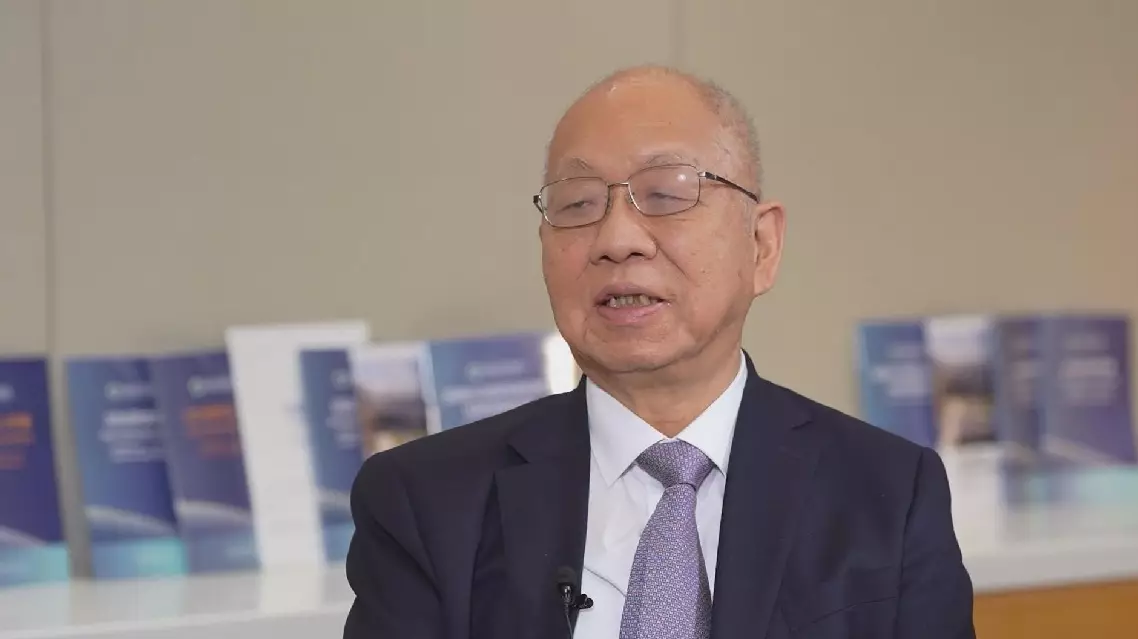
Speaking on the sidelines of the two-week event, Yau , who is also director of Yau Mathematical Sciences Center at the Tsinghua University in Beijing, shared his optimism about the future of the Chinese math scene, although Hong Kong lost out to Glasgow in the battle for the hosting rights of the coveted 2030 ICM.
China last hosted the major Maths gathering back in 2002, and Yau said he is hopeful that either the Chinese capital or Hong Kong can be successful in its next bid for the quadrennial congress.
In an interview with the China Global Television Network (CGTN), Yau pointed to the recent achievements of young Chinese mathematicians Deng Yu and Wang Hong, who were honored with the Fields Medal at the 2026 ICM held in Philadelphia, USA, last month. Notably, Wang became only the third woman to receive the prestigious Field Medal since the prize was first established 90 years ago.
Yau believes this double success will help ignite public enthusiasm for basic research and signals that China is well on its way to becoming a world mathematical powerhouse as more young talents emerge.
"I believe because the momentum given by Hong Wang and also Yu Deng, I think we [can] build on this momentum and I think many young students who are now close to finishing their PhD in China by the year 2030, they would be mature enough. And by that time we can [tell very] well how many homegrown mathematicians from China are doing well. By that time, it may be ideal for us that they will get a Fields Medals in 2034 because they have a few more years to let their results known to the whole world. So, we hope for the best," he said.
Born in south China's Guangdong Province in 1949, Yau was inspired to become a mathematician in his youth. After completing his junior year at the Chinese University of Hong Kong, Yau left for the PhD program in mathematics at the University of California, Berkeley, where he studied under the supervision of world-renowned overseas Chinese mathematician Shiing-Shen Chern, obtaining his doctorate in just two years.
Yau went on to tackle the highly-complex theory of the Calabi conjecture, which had been posed by the Italian-born mathematician Eugenio Calabi in 1954 and concerned the idea of being able to reshape a multi-dimensional curved space. His bold work pioneered the field of "geometric analysis" and, despite some setbacks along the way, he finally made a historic breakthrough and was awarded the Fields Medal at the age of 33.
History-making Fields medalist backs China's future ICM bid, foresees rise in homegrown talent