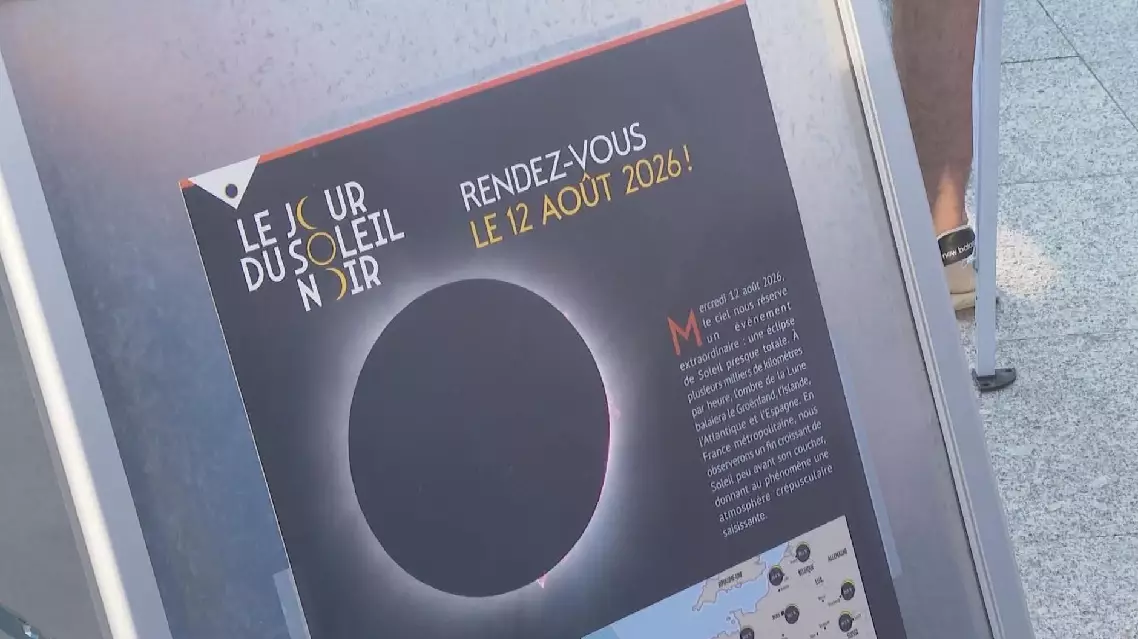
A rare solar eclipse swept through Europe from Wednesday evening to Thursday morning, drawing millions to prime viewing locations to witness the spectacular celestial show.
It marked the first total solar eclipse visible from mainland Europe in over two decades. Parts of Greenland, Iceland, Spain and Portugal experienced the complete darkness and spectacle of a total eclipse, while those watching the astronomical phenomenon from countries such as France were treated to a partial eclipse.
In Paris, large crowds turned out Wednesday with specialist glasses to view the highly-anticipated celestial event despite the sweltering summer heat. They gathered at the Parc Andre-Citroen, a public park located on the left bank of the Seine River, where the sprawling lawns and open spaces offered an unobstructed view of the sky.
At 19:22 local time, the first subtle notch appeared on the Sun's lower rim. Within minutes, the silhouette of the Eiffel Tower and the Parisian skyline were framed against a shrinking crescent of gold, creating a surreal cityscape that amazed the skygazers.
By 20:17, the eclipse reached its peak in the sky, with the Moon covering about 92 percent of the solar surface. Though the French capital is located outside the path of totality and the sky never plunged into full darkness, the widespread obscuration of the Sun cast a palpable dimness over the early evening hours.
The spectacle took the breath away from locals and tourists alike.
"I came specifically to see the eclipse. I'm fascinated - it's giving me goosebumps. I'm here with friends, and watching the eclipse makes me so happy," said Agnieszka, a Polish tourist.
"It's amazing. It's a beautiful moment. It's the best moment for the family and friends. You can enjoy, take something to drink and snacks. And it's a perfect moment," said Paris resident Jeremy.
A solar eclipse happens when the Moon passes between the Sun and Earth, blocking some or all of the Sun's light and casting a shadow on Earth.
Rare solar eclipse wows millions across Europe