ZUG, Switzerland--(BUSINESS WIRE)--Aug 13, 2026--
AMINA Bank AG ("AMINA"), a Swiss Financial Market Supervisory Authority (FINMA)-regulated crypto bank with global reach, today announced it has added trading and custody support for HYPE, the native token of the Hyperliquid blockchain, for its clients. As Hyperliquid has hyperscaled and more regulated entry points to HYPE emerge, institutional and professional investors holding the token increasingly require the custody standards of a licensed bank to manage it.
This press release features multimedia. View the full release here: https://www.businesswire.com/news/home/20260812902547/en/
Hyperliquid is a fully on-chain exchange for perpetual futures and spot trading, matching buyers and sellers directly on-chain at speeds comparable to centralised exchanges. Hyperliquid currently processes roughly 70% of all on-chain perpetual futures volume across decentralised platforms.
Hyperliquid's growing institutional profile reflects a wider embedding of crypto into traditional finance. In March 2026, S&P Dow Jones Indices licensed the S&P 500 index to TradeXYZ for a perpetual futures contract trading on Hyperliquid, the first licensed perpetual derivative contract based on the index. Regulated investment products built around HYPE have followed a similar trajectory: Bitwise launched a spot HYPE exchange-traded fund (BHYP) in the U.S. in May 2026, and has since added a Hyperliquid staking exchange-traded product on Deutsche Börse Xetra in Europe.
"Hyperliquid's ability to match trades atomically on-chain, at speeds comparable to centralized exchanges, closes the gap between the transparency of decentralised markets and the execution quality they're used to from traditional venues,” said Myles Harrison, Chief Product Officer, AMINA. “As the separation between traditional and digital finance continues to shrink, projects like Hyperliquid are pushing the boundaries in a meaningful way. Adding HYPE gives AMINA’s clients regulated access to one of the most active and in-demand venues in decentralised finance, with the custody standards they expect from a bank."
AMINA clients can now trade and custody HYPE with no volume caps or trading limits, alongside the security and governance clients expect from a traditional banking partner. Support covers HYPE on Hyperliquid's EVM-compatible environment (HyperEVM); staking and native HyperCore functionality are not included in this offering.
Disclaimer: This publication constitutes advertising and marketing material within the meaning of Art. 68 of the Swiss Financial Services Act (FinSA) and Art. 95 of the Swiss Financial Services Ordinance (FinSO). Where products are advertised, the relevant product documentation, if required or available, can be accessed on AMINA’s website or obtained free of charge upon request. Any additional information or documents made available for purposes other than marketing are subject to the specific terms and conditions applicable to such materials. All information and documents provided via this publication are for informational purposes only. AMINA Bank AG (“AMINA”) is a Swiss bank, authorized and regulated by the Swiss Financial Market Supervisory Authority (FINMA). AMINA is authorized and regulated in Switzerland. Products and services described in this publication may not be registered, approved, offered or available in all jurisdictions and may be subject to legal and regulatory restrictions. Nothing in this publication constitutes investment, legal, tax, or other professional advice. This publication does not constitute an offer, solicitation, recommendation or invitation to buy or sell any financial instrument, nor does it constitute financial advice, in any jurisdiction where such activity would be unlawful. Investments and financial instruments involve risks, including the possible loss of capital. Risks may include market, liquidity, currency, counterparty, operational and, where applicable, digital-asset or technology risks. Any investment decision should be made only after reviewing the relevant product documentation and obtaining independent advice where appropriate. AMINA’s products, services, information and materials contained within this publication may not be available, offered or distributed to residents of certain jurisdictions. Recipients are responsible for informing themselves about, and complying with, any applicable legal, regulatory or sales restrictions in their jurisdiction. Please consult AMINA’s terms and conditions or applicable sales restrictions relating to the products or services in question for further information.
About AMINA — Crypto. Banking. Simplified.
Founded in April 2018 and established in Zug (Switzerland), AMINA Bank AG is a pioneer in the crypto banking industry. In August 2019, AMINA Bank AG received the Swiss Banking and Securities Dealer License from the Swiss Financial Market Supervisory Authority (“FINMA”). In February 2022, AMINA Bank AG, Abu Dhabi Global Markets (“ADGM”) Branch received Financial Services Permission from the Financial Services Regulatory Authority (“FSRA”) of ADGM. In November 2023, AMINA (Hong Kong) Limited received its Type 1 (Dealing in Securities), Type 4 (Advising on Securities) and Type 9 (Asset Management) licenses from the Securities and Futures Commission (“SFC”). In October 2025, the firm’s Type 1 license was further approved for uplift to include digital asset dealing services for Professional Investors under Hong Kong’s digital asset regulatory framework. In October 2025, AMINA (Austria) AG (“AMINA EU”) received its CASP license from Austria’s Financial Market Authority (“FMA”) under the Markets in Crypto-Assets (MiCAR) framework.
CVVC Global Report and CB Insights named AMINA as one of the Top 50 Companies within the blockchain ecosystem. In 2025, AMINA won ‘Institutional Digital Asset Innovation of the Year’ at the Hedgeweek® Global Digital Assets Awards 2025. AMINA was most recently recognised as ‘Best Digital Challenger — Private Banks’ by FT Live’s PWM Wealth Tech Awards.
To learn more about AMINA, visit www.aminagroup.com

AMINA Adds Trading and Custody for HYPE as Hyperliquid’s Institutional Profile Gains Traction
HUNTINGTON BEACH, Calif. (AP) — Jake Hemann grabbed a board and headed out to surf. But an hour later, he wound up sitting at the lifeguard station soaking his foot in a pail of hot water alongside four other beachgoers.
It is a common scene at Bolsa Chica State Beach and some other popular beaches in Southern California where the number of people being hit by the sharp, serrated caudal barbs found on the tails of stingrays has gone up significantly from a year ago as a marine heat wave draws more stingrays — and people — to shore.
Hemann, a 31-year-old tourist from New Mexico, said he was learning to surf when he hopped off his board and landed on what he thought was a sharp stick. “It hurt pretty bad,” he said, while sinking his throbbing foot into the hottest water tolerable to ease the pain. “It was radiating up to my ankle.”
Bolsa Chica and Huntington State Beaches reported more than 3,100 incidents so far this year, twice the number for all of 2025. The city of Huntington Beach's 3.5-mile (5.6-kilometer) stretch of shoreline has reported more than 2,000 such incidents so far this year, more than during all last year, while more than 900 stings were recorded on San Diego’s beaches during the first half of 2026, more than during the first six months of any of the past five years, lifeguard data shows.
“We’re definitely seeing an increase,” said Bryan R. Etnyre, state park superintendent in northern Orange County. “A lot of it is due to warming ocean temperatures that are consistently staying in the 60s. I don’t think there was a week all winter where we dropped below 60 this year.”
Round stingrays are found in Pacific Ocean waters from Panama to Southern California and are known to veer toward the shore when the swell is down and the water warm.
In recent years, many species that feed on rays, such as sharks, sea lions and giant sea bass, have seen their populations dwindle, causing the number of stingrays to grow, said Chris Lowe, a professor of marine biology and director of the Shark Lab at California State University, Long Beach.
Rays are known to prefer warmer water, such as lagoons. Females prefer these waters to reproduce, and during the summer male rays have a higher metabolism that drives them to seek out food in the invertebrates along the shore, Lowe said.
“They’re really a subtropical species that is thriving at the end of its range because of climate change,” Lowe said.
The ocean already has been warming because of human-caused climate change, according to meteorologists.
This year has seen even more rays with a marine heat wave persisting off parts of the West Coast, marking the third time on record that such a large section of coastal waters stayed warm for so long, according to the U.S. National Oceanic and Atmospheric Administration. In June, officials confirmed the formation of an El Niño, the natural warming of parts of the central Pacific that alters weather worldwide, that is expected to grow to historic strength.
Meanwhile, more people have been heading to beaches seeking outdoor recreation since the coronavirus pandemic. And when the water is warm, they are more likely to swim.
When rays are stepped on, they instinctively flick up their tails, stinging people with venomous barbs. Lifeguards urge bathers to shuffle their feet as they enter the water as the movement often gets rays to slide out of the way without stinging.
In Southern California, lifeguards can treat 10,000 stingray injuries a year, Lowe said.
In Seal Beach, one area draws so many due to an influx of warm water from a nearby power plant it is known as “ray bay,” though lifeguards there haven’t seen much change in stings this year.
Using a 75-foot-long net, researchers swept up some 200 stingrays, each about the size of a dinner plate, on a section of the beach on a recent morning.
“There can be so many that they actually carpet the bottom, like you can’t see sand,” Lowe said. “During El Niños, we get more of them up from the south, and they come closer to shore. So this year, we’re expecting record numbers.”
Lowe said he is working with television stations to develop a stingray advisory to help reduce the number of people who get stung, and the number of rays that get squished. Rays help keep the beach healthy by feeding on small clams and aerating sediment.
Many beaches use an app to notify bathers when there are multiple stings at a location. Meanwhile, a company has developed surf booties that claim to be barb-resistant — though swimmers are urged to still tread lightly to avoid trampling the rays.
At Bolsa Chica State Beach, swimmers suffering stings to the sides of their feet and toes sat in a circle refilling their pails with hot water from a hose. Some were there more than an hour waiting for the pain to ease.
Most stings don't require additional medical attention. If redness and swelling continue more than four or five days, there could be a medical complication such as an infection or a retained barb that can be seen on an X-ray, said Dr. Christanne Coffey, who researches the stings at University of California, San Diego Health.
Allen Lowry said he was playing with his 7-year-old grandson when he came down on something squishy. He lifted his foot and saw blood so his wife drove him to the lifeguard station for a hot water soak, which is the remedy for stings.
Lowry, 69, said he swims three times a week at another beach, and getting stung, though painful, won’t change that. He said some people in his swim group have been stung multiple times.
“Usually, once the pain you feel goes away, you feel fine the next day,” he said.
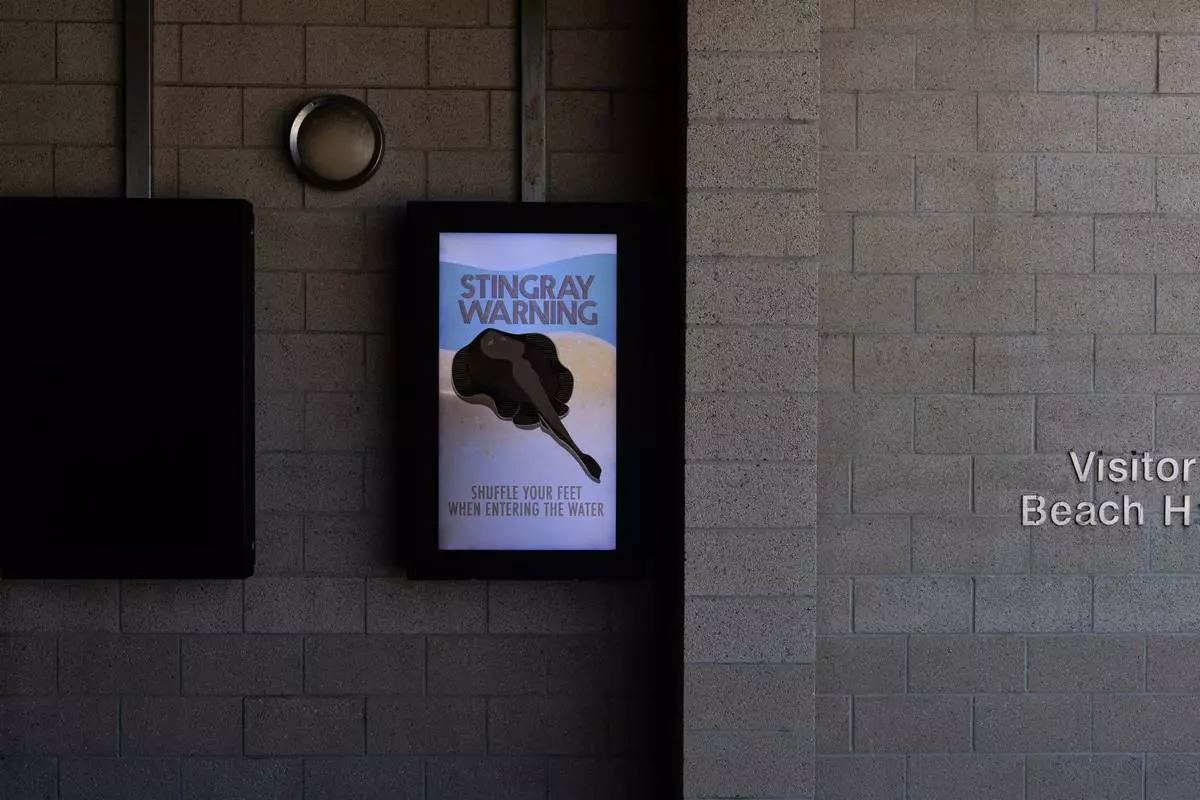
A stingray warning is displayed at Bolsa Chica State Beach in Huntington Beach, Calif., Friday, July 24, 2026. (AP Photo/Jae C. Hong)
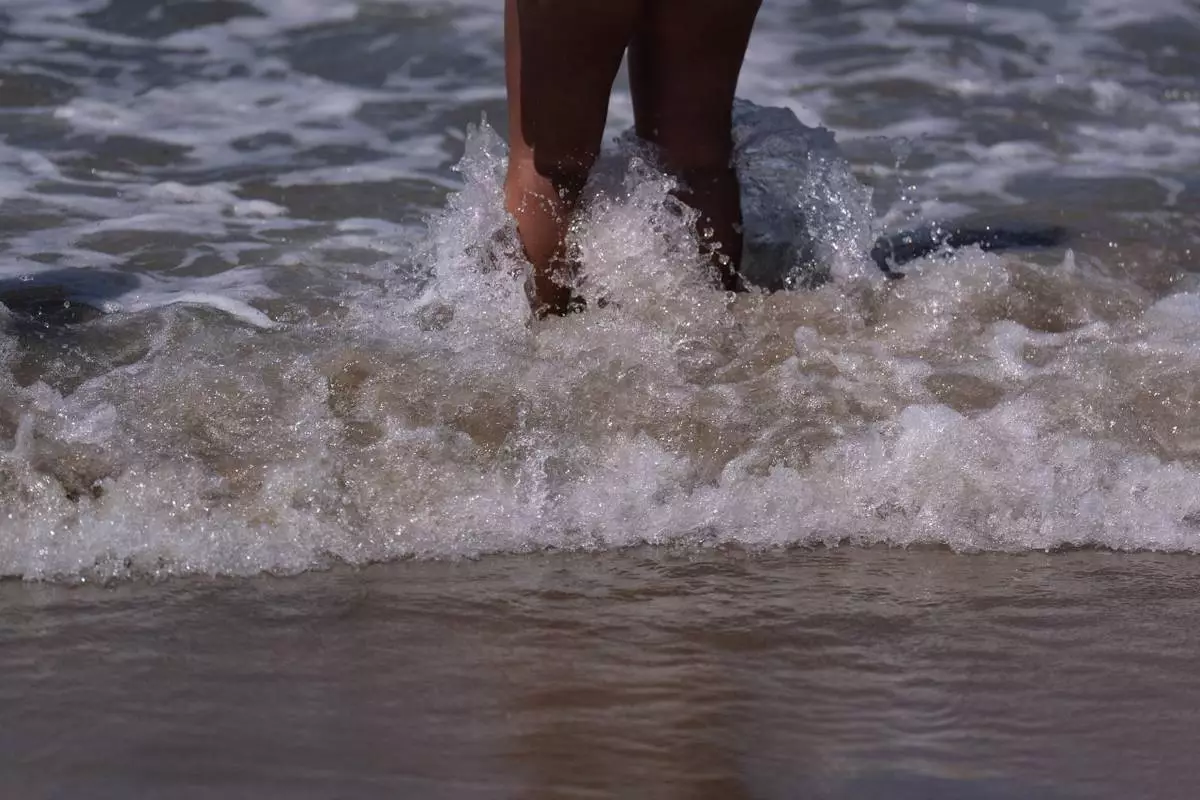
A beachgoer stands in shallow water at Bolsa Chica State Beach in Huntington Beach, Calif., Friday, July 24, 2026. (AP Photo/Jae C. Hong)
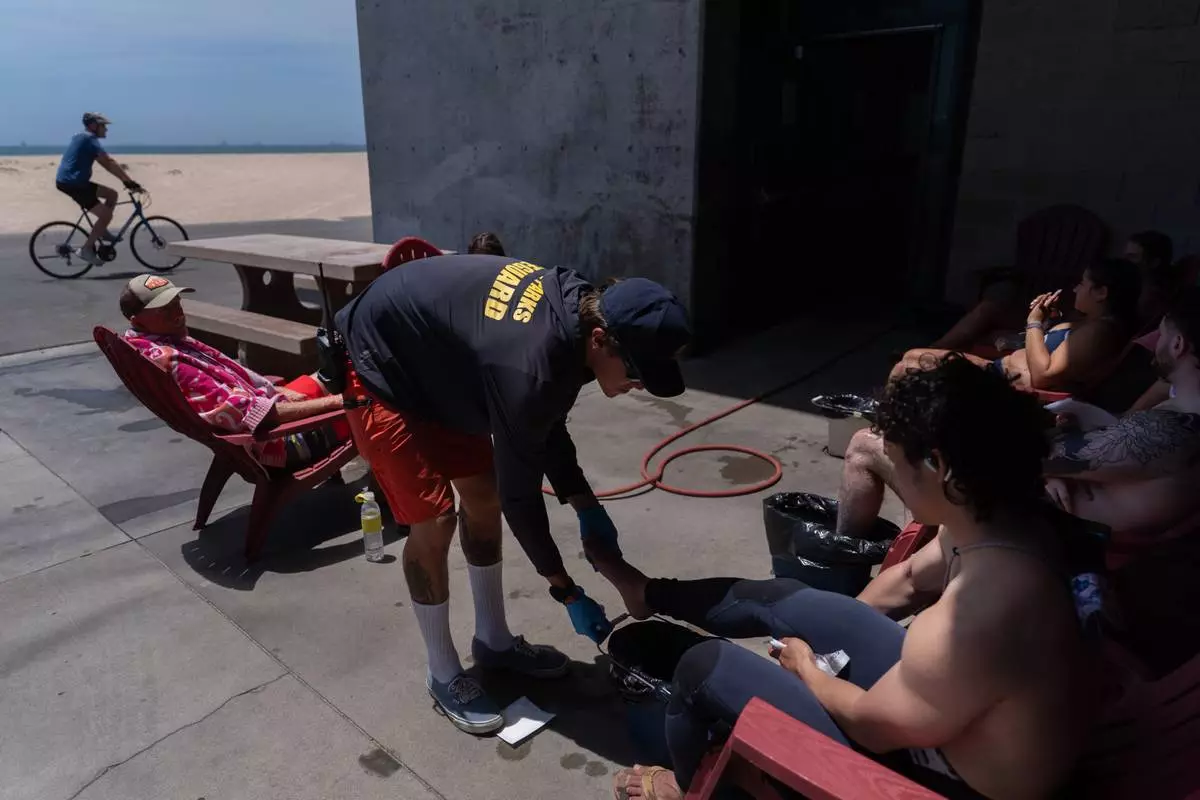
Lifeguard Max Voci, center, treats beachgoers for stingray stings at Bolsa Chica State Beach in Huntington Beach, Calif., Friday, July 24, 2026. (AP Photo/Jae C. Hong)
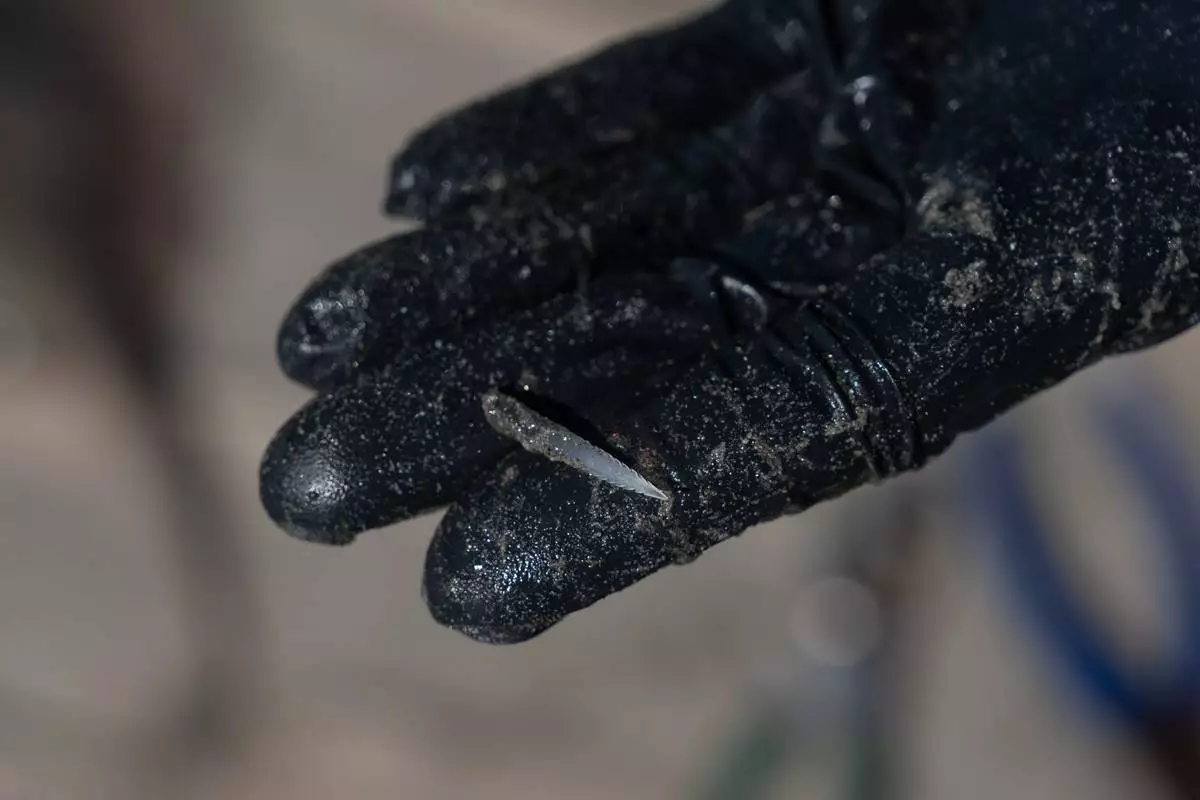
A researcher shows a barb clipped from a stingray in Seal Beach, Calif., Friday, Aug. 7, 2026. (AP Photo/Jae C. Hong)
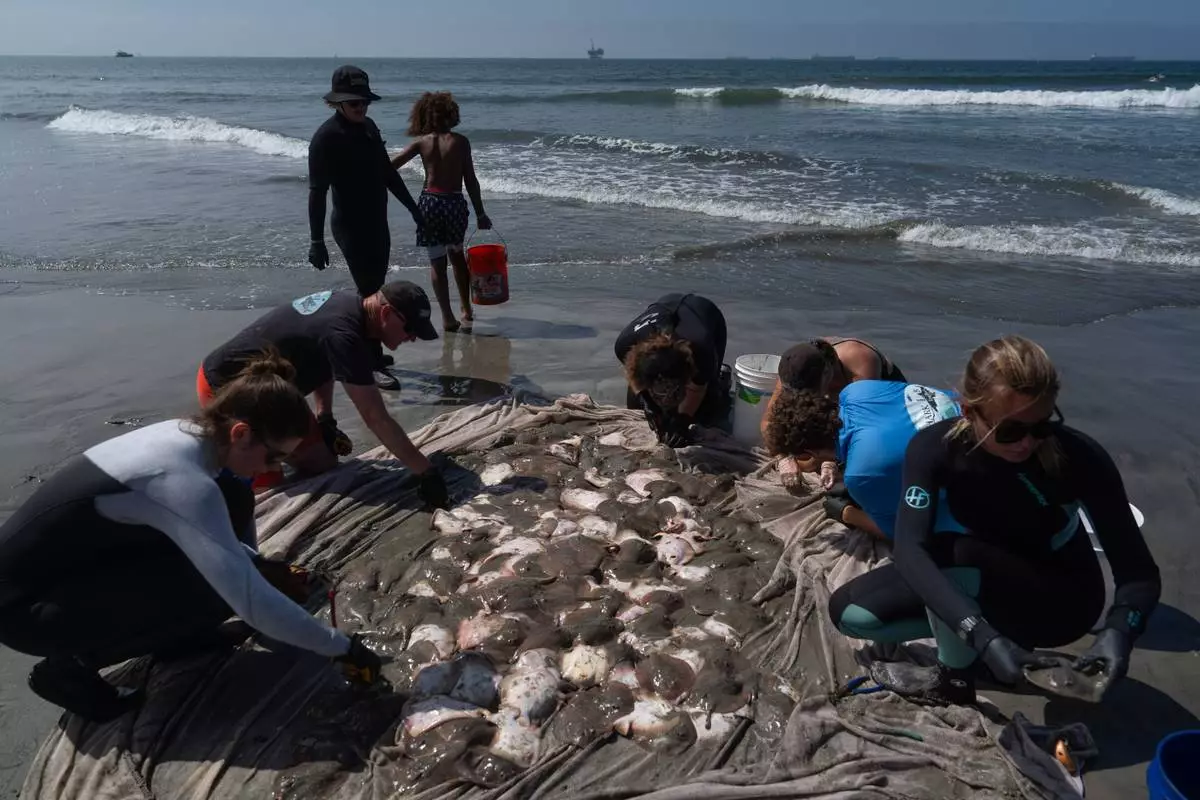
Researchers gather around a pile of stingrays to clip their barbs after catching them in Seal Beach, Calif., Friday, Aug. 7, 2026. (AP Photo/Jae C. Hong)