MOKHA, Yemen (AP) — Crew members of a Yemeni commercial ship who survived a deadly attack by Houthi rebels earlier this week said a second missile struck the vessel just as rescue efforts from the initial strike were underway, causing even more chaos and casualties.
In all, three ballistic missiles fired by the Iran-backed Houthis struck the ship in the Bab el-Mandeb Strait, just off Yemen’s coast, as it was coming into port, killing six people and injuring at least nine others, according to Yemeni authorities.
It was part of an escalating campaign by the Houthis and their first deadly attack this year on a vessel navigating the strait, which connects the Red Sea to the Gulf of Aden and accounts for roughly 12% of global trade.
“People were burning ... it was a strange scene of doomsday,” said Zaheer Ahmed, a Pakistani crew member recovering at a hospital in the port city of Mokha.
“I shouted for help and a Yemeni soldier came to my aid,” said Ahmed, who was injured in both legs.
All three of the crew members The Associated Press interviewed Wednesday at the hospital described intense fire, panic and damage aboard the ship, which was struck before dawn on Tuesday.
Muhammad Alteno, an Indonesian crew member, said he was in “complete shock” after witnessing another Indonesian crew member — a friend — die in the attack. Alteno said he had tried to rescue his friend, who was trapped inside the room they shared, after the first missile strike.
“But the flames were so intense that I couldn't breathe,” Alteno said. “I managed to escape with some of the (other) crew members.”
Two members of Yemen's government-allied National Resistance Forces were killed in the attack, as were three crew members from Pakistan.
The attack was one of many in recent weeks by the Houthis, who have killed government forces and civilians in an escalating campaign on the government-held city of Mokha and other areas, according to the Yemeni military. The rebel group has also intensified its attacks on troops and oil facilities in neighboring Saudi Arabia, which supports the Yemeni government.
The attacks risk reigniting Yemen’s civil war following a 2022 U.N.-brokered truce, and could open a new front in the Middle East war.
The Houthis declared a blockade several weeks ago on Saudi-linked ships leaving the Bab al-Mandeb strait in retaliation for a yearslong Saudi siege on Yemen and recent attacks on the Houthi-controlled capital, Sanaa. The Houthis had said they would only stop vessels connected to Saudi Arabia or going in and out of its Red Sea ports.
During a similar blockade it announced during the war in Gaza, the Houthis attacked over 100 vessels before a punishing U.S. and Israeli air campaign put an end to the attacks in early 2025.
Ezzidin reported from Cairo.

Pakistani crew member Muhammad Hamza receives medical treatment at 2 December Hospital in Mokha, Yemen, Wednesday, Aug. 12, 2026, after the cargo ship Tihama was struck in a Houthi attack in the Bab al-Mandab Strait off Yemen's Dhubab district on Aug. 10, 2026. (AP Photo/Abdulnasser Alseddik)

Pakistani crew member Zaheer Ahmed, right, receives medical treatment at 2 December Hospital in Mokha, Yemen, Wednesday, Aug. 12, 2026, after the cargo ship Tihama was struck in a Houthi attack in the Bab al-Mandab Strait off Yemen's Dhubab district on Aug. 10, 2026. (AP Photo/Abdulnasser Alseddik)

Indonesian crew member Muhammad Al Taindo , right, receives medical treatment at 2 December Hospital in Mokha, Yemen, Wednesday, Aug. 12, 2026, after the cargo ship Tihama was struck in a Houthi attack in the Bab al-Mandab Strait off Yemen's Dhubab district on Aug. 10, 2026. (AP Photo/Abdulnasser Alseddik)
Oklahoma put a man to death Thursday for killing his girlfriend in 2005 in the first of three executions scheduled for the same day in the U.S.
In the other executions, a Tennessee man faces death for killing a motel maid and an Alabama man will be executed after dropping all his appeals in the killing of a 5-year-old girl he paid her mother to abuse.
Eleven states carried out executions in 2025 in the U.S. If the Tennessee and Alabama deaths take place, six states will have had executions in 2026.
The last time three executions were held on the same day was Jan. 7, 2010, when Louisiana, Ohio and Texas put inmates to death. Three executions were scheduled on the same day in 2018, but only one went forward after a Texas man was granted a reprieve and prison officials in Alabama had problems with the IV line.
Florida executed two men on the same day in July and has put 31 prisoners to death since the start of 2025.
Tennessee plans to execute Anthony Darrell Hines for the 1985 murder of Catherine Jean Jenkins.
Hines stabbed Jenkins to death while the 54-year-old was working as a motel maid in Kingston Springs. He was sentenced to death in 1986, won an appeal for a new sentencing hearing and was again sentenced to death in 1989.
Hines' execution date comes just three months after the attempted lethal injection of another man was called off because of a problem inserting an IV.
Hines, 66, appealed unsuccessfully to the governor and the courts, saying that the doctor who oversaw the May execution was unqualified and likely to botch his execution as well. He said his thinness and muscular atrophy after two strokes mean he could face problems with an IV as well.
During the attempted execution of Tony Carruthers, the IV team established a primary line right away but then worked for more than an hour trying to insert a backup line. Carruthers' lawyer witnessed the attempts and said the team tried to insert an IV in Carruthers’ arm, hand and foot before attempting to insert a central line.
In the end, Gov. Bill Lee called off the execution and gave Carruthers a one-year reprieve.
The state has declined to say whether the same doctor will preside over Hines’ execution. Regardless, the Tennessee Supreme Court ruled Hines had not proven the doctor was unqualified and suggested the problems were an isolated mishap.
Alabama is scheduled to execute Jeremy Williams by lethal injection for the 2021 rape and murder of a 5-year-old Georgia girl.
Williams, who pleaded guilty to killing Kamarie Holland, declined to appeal and asked for his death sentence to be carried out.
Williams, 42, raped and strangled Holland after offering her mother $2,500 for the child to perform a sex act, prosecutors said.
Williams filmed his attack on the girl and kept her body to continue to abuse, prosecutors said.
“To see on video what he did to this baby, what a grown man could do to a child, it’s shocking, it’s horrible, it’s disgusting,” Russell County District Attorney Richard Chancey said. “It’s just a level of evil.”
Williams also was a suspect in the 2005 death of his infant daughter in Alaska but charges were not filed until 2022.
Corey Holland, Kamarie’s father, said his daughter was an exuberant 5-year-old who loved princesses and made people laugh.
“She loved playing dress-up, all her little Halloween costumes and her princess stuff I got her. She liked anything girly,” Corey Holland said.
It will be Alabama’s first execution of the year if it goes forward. A nitrogen gas execution was halted in June after a federal judge ruled the method unconstitutional.
The girl's mother is serving a 20-year prison sentence after pleading guilty to sex trafficking.
Carlos Cuesta-Rodriguez, 70, died by lethal injection at 10:13 a.m CDT at the state’s penitentiary in rural McAlester.
He was the third person put to death this year in Oklahoma and the 20th under Republican Gov. Kevin Stitt, who leaves office in January after eight years.
Convicted of fatally shooting his girlfriend at their Oklahoma City home in 2003, Cuesta-Rodriguez had said he regretted killing Olimpia Fisher and didn't ask a board for clemency.
Fisher, 43, planned to leave Cuesta-Rodriguez when he shot her in one eye and then waited about eight minutes as she screamed for help before firing the fatal shot into her other eye.
“He made her suffer because she dared to live beyond his control,” Oklahoma Attorney General Gentner Drummond told the state’s Pardon and Parole Board on July 14.
Last month, the board voted 3-1 against recommending clemency for Cuesta-Rodriguez. His attorneys had asked the board to recommend he serve life in prison, saying he had a difficult childhood in Cuba and suffered from brain damage, post-traumatic stress disorder and major depression with psychotic episodes.
Associated Press writer Jeffrey Collins contributed.

This Aug. 18, 2025, photo provided by the Oklahoma Department of Corrections shows Carlos Cuesta-Rodriguez, who was sentenced to death for the 2003 fatal shooting of his girlfriend. (Oklahoma Department of Corrections via AP)

This undated photo, courtesy of the Tennessee Department of Correction (TDOC), shows death row inmate Anthony Darrell Hines at an unknown location in Tennessee. (TDOC Communications via AP)
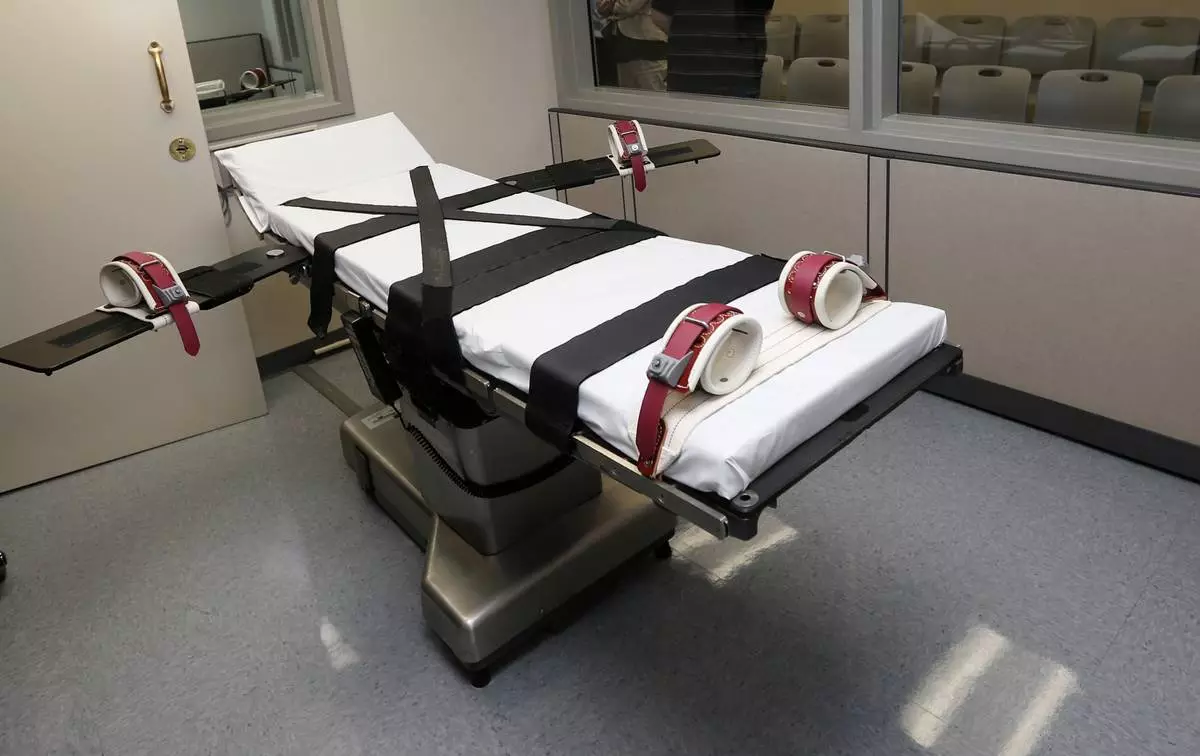
FILE - This Oct. 9, 2014, file photo shows the gurney in the execution chamber at the Oklahoma State Penitentiary in McAlester, Okla. (AP Photo/Sue Ogrocki, File)