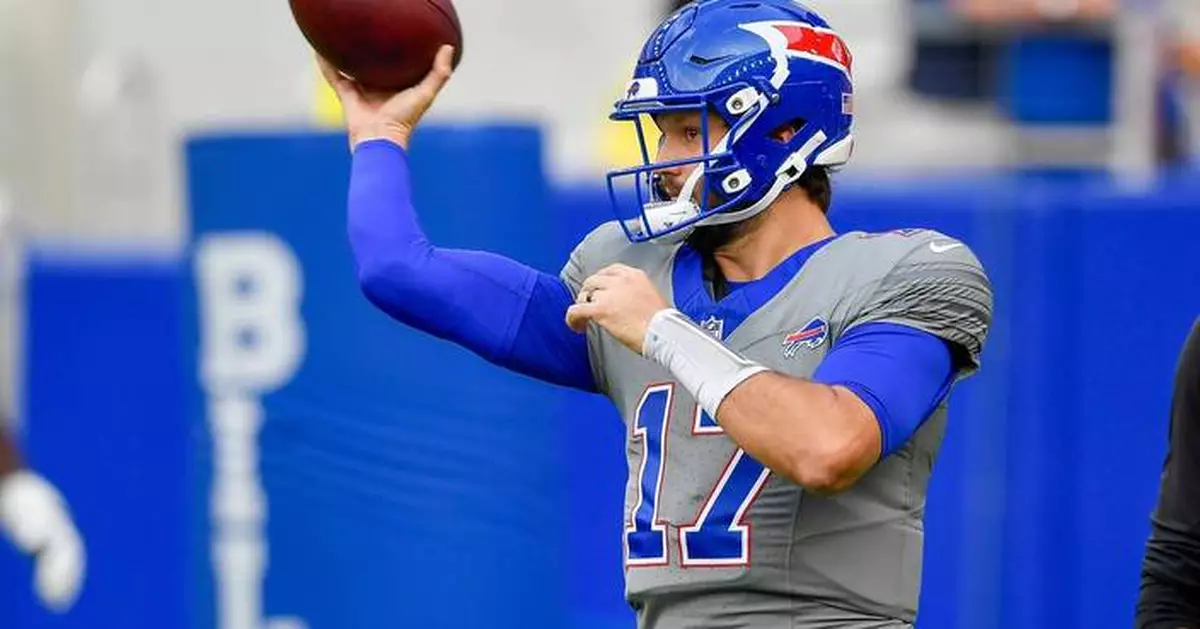
ORCHARD PARK, N.Y. (AP) — A new coaching staff and another chance to get accustomed to Buffalo's new stadium led to Bills coach Joe Brady’s decision to have Josh Allen and the rest of his healthy starters play in the team’s preseason opener against Carolina on Saturday.
“We obviously have a new everything,” Brady said Thursday. “So it’s our first opportunity for us to come together and show an example of what the Buffalo Bills are about. So I think that’s important.”
Brady is a first-year head coach, with Buffalo's former offensive coordinator promoted to take over after Sean McDermott’s firing in January. The game will provide Brady an opportunity to get a feel for his new role, and working with a staff that’s undergone numerous changes this offseason.
And the outing presents the Bills a chance to get more accustomed to their new $2.1 billion home in a game situation. The game comes a week after the Bills held their first practice in Highmark Stadium, built across the street from their former home.
For Allen, the preseason appearance will become his first in two years. The ninth-year player was held out of all three of Buffalo’s preseason games last year, and hasn’t made an appearance since playing the first quarter of the Bills preseason opener against Chicago on Aug. 10, 2024.
“New environment. New routine,” said Allen, who has previously been in favor of playing preseason games.
“We want to make sure this is real game-like as possible because it is a real game,” he added, looking ahead to Buffalo's regular-season opener against Detroit on Sept. 17. “To have those reps before the first game when we have it here on Thursday night, just understanding the process behind everything and not being surprised by anything new.”
Among the items on Allen's checklist include getting accustomed to the field — the Bills have made the switch to natural grass from artificial turf. There's getting familiar with where the game clocks are situated, and also adjusting to the lights, which are now located below the roof canopy as opposed to being on top of towers overlooking the old field.
Brady said a final determination on who plays and how much will be made following practice.
First-year defensive coordinator Jim Leonhard had previously announced having his starters play on Saturday. Buffalo’s defense has undergone the most changes this offseason, with Leonhard introducing a 3-4 system and the unit expected to feature at least five new starters.
Several injured starters are not expected to play, including center Connor McGovern, safeties C.J. Gardner-Johnson and Cole Bishop and cornerback Maxwell Hairston. The four players have missed at least several days of practice, though Brady has not revealed their injuries or a timeline for their returns.
After traveling to Cleveland next week for a joint scrimmage followed by a preseason game on Aug. 22, the Bills will close their schedule by hosting Pittsburgh on Aug. 27.
See AP’s full NFL coverage here

Buffalo Bills quarterback Josh Allen (17) plays catch with fans during practice at the team's NFL football training camp Saturday, Aug. 8, 2026, in Orchard Park, N.Y. (AP Photo/Adrian Kraus)

Buffalo Bills quarterback Josh Allen (17) walks on the field during practice at the team's NFL football training camp Saturday, Aug. 8, 2026, in Orchard Park, N.Y. (AP Photo/Adrian Kraus)

Buffalo Bills quarterback Josh Allen looks to throw during practice at the team's NFL football training camp Saturday, Aug. 8, 2026, in Orchard Park, N.Y. (AP Photo/Adrian Kraus)
RICHMOND, Va. (AP) — Flock Safety, the surveillance technology company increasingly under scrutiny from lawmakers from both parties, civil liberties advocates and citizens across the U.S., announced Thursday that it is making changes to its platform intended to quell privacy concerns and address documented abuses of its system by some members of law enforcement.
The company operates a vast nationwide network of automated cameras that record the license plate numbers and other characteristics of all passing vehicles every day. Thousands of law enforcement agencies in 49 states can search and share Flock's data across jurisdictions to aid their investigations.
Police have credited the technology as an important crime-fighting innovation that has helped locate missing people and track suspects in violent crimes. But some critics say its pervasiveness amounts to unconstitutional warrantless mass surveillance. Dozens of cities and agencies have nixed their relationships with Flock amid concerns that the data can be accessed for immigration enforcement or used in unauthorized tracking, after a flurry of examples surfaced of law enforcement officers misusing the technology for personal searches.
In an interview, Flock CEO Garrett Langley said many of the product changes will make what were once optional guardrails mandatory for its users to implement by Jan. 1.
Among them: All law enforcement customers will have to implement an audit tool that's intended to flag abnormal search behavior. When the system detects abnormal behavior, the user would be locked out pending an internal review, the company said in a description of the changes provided ahead of Thursday's announcement.
Flock, which says its customers own the data that the cameras record, is also shortening the standard data retention window from 30 days to seven. It said it will allow data to be preserved for longer when it is evidence tied to a case number.
Law enforcement users will now also be required to enter a code from their records management system tying each search to a specific case before it is run, something Langley said civil liberties advocates have long been calling for. Overrides for emergencies would be automatically flagged for review, the company said.
Customers will also be allowed to decide which offense types — such as homicide or arson — outside agencies can search their data for, which would allow a customer to block outside searches related to immigration enforcement, the company said.
Langley said that change will give individual cities and departments control to use the system in a manner “consistent with community values.”
Critics of the company reacted skeptically to the changes, which they said appeared designed to address the growing bipartisan anger about the cameras but could still leave room for police to abuse the system.
The American Civil Liberties Union said in a blog post that the shortened evidence retention window could be “a step in the right direction,” but it characterized the other changes as “retreads” of inadequate safety measures.
Robert Frommer, a senior attorney at the Institute for Justice, a public interest law firm that's led closely watched litigation over the technology, called the changes “window dressing” from a company in “panic mode."
“This is window dressing that doesn’t address the fundamental problem, which is that police officers are the ones deciding who and when to search, and that should be done by judges with real warrants,” he said.
Andrew Guthrie Ferguson, a professor at the George Washington University Law School whose scholarship has focused on policing, big data surveillance and the Fourth Amendment, said Thursday’s shifts were “better than the opposite” but called for further scrutiny of the technology in the form of “sustained democratic engagement with the rules and judicial checks on access at a minimum.”
Ferguson said he’s been surprised to see the “growing community backlash” against Flock specifically, given that the technology isn't new and other companies sell it as well. But Flock and the movement against it have “captured people’s sense that maybe they don’t want to be surveilled all the time,” he said.
More than 50 agencies or jurisdictions have canceled, suspended or rejected a contract or deactivated their cameras since the beginning of the year, according to a tracker maintained by DeFlock, a grassroots group formed to track the use of license plate reader technology and push back against it. Cameras around the country have also been vandalized.
In Congress, Republican representatives filed at least two bills aiming to restrict the use of the technology in July.
Ian Adams, an associate professor of criminology at the University of South Carolina currently working on a Flock-related research study, said many of the concerns raised about how the company's data can be used are not new concerns in law enforcement.
“Anyone with policing experience could have reasonably foreseen that what have been termed as ‘curiosity searches’ by officers, searches for private reasons not related to police work, were going to be a problem this technology faced,” he added, noting that other technologies and platforms like the FBI’s Criminal Justice Information had faced those issues.
Law enforcement experts said it's a common tension of “policing in a democracy” — balancing useful technology that officers say helps solve and prevent crime with the community's interest and right to privacy.
“It's a balancing act. A community has a legitimate interest in how information is used, but it also has a legitimate interest in the effectiveness of a police department in preventing crime,” said Chuck Wexler, executive director of the Police Executive Research Forum, a Washington-based nonpartisan think tank. “I think a balance can be struck, but it's more likely to come from department policy than company changes.”
Flock, based in Atlanta, Georgia, often posts to its website what the company deems to be everyday examples of success stories for its cameras, including finding missing seniors and catching car thieves. But the tech has also been used in high-profile cases that have garnered national attention, such as the search for a suspect in a fatal shooting at Brown University and in tracking and arresting a former North Carolina police officer who authorities say had made threats that he planned to carry out a mass shooting at a festival in Louisiana.
Abuses have also drawn widespread attention. The Washington Post reported earlier this month finding nearly 50 instances of police officers charged or accused of using the cameras for unauthorized purposes, many for tracking current or former romantic partners or family members.
Just this week, six employees — including four officers — of the Savannah Police Department in Georgia were fired after they were accused of searching for friends and family using the tool and allowing an officer from an outside agency to use the city’s cameras.
The Savannah department said it was made aware of the misuse through Flock’s voluntary audit function.
Lauer reported from Philadelphia.
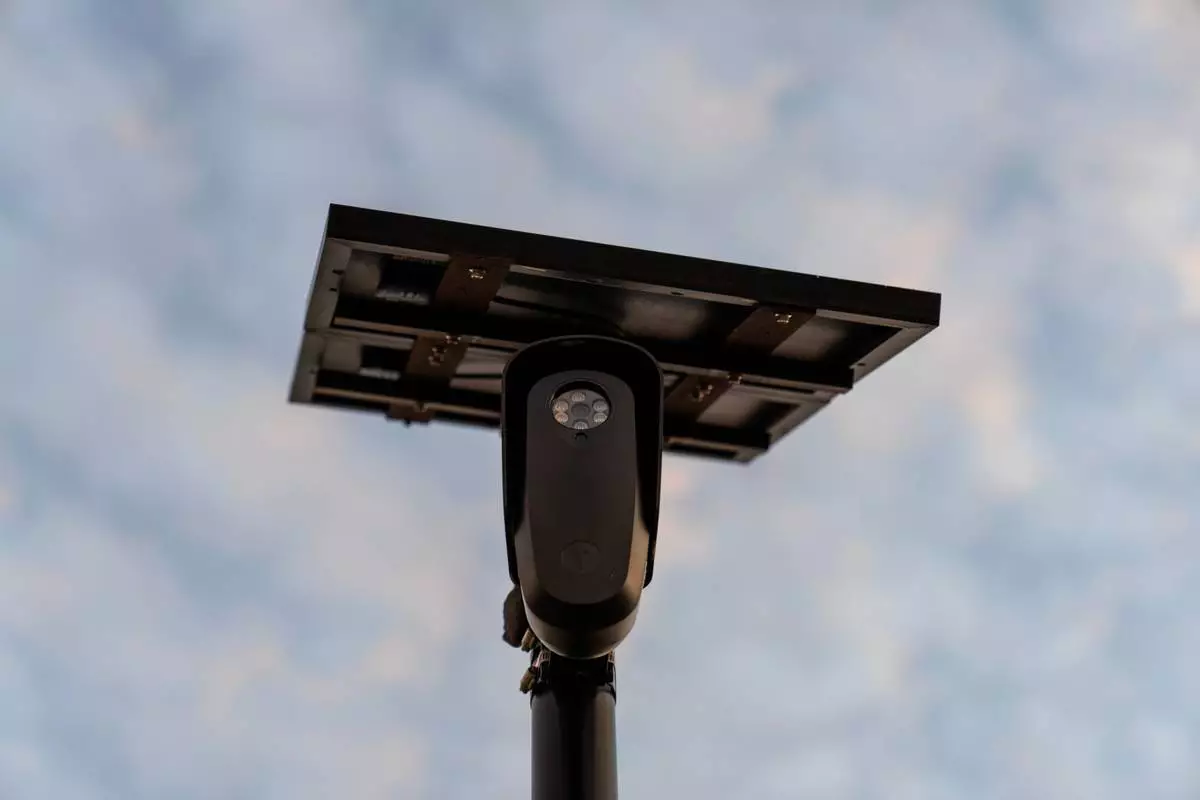
FILE - A Flock Safety license plate reader is seen along a public road, Thursday, Oct. 16, 2025, in Houston. (AP Photo/David Goldman, File)

FILE - A Flock Safety license plate reader is seen along a public road, Thursday, Oct. 16, 2025, in Houston. (AP Photo/David Goldman, File)