China has succeeded in artificial breeding in Sanya City, south China's Hainan Province of 12 young common shovelnose rays, a critically endangered species on the International Union for Conservation of Nature (IUCN) Red List.
The baby rays were born on July 31.
"The shovelnose rays measured about 34 to 35 centimeters in length each when they were just born, and now they have grown significantly. Each baby ray can eat six to seven slices of shrimp every day. They use the transparent cartilage at the front end to explore food, then suck the food at the bottom into the mouth, and then swallow it. Every day after feeding, we would clear away the leftover, aiming to prevent it from polluting the water," said Zhang Jiayang, chief of the aquarium.
The common shovelnose ray is an important benthic cartilaginous fish in the tropical and subtropical coastal waters of the Indian Ocean and the Western Pacific Ocean, playing a significant role in maintaining the balance of marine ecosystem.
Their breeding is extremely difficult, as they are highly sensitive to disturbances such as water quality, water temperature and the environment, and slight external stimulus may also cause their miscarriage.
"They live in shallow sea waters with a depth of 100 meters or so, and require water with high quality. Their reproductive cycle is very long, as it often takes them eight to 10 years to reach sexual maturity. Only with a highly suitable environment can they reproduce smoothly," said Zhang Jie, associate research fellow with the Institute of Zoology under the Chinese Academy of Sciences.
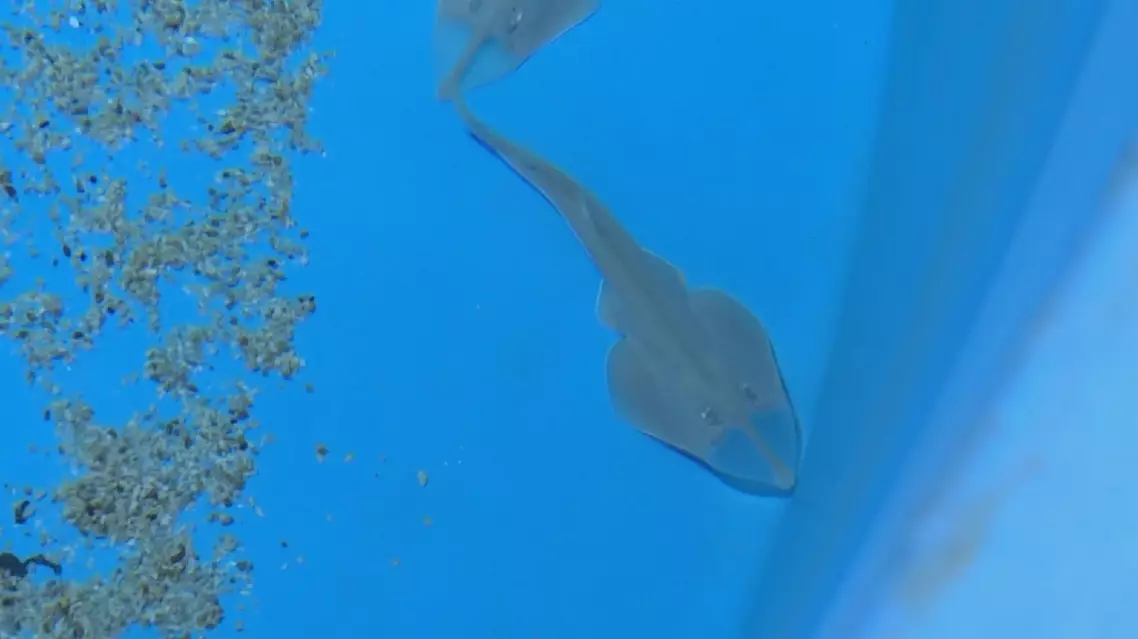
China succeeds in artificial breeding of critically endangered shovelnose ray