A devastating earthquake that struck western Colombia on August 10 has severely damaged a neo-Gothic cathedral, a masterpiece of architecture and a Colombian national historic heritage site, with restoration work expected to last until at least 2028.
The 7.5-magnitude quake caused one of the side towers of the Cathedral Basilica of Our Lady of the Rosary in the heart of Manizales to collapse. As the tallest Gothic-style building in Latin America and a favorite among tourists, the cathedral's damage and restoration is a matter of great concern.
Its construction began in 1928 and was completed in 1939. Built entirely of concrete, the cathedral features a distinctive Gothic architectural style and stands at an imposing 119 meters tall. It was designated a national historic heritage site in 1984.
On the day of the earthquake, local residents witnessed the tower's collapse firsthand. Amateur footage captured by cell phone shows chaos on the square as the tower tilts over.
"The earthquake occurred after 07:30 and the site was chaotic. We were all here. We watched the tower fall with our own eyes. The noise was enormous, like a clap of thunder. The ground shook violently, and none of us could stand steady," said Pedro Gonzalez, a Manizales resident.
Restoration teams are currently working with Colombian cultural authorities to develop emergency repair plans. Experts say removing the fallen tower is only the first step. Since the main tower and its foundation have also sustained damage, a comprehensive structural assessment and reinforcement design will be required, and the entire restoration process could take several years.
"We must proceed with extreme caution to avoid causing additional damage to the existing cathedral structure. Next, we will conduct structural reinforcement studies. The earliest we expect to begin the structural reinforcement work is the second half of next year, so the restoration will extend into 2028," said Jose Montoya, a civil engineer at the National University of Colombia.
For local residents, the restoration effort is about more than repairing a building. It is about preserving the historical memory of an entire city.
"Its collapse breaks my heart. This is our city's precious historical heritage, a symbol that has been with us for so many years. I sincerely hope it recovers soon and once again stands as a symbol of Manizales," said Claudia Perez, a Manizales resident.
The powerful quake struck cities across western Colombia at 07:34 local time on Aug. 10, leaving at least 289 people dead, 3,935 injured and 320 missing, according to data released by the National Unit for Disaster Risk Management on Sunday.

Repairs to take years after Colombia's powerful earthquake topples church tower
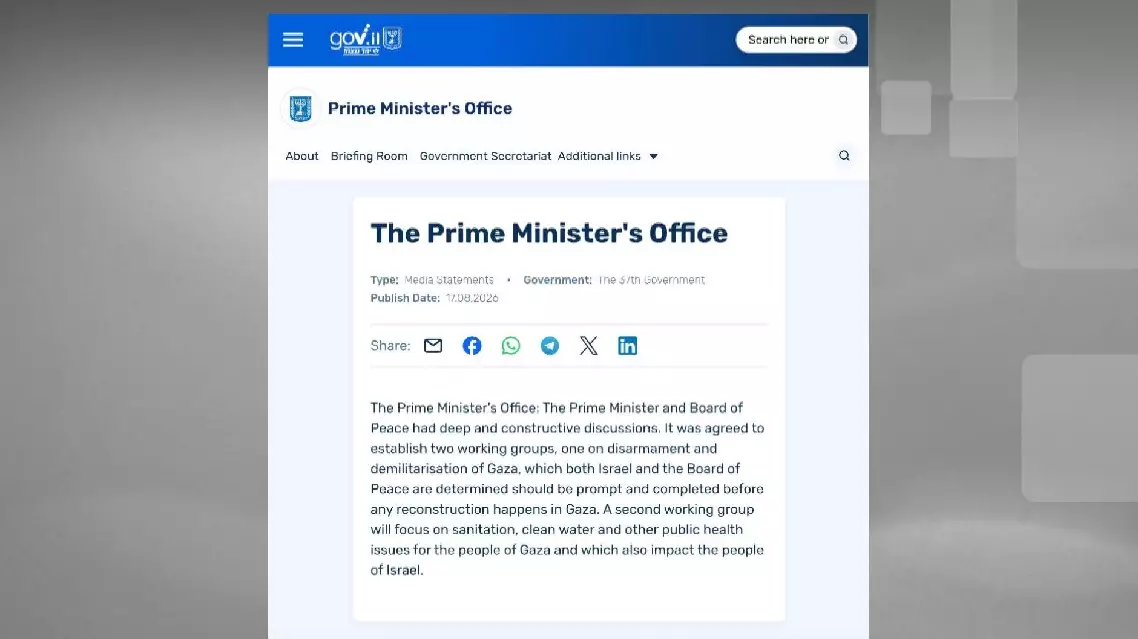
Israeli Prime Minister Benjamin Netanyahu and visiting U.S. President Donald Trump's son-in-law and envoy Jared Kushner agreed on Monday to establish two working groups to advance the demilitarization of Gaza and address infrastructure and public health needs in the war-devastated enclave, according to a statement of Prime Minister's Office.
The statement was published after the two held a meeting in Jerusalem, which was also attended by Nickolay Mladenov, "high representative for Gaza" of the U.S.-led "Board of Peace."
One working group will focus on the disarmament and demilitarization of Gaza, the statement said, noting that Israel and the "Board of Peace" are "determined" that demilitarization be completed before reconstruction begins.
A second group will focus on sanitation, clean water and other public health issues in Gaza, it said.
Earlier this month, Netanyahu said Israel rejects a Gaza peace roadmap plan presented by the "Board of Peace," maintaining that Israeli forces will not withdraw until Hamas is fully disarmed. Israel would never agree to the establishment of a Palestinian state in either the Gaza Strip or the West Bank, he added.
In an interview following his talks with Netanyahu, Kushner said he believed progress might come in as little as 30 days, and expressed hope that some weapons could begin to be removed and that certain tunnels could be filled in within the following 60 to 90 days. He also warned that if Hamas fails to deliver on commitments, Israel will receive stronger support from the United States and other parties.
Kushner noted the U.S. would not allow reconstruction in Gaza before demilitarization is achieved and would not restrict Israel's right to self-defense if it faces an imminent threat.
Kushner arrived in Israel a day after holding talks with Hamas leader Khalil al-Hayya in Egypt, a rare direct meeting as part of efforts to advance the Gaza ceasefire. He described the talks as very cordial but stressing that any understanding must be backed by concrete actions.
On Monday, Khaled Qaddoumi, Hamas' representative in Iran, said that while the group agrees with the Gaza peace plan's broad goals of a ceasefire and ending the war, armed resistance will continue as long as the Israeli occupation exists. Qaddoumi accused Israel of failing to implement ceasefires and questioned whether the United States possesses the ability to force Israel to comply with any agreement.
Trump said on July 30 that the so-called "Board of Peace" had reached an agreement for the "complete disarmament" of Hamas and all other armed groups in Gaza. A 15-point peace plan released the next day called for Hamas to disarm and Israel to withdraw its troops from Gaza in phases.
Hamas said on July 31 that it will only hand over its weapons after the Israeli military withdraws from Gaza.
Netanyahu, Kushner agree to form Gaza demilitarization, public health working groups