SAN FRANCISCO & DOWNERS GROVE, Ill.--(BUSINESS WIRE)--Aug 18, 2026--
Trossen Robotics, a provider of research and data-collection platforms for Physical AI, and Stereolabs SAS, a wholly owned subsidiary of Ouster, Inc. (Nasdaq: OUST), and maker of the ZED series of AI stereo cameras, today announced a collaboration that integrates Stereolabs' ZED X Mini and ZED X Nano cameras into Trossen's new Physical AI hardware suite for robot learning. The suite is headlined by the Trossen Workbench and Rivet, its stationary and mobile bimanual manipulation platforms.
This press release features multimedia. View the full release here: https://www.businesswire.com/news/home/20260818161842/en/
Physical AI models are only as good as the demonstration data they are trained on and most of that data is visual. Today, teams typically assemble their own rigs from individually sourced robot arms and consumer-grade USB cameras, relying on custom driver code to connect them. The result is datasets with low-resolution imagery, inconsistent calibration, motion blur, and timing drift across views and data streams.
The Trossen Workbench and Rivet are unified development platforms featuring dual WidowX Pro 6-DoF arms with reach from 700 mm to 1000 mm, payload capacities of 4 to 6 kg payload, and 1 mm repeatability. Each platform is powered by an onboard NVIDIA Jetson AGX Orin 64 GB compute and supports teleoperation over local networks and the internet. Each also includes a factory-calibrated three-camera vision system built entirely with Stereolabs hardware.
The Stereolabs and Trossen joint vision architecture mirrors how state-of-the-art manipulation policies are trained. A center-mounted Stereolabs ZED X Mini provides the global scene view and stereo-depth context of the full workspace, while each wrist-mounted ZED X Nano delivers the close-range view of the gripper and object that imitation-learning policies rely on for fine manipulation.
The ZED X Nano was designed specifically for this application. Its dual 2.3 MP (1920×1200) global-shutter sensors capture at up to 60 fps without the motion blur of rolling-shutter USB cameras, and its neural depth engine resolves geometry from as close as 3 cm, the distances at which grasping actually happens. GMSL2 connectivity with locking, EMI-resistant cabling keeps all three cameras deterministically synchronized on the Jetson with a zero-copy pipeline, so teams can record, encode, and run inference simultaneously without frames silently dropping mid-episode. A vibration-resistant onboard IMU keeps the wrist views usable even as the arms move at speed.
Every teleoperated episode collected on the Workbench and Rivet is a clean, synchronized, multi-view, RGB-plus-depth training sample, ready for imitation learning, reinforcement learning, and sim-to-real workflows through native support for ROS 2 and NVIDIA Isaac Sim / Isaac Lab.
“The Physical AI community is migrating to GMSL2 because USB can't handle the long cable runs from the end effector to compute that real robots demand,” said Matt Trossen, CEO from Trossen Robotics. “Stereolabs ZED X Nano gives us the signal stability, image quality, and throughput to take Physical AI from the lab into hardened industrial deployments. Teams should spend their time collecting demonstrations and training policies, not integrating and calibrating camera rigs.”
“Trossen has done what few others have: put the camera at the heart of a complete, calibrated data-collection system,” said Cecile Schmollgruber, President of Stereolabs. “The Workbench with Stereolabs ZED X Mini and ZED X Nano turns every demonstration into training-grade data, and that's what will move Physical AI forward.”
The Workbench anchors Trossen's broader Physical AI hardware suite including the RIVET mobile manipulation platform, GLIDE passive leader arms, and COCKPIT operator station for scalable teleoperated data collection. The suite will be shown publicly at Trossen's Physical AI Residency in San Francisco, August 12–28, 2026, alongside live data-collection and policy-evaluation demos at Trossen’s booth at the Actuate conference also in San Francisco, August 18-19, 2026.
About Trossen Robotics
Trossen Robotics develops accessible, modular hardware and software platforms for Physical AI research, data collection, and deployment. Its robotic arms, mobile manipulators, teleoperation systems, and developer tools help teams collect high-quality data, train embodied AI models, and move robotic applications from the lab into real-world use.
About Stereolabs
Stereolabs, a wholly owned subsidiary of Ouster, Inc. (Nasdaq: OUST), is a leader of 3D vision and depth perception for Physical AI. Its ZED camera family and ZED SDK platform provide real-time depth sensing, spatial mapping, and AI-powered object understanding for robotics, industrial automation, and smart spaces.
Forward-Looking Statements
This press release contains forward-looking statements within the meaning of the Private Securities Litigation Reform Act of 1995. Ouster intends such forward-looking statements to be covered by the safe harbor provisions for forward-looking statements contained in Section 27A of the Securities Act of 1933, as amended and Section 21E of the Securities Exchange Act of 1934, as amended. Such statements are based upon current plans, estimates and expectations of management that are subject to various risks and uncertainties that could cause actual results to differ materially from such statements. The inclusion of forward-looking statements should not be regarded as a representation that such plans, estimates and expectations will be achieved. Words such as “anticipate,” “expect,” “project,” “intend,” “believe,” “may,” “will,” “should,” “plan,” “could,” “continue,” “target,” “contemplate,” “estimate,” “forecast,” “guidance,” “predict,” “possible,” “potential,” “pursue,” “likely,” and the negative of these terms and similar expressions are intended to identify forward-looking statements, though not all forward-looking statements use these words or expressions. All statements, other than statements of historical fact, including statements regarding the capabilities and applications of Ouster’s product offerings, uses for Physical AI, the anticipated performance, benefits to and expectations around customer adoption and application of our product offerings; and Ouster’s competitive position constitute forward-looking statements. All forward-looking statements are subject to risks and uncertainties that may cause actual results to differ materially from those that we expected, including, but not limited to, risks related to the capabilities and benefits of our hardware offerings and software-attached offerings, including with respect to the enhancement of signal stability and data collection; product quality and liability risks; cancellation or postponement of contracts or unsuccessful implementations; dependence on key third party suppliers; Ouster’s ability to complete, successfully integrate or achieve the anticipated benefits of new acquisitions or investments, including the Stereolabs acquisition; risks related to the use of AI tools by us and others, including risks related to product performance, cybersecurity, and data privacy; Ouster’s ability to adequately protect and enforce its intellectual property rights; legal and regulatory risks; and other important factors discussed in Ouster’s Annual Report on Form 10-K for the year ended December 31, 2025, and as may be further updated from time to time its Quarterly Reports on Form 10-Q and other filings with the SEC. Readers are urged to consider these factors carefully and in the totality of the circumstances when evaluating these forward-looking statements, and not to place undue reliance on any of them. Any such forward-looking statements represent management’s reasonable estimates and beliefs as of the date of this press release. While Ouster may elect to update such forward-looking statements at some point in the future, it disclaims any obligation to do so, other than as may be required by law, even if subsequent events cause its views to change.
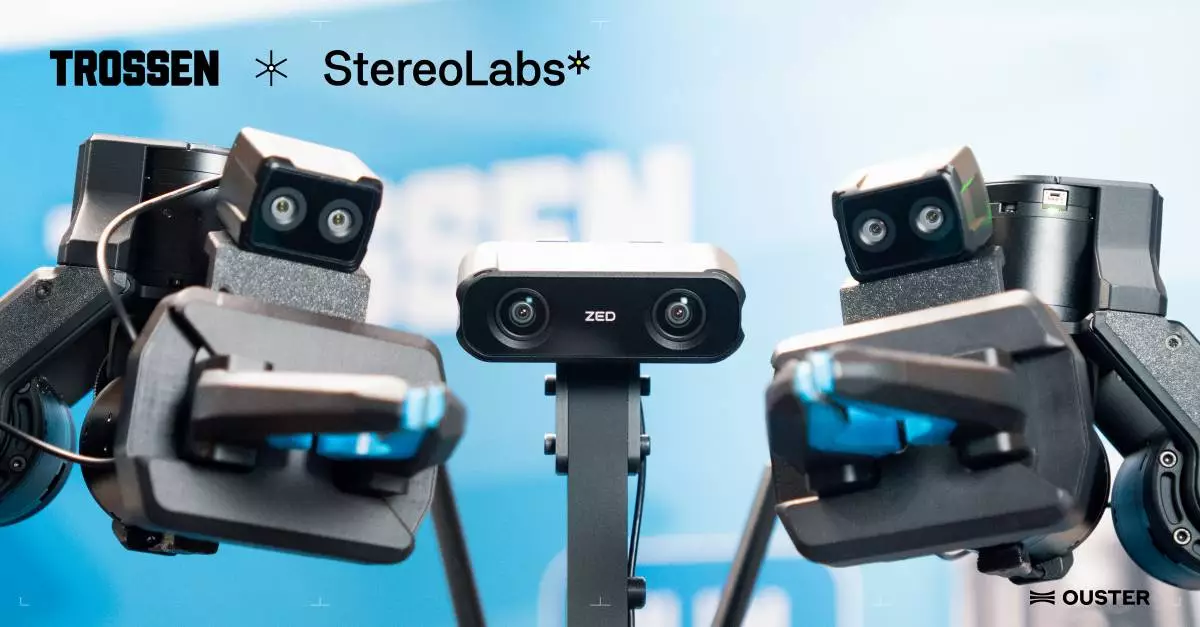
Trossen and Stereolabs Workbench Rivet with ZED X Mini and Nano Cameras
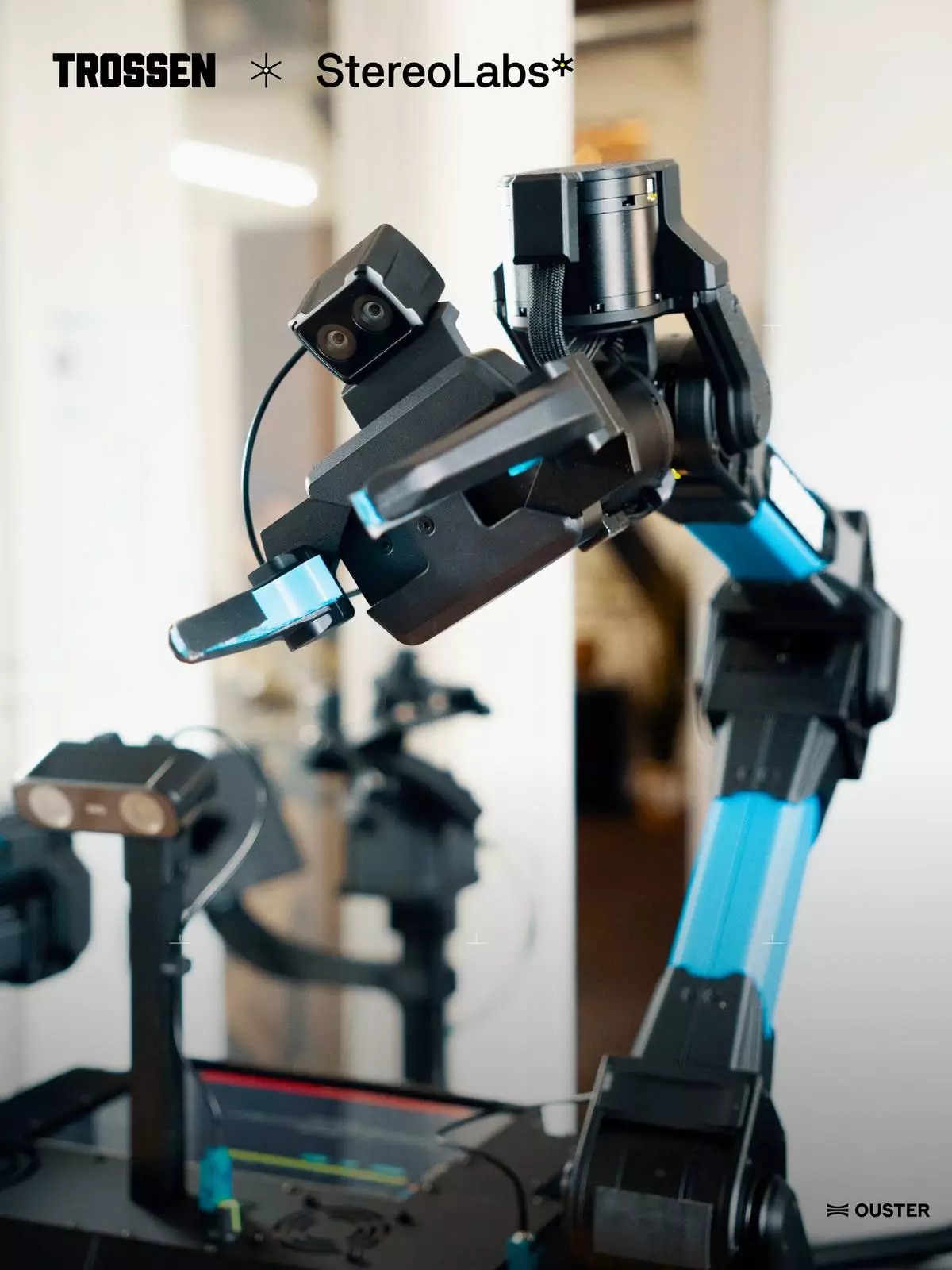
Trossen and Stereolabs Workbench Arm Close-Up with ZED X Nano Camera