Chinese smart device maker Honor is putting its high-performance humanoid "Flash" through its paces as it chases more glory at the upcoming Second World Humanoid Robot Games, with the running robot having raced its way to victory in an international half-marathon in Beijing earlier this year.
The Games, scheduled to run from Aug 22 to 26 in Beijing, is set to feature over 2,000 robots from 666 teams representing 16 countries and regions, with the number of participating robots quadrupling from last year's inaugural edition.
The event has become a premier showcase for advancements in bipedal robotic locomotion and artificial intelligence. This year's edition will see humanoids from around the world participating in more than 30 different competitions including obstacle courses, endurance races, long jump, weightlifting, tug of war, and table tennis, among others.
China dominates the field in terms of participation, with over 150 domestic enterprises and 200 universities and research institutions putting forward entrants, including some of the country's foremost robotics companies and prestigious Chinese universities.
Among them is Shenzhen Honor Smart Technology Development, whose defending champion -- the aptly named "Flash" -- will again look to show off its speed and power as it competes in the 100-meter, 400-meter, and 1,500-meter races at this year's Games.
The robot is already in record-breaking form and gained global attention back in April when it ran alongside human competitors at the 2026 Beijing E-Town Half-Marathon.
Equipped with an autonomous navigation system, "Flash" completed the 21-kilometer race in the Chinese capital in a time of 50 minutes and 26 seconds, comfortably beating the human world record of 57 minutes and 20 seconds and defeating fellow robot runners from countries such as Germany, France and Brazil.
To maintain its edge, the Honor team has redesigned the robot's leg proportions, increasing its stride length while incorporating lightweight materials to strike a balance between delivering top-end speed and ensuring greater endurance.
"We've extended the robot's leg length by 10 centimeters for it to achieve a larger stride and a faster speed. We've selected new materials that can ensure both its lightness and reliability," said Gao Shiming, a team member who specializes in embodied perception in robotics.
The upcoming races at the Robot Games present formidable technical challenges. Except for the 100-meter and 400-meter hurdle events, all track races require robots to complete their runs fully autonomously, with no external controls, which will directly test the robots' vision systems, decision-making algorithms, and motion stability.
As part of its rigorous preparations, the Honor team has built a full-scale replica of the official 100-meter track at their testing site, allowing "Flash" to practice under race-like conditions and fine-tune its performance.
For the short sprint race, the robot will rely on a pure visual recognition system, with a camera mounted on its hip to ensure it stays within lane boundaries during the race. For the 400-meter race, "Flash" will have an extra radar detection device added on its head to maintain overall course direction.
Zhou Yingjun, a senior executive at Honor, believes Flash is on the verge of running the 100-meter race in under 10 seconds, putting it on par with the world's fastest athletes. Zhou said the team is pushing for the robot to smash the current human world record of 9.58 seconds set by Jamaican sprinter Usain Bolt back in 2009.
"We've set up stopwatches at the testing site to monitor the robot's reaction time at the start. In the meantime, we are working hard to increase our robot's maximum speed. Our goal is to break the human world record," he said.
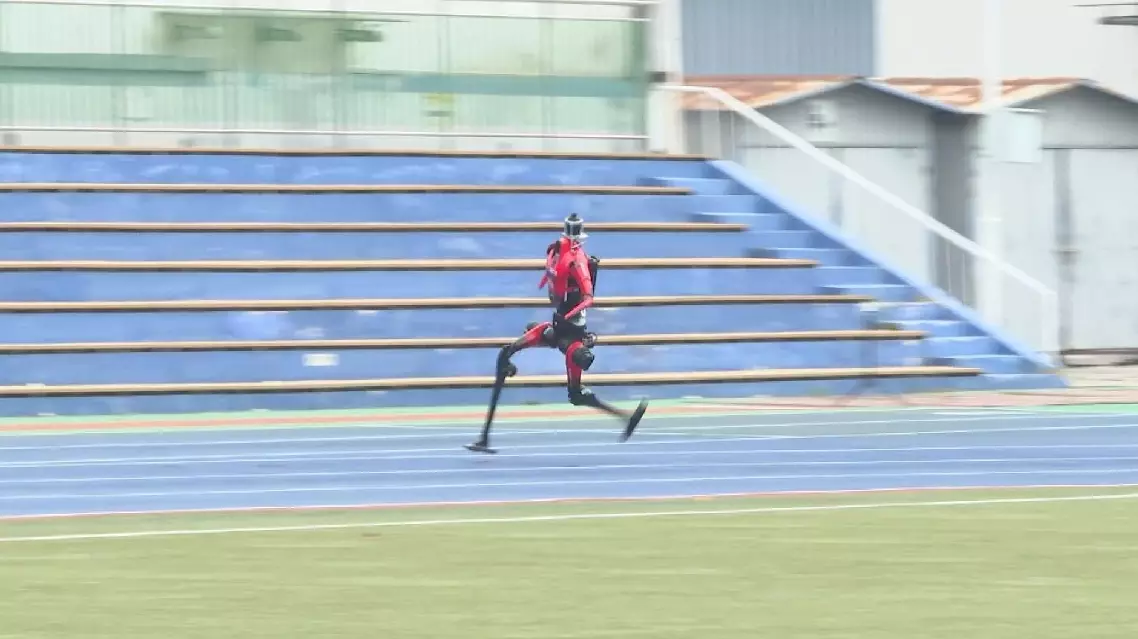
Chinese humanoid robot runner 'Flash' on track for World Games glory