Skip to Content Facebook Feature Image

Over 80 percent of vessels transiting Strait of Hormuz choose Omani route: US media

China

Over 80 percent of vessels transiting Strait of Hormuz choose Omani route: US media
China

China

Over 80 percent of vessels transiting Strait of Hormuz choose Omani route: US media

2026-08-19 17:35 Last Updated At:20:37

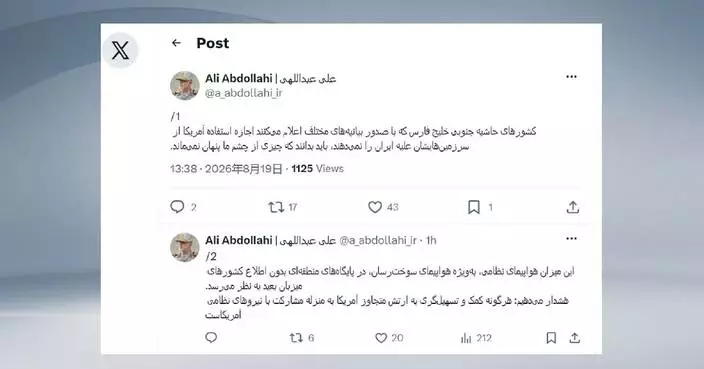
More than 80 percent of vessels transiting the Strait of Hormuz over the past two weeks chose the Omani route, CNN reported on Tuesday, citing data from ship-tracking platform Kpler. The reort said the result suggests Iran's control over the strait has weakened compared with one or two months ago.

Kpler found through tracking vessel transponders and satellite data that most ships have recently chosen to navigate the waterway via the Omani side despite the risks.

"Iran appears to have at least partially lost control of the strait," said Homayoun Falakshahi, head of crude oil analysis at Kpler.

According to CNN, Iran wants ships to prefer the northern route on the Iranian side, which is controlled by Iran. However, traffic on that route has dropped sharply, making it impossible for Iran to collect "tolls" from passing vessels, as it had been doing since the Iranian Parliament's national security and foreign policy committee passed a bill on March 30 to charge vessels transiting the strait.

After the United States and Iran signed a memorandum of understanding (MoU) in mid-June, the Strait of Hormuz, which had been closed due to the conflict between the two countries, was briefly reopened, creating the Iranian-controlled northern route and the two southern routes on the Omani side where the U.S. military provided navigation assistance, known as the Omani route.

Later, conflicts between the two countries over control of the strait resumed, and Iran announced the closure of the strait again.

Dan Pickering, chief investment officer at Pickering Energy Partners, said most vessels in the Middle East are unwilling to pay and have never paid "tolls" to Iran, making the Omani route the most practical choice.

According to Andy Lipow, president of Lipow Oil Associates, Kuwait, Saudi Arabia and the United Arab Emirates have chartered ultra-large crude carriers to sail out of the Persian Gulf through the Strait of Hormuz and transfer crude to customer tankers in the Gulf of Oman, outside the danger zone. To avoid attacks, these carriers have turned off their transponders, sometimes for weeks at a time.

CNN said this covert shipping activity appears to have also evaded tracking by Kpler and other ship tracking agencies.

Over 80 percent of vessels transiting Strait of Hormuz choose Omani route: US media


Over 80 percent of vessels transiting Strait of Hormuz choose Omani route: US media

The 2026 World Robot Conference opened in Beijing E-Town on Wednesday, bringing more than 3,000 exhibits, with one tenth of them premiered.

Running for five days, the event has drawn over 300 exhibitors, up 69 percent from last year, and more than 60 activities are on agenda.

"We have built a 600-square-meter immersive zone with several hundred products on display. We designed scenarios like a cyber training camp, a real-life industrial park, and a future-life house to show innovative applications of robots. Visitors can even remotely operate the robots on their own and experience the latest robotic technologies," said Fang Pei, procurement and sales head at JD Embodied Intelligent Robotics.

Apart from the larger scale, the exhibition at this year's conference shifts more from individual robot skills to scenarios of their working applications.

At the booth of a Humanoid Robot Innovation Center, the robot Tiangong, once a "marathon runner" in previous robot marathon competitions, performs various jobs. Controlled through large models, Tiangong can carry goods, conduct quality inspections, and do other work.

In a household scenario, Tiangong can execute orders of users like finding sausage and putting in into a designated container.

"The general trend shows that the industry is now shifting the focus from robot bodies, its motion and manufacturing to its intelligence and ability to working in the real world," said Xiong Youjun, general manager of the Beijing Humanoid Robot Innovation Center.

The expansion of the exhibition scale aligns with the sector's rapid growth as a whole. According to the Ministry of Industry and Information Technology, China's industrial and service robot output rose 28 percent and 11.9 percent year on year in the first half of 2026, respectively. Chinese-developed quadruped robots now account for nearly 70 percent of global sales, with more than 400 domestically-built humanoid robot models, over half of the world's total.

World Robot Conference features real-life applications

World Robot Conference features real-life applications

Recommended Articles