Skip to Content Facebook Feature Image

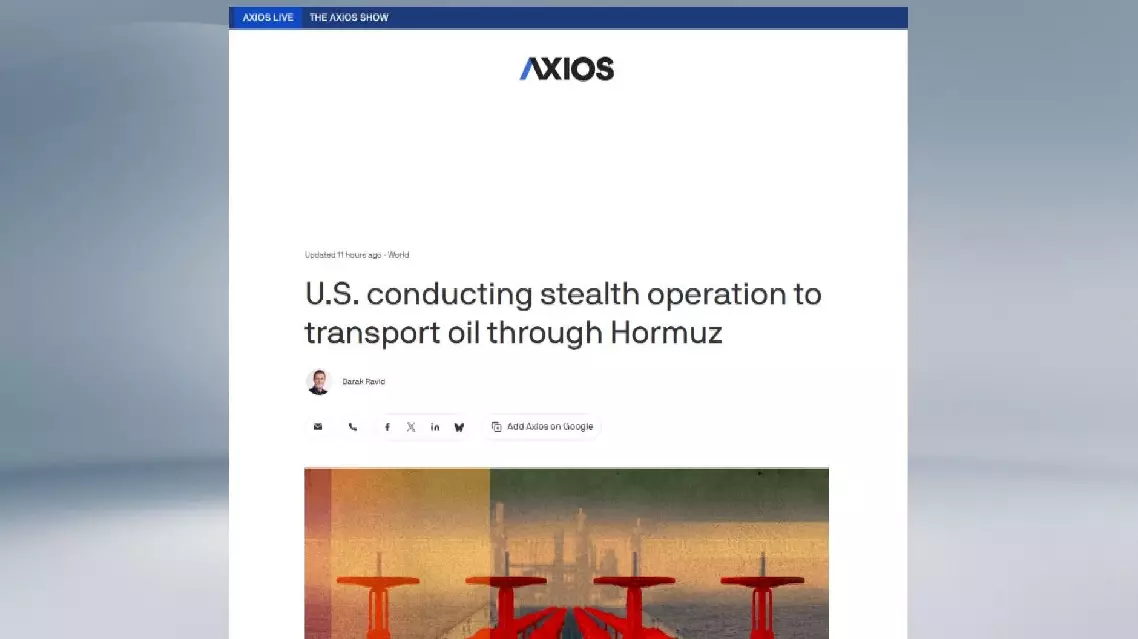
US secretly establishes shipping corridor in Strait of Hormuz to maintain oil flow: media

China

China

China

US secretly establishes shipping corridor in Strait of Hormuz to maintain oil flow: media

2026-08-20 16:37 Last Updated At:19:47

The U.S. military has quietly established a shipping corridor through the Strait of Hormuz to ensure the daily passage of millions of barrels of oil, U.S. media outlet Axios News cited two U.S. officials as saying on Wednesday.

The operation, which has been ongoing for several weeks, has seen 15 to 20 tankers nightly traversing a southern route along the coast of Oman over the past two weeks. According to the U.S. officials, daily oil shipments have steadily increased and now approach 10 million barrels, with some nights seeing total exports from the Gulf reach 15 to 20 million barrels.

While oil volumes passing through the Strait of Hormuz remain below pre-conflict levels, the operation has already had a noticeable impact on global supply.

The operation extends beyond escorting loaded oil tankers, according to Axios News. It also assists empty tankers in entering the Persian Gulf through the Strait of Hormuz from the Arabian Sea, where they load oil from regional countries before departing.

A working group managing the operation, under the command of U.S. Army headquarters at Fort Bragg, North Carolina, coordinates with Gulf partners to compile daily lists of vessels exiting the Strait of Hormuz into the Arabian Sea, as well as empty tankers entering the Persian Gulf through the strait from the Arabian Sea. Under the plan, these ships form large convoys at specific times each night -- one group exiting and another entering.

U.S. aircraft provide defense for these vessels against Iranian cruise missile and drone attacks.

The U.S. officials also stated that recent military operations by the U.S. Central Command have degraded Iranian radar and maritime surveillance systems, significantly reducing Iran's ability to monitor vessel traffic along the southern route of the Strait of Hormuz. Many Iranian attacks on ships have been intercepted by U.S. forces, they said.

Iran has not yet responded to the reports.

In a separate statement posted on social media on August 19, the U.S. Central Command said that U.S. forces continue to enforce a maritime blockade against Iran. As of August 19, U.S. forces have redirected 65 commercial vessels, disabled three, and boarded two to ensure compliance.
US secretly establishes shipping corridor in Strait of Hormuz to maintain oil flow: media

US secretly establishes shipping corridor in Strait of Hormuz to maintain oil flow: media
Russian President Vladimir Putin has identified launching a new investment cycle in industry, agriculture, services and housing as a key priority for the national economy during a meeting of the Council for Strategic Development and National Projects on Wednesday.

Putin noted that Russia's many export-oriented megaprojects in the chemical industry, metallurgy, mining and petrochemicals have already passed their peak investment phase, leading to a slowdown in capital investment growth.

"The overall economic dynamics are modest but positive. Gross domestic product (GDP) growth stands at about 1 percent. Moreover, in the first half of the year, the GDP grew by 0.6 percent, and in the second quarter, it reached 1.3 percent," he said.

While noting that Ukrainian attacks had not caused serious damage, Putin said logistics and storage infrastructure required restoration, including with the government's participation.

Russia's Deputy Prime Minister Alexander Novak noted despite the impact of international sanctions, Russia's real GDP has increased by more than 10 percent over the past three years.

During the period, Russia's economic growth structure has shifted. The share of net economic exports have fallen by nearly threefold, and the economy has in effect pivoted toward the domestic market. Investment accounted for 23.3 percent of the GDP in 2025, reaching its highest level in the past 15 years.

Novak told Putin at the meeting that Russia's sector-level economic structure has also undergone changes. Manufacturing has become the key growth driver, and its share climbed from 13 percent to almost 15 percent in 2025. For the first time, manufacturing output has consistently exceeded extractive-industry output by more than 1.5 times. The share of high-value-added industries grew from 15 percent to 18.4 percent.

Putin calls for new investment cycle to boost Russian economy

Putin calls for new investment cycle to boost Russian economy

Recommended Articles