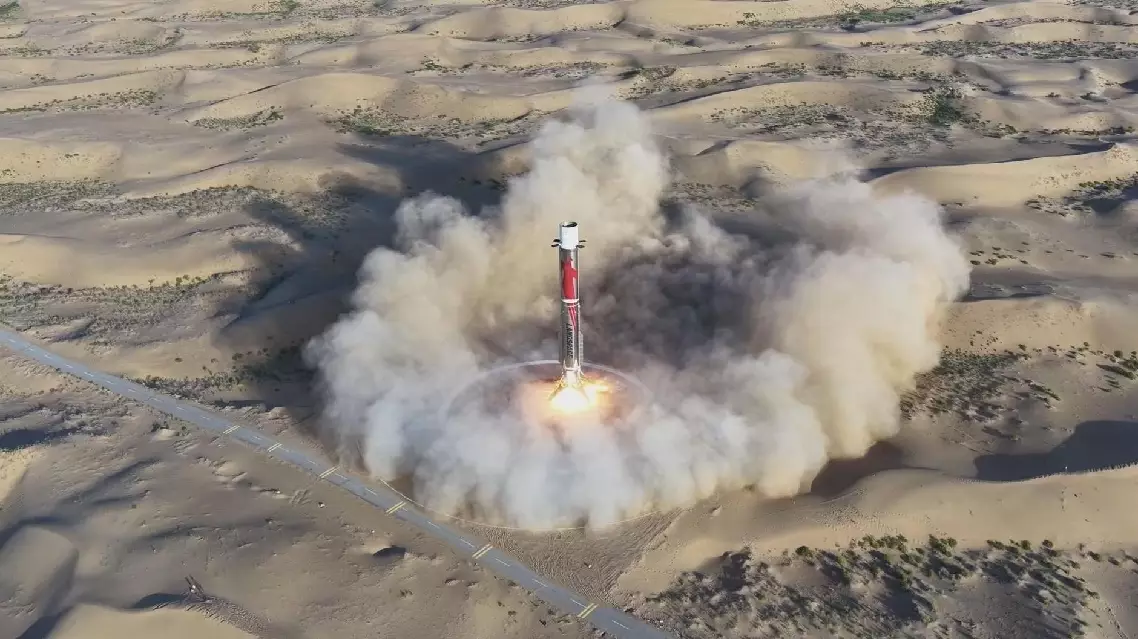
China successfully completed its first on-land recovery of a rocket booster on Wednesday morning following eight months of thorough failure reviews, marking a major breakthrough in the country's reusable rocket technology.
China launched the reusable rocket Zhuque-3 on Wednesday, which blasted off at 07:35 (Beijing Time) from the Dongfeng commercial space innovation pilot zone in northwest China.
The rocket's first and second stages separated approximately 137 seconds after the liftoff. The first stage then entered its preset return phase, and completed a series of key maneuvers, including high-altitude flight attitude adjustment, re-entry propulsive deceleration, controlled aerodynamic glide, deceleration burn, and landing leg deployment.
The land-based recovery was completed as planned, with the rocket's first stage touching down smoothly at the designated recovery site in Minqin County of northwest China's Gansu Province. The second stage kept flying and sent the onboard Honghu-03 satellite into the preset orbit. The flight mission was a complete success.
The situation was totally different on December 3 last year, as an incident took place when the returning rocket was just about three kilometers away from the recovery site.
"The rocket was very close to the ground when the deflagration took place, just about three kilometers away, so it quickly crashed down to the ground, leaving us no time to react," said Dai Zheng, Zhuque-3's chief commander.
Describing the mission as "basically successful" was once seen by observers as a form of consolation, but for Dai and his team, it represented a step further to achieve land-based recovery.
"On our first attempt, the team felt relatively relaxed, because we know that we were making the first effort in China to achieve rocket recovery on land, and it is possible that we may fail. Since we still had room for making more efforts, we thought that a 'basically successful' mission, which was just one step away from success, was a motivation for us to progress. Yet huge pressure built up ahead of the second launch and there was a subtle change in our mentality -- How many failures will we suffer before we finally succeed?" said Dai.
It took Dai and his team eight months to complete the failure reviews. They listed all the possible modes that might cause the incident and investigated them one by one.
"We drew up a list of all failure modes that might lead to the incident. There were dozens of them, which we examined one by one. It is a method of exhaustion. We first listed out all the possibilities and then used flight data, simulations and ground tests to see whether they could cause the incident," said Dai.
The team also conducted multiple improvements, including reducing the number of engines used in landing ignition from five to three, which greatly lowered system complexity.
"The final 'braking' was pretty beautiful, bringing the rocket to a steady halt at our recovery site from supersonic speed. I think our team has finally withstood the pressure, and that we have proven ourselves," said Dai.
Eight-month failure reviews help China achieve first rocket recovery on land: commander