PERTH, Australia (AP) — British social media celebrity and rapper Yung Filly will be retried on three charges that allege he raped a fan in Australia following a music performance two years ago.
The 30-year-old entertainer, whose real name is Andres Felipe Valencia Barrientos, learned on Friday that prosecutors intend to try him for a second time on the charges.
Barrientos underwent an eight-day trial for the same alleged attack last month in the District Court of Western Australia state in Perth.
A jury found him guilty on two charges that he had assaulted the woman, then aged 20, occasioning bodily harm in a Perth hotel room in September 2024.
The jury also found him not guilty of choking her and not guilty of three of six charges of rape.
The jury could not reach majority verdicts of at least 10 out of 12 jurors on the remaining three rape charges.
Prosecutor Danielle Clarke told Judge Linda Black that the alleged victim, who cannot be identified, was willing to testify again at a retrial.
Black was the original trial judge. She told defense and prosecution lawyers on Friday to consider whether they want a new judge to hear the retrial and whether the proceedings should be heard by a jury or by a judge alone.
The Colombian-born entertainer will be sentenced for the assault convictions after his retrial. No date for the trial has been set.
Barrientos has been free on bail since he was charged and was allowed to return to Britain for several months.
He said nothing to reporters as he left the court on Friday.
Barrientos had been touring Australia and had already performed in Sydney and Melbourne before he encountered his victim in Perth. He was arrested several days later in the east coast city of Brisbane, where the tour was to end.
Prosecutors alleged the woman initially agreed to have sex but withdrew her consent because she feared for her safety.

British rapper Yung Filly, whose real name is Andres Felipe Valencia Barrientos, leaves the Western Australian District Court in Perth, Australia, on July 27, 2026. (Aaron Bunch/AAP Image via AP)
TUNIS, Tunisia (AP) — A summer of extreme heat has left many Tunisians short of water and electricity — and full of anger at the country's leadership. Protesters rallied in the capital Tunis on Thursday, many calling on President Kais Saied to leave power.
Mobilized by a new opposition collective, the demonstrators pleaded for improvements to basic utility services and an end to medicine shortages, rising living costs and restrictions on freedoms. Some denounced what they described as the president's failure to meet the people’s demands since he was elected seven years ago.
The protest was called by the Nafas movement, which seeks to bring together political parties and independent figures beyond the North African country's traditional opposition to Saied.
The umbrella initiative, launched in May, has been calling for an end to what it describes as government failure and injustice in the country that was the birthplace of the Arab Spring pro-democracy uprisings.
The protest came during a summer of extreme heat, with temperatures reaching up to 50 degrees C (122 F) in some parts of Tunisia. The heat wave pushed electricity demand to record levels and led state-owned utility STEG to introduce rationing measures in several regions.
The power cuts also affected water pumping stations, exacerbating long-running concerns over access to drinking water in parts of the country. Shelves of bottled water emptied quickly as lengthened blackouts disrupted factory operations.
The production slowdown was deepened by a shortage of raw plastic materials, triggered by ongoing shipping disruptions in the Strait of Hormuz, which cut off petrochemical exports to North Africa for bottle manufacturing.
Mohamed Hawel, a university teacher, struggles to make ends meet despite making a relatively high salary. A member of the Nafas collective, he said the group was created to unite people around basic necessities, including water, electricity and food.
“We are not making the bare minimum. We keep queuing to get water and bread. This is unbelievable in Tunisia in the 21st century,” Hawel told The Associated Press at the protest.
Thursday's protest and another one by Nafas in Tunis last month brought together opposition activists alongside citizens who had not previously taken part in political demonstrations. Participants included social media influencers expressing discontent with the country’s political status quo for the first time, mobilizing younger people.
Oussama Farhat, 25, a primary school teacher and online influencer, said he joined the protest because he believed the achievements of Tunisia’s 2011 revolution were being eroded.
“I came out today because I am a strong believer in the revolution’s achievements which have started to fall apart or get eroded,” he told the AP following Thursday’s protest.
Farhat said the demonstration was about more than freedom of speech, pointing to deteriorating access to basic services.
“We are also calling for the fall of the regime because after seven years, it has been proving its failure without a vision for change and reform,” he said.
Last month's protest was held on the fifth anniversary of a power grab by Saied, when he suspended parliament, sacked the government and cemented his rule.
Saied has consolidated power since 2021 and has presided over increasing restrictions on independent media, civil society and any dissenting voices. He accuses his critics of receiving foreign funding to stir unrest and destabilize Tunisia’s national interests.
Recent rallies have seen a distinct shift in tone, as slogans demanding that Saied step down have become more explicit. Among those utilized recently were the 2011 Arab Spring revolutionary chant “the people want the fall of the regime” and “Dégage” (Get Out), a slogan raised in the protests that ousted Tunisia's long-serving autocratic leader Zine El Abidine Ben Ali.
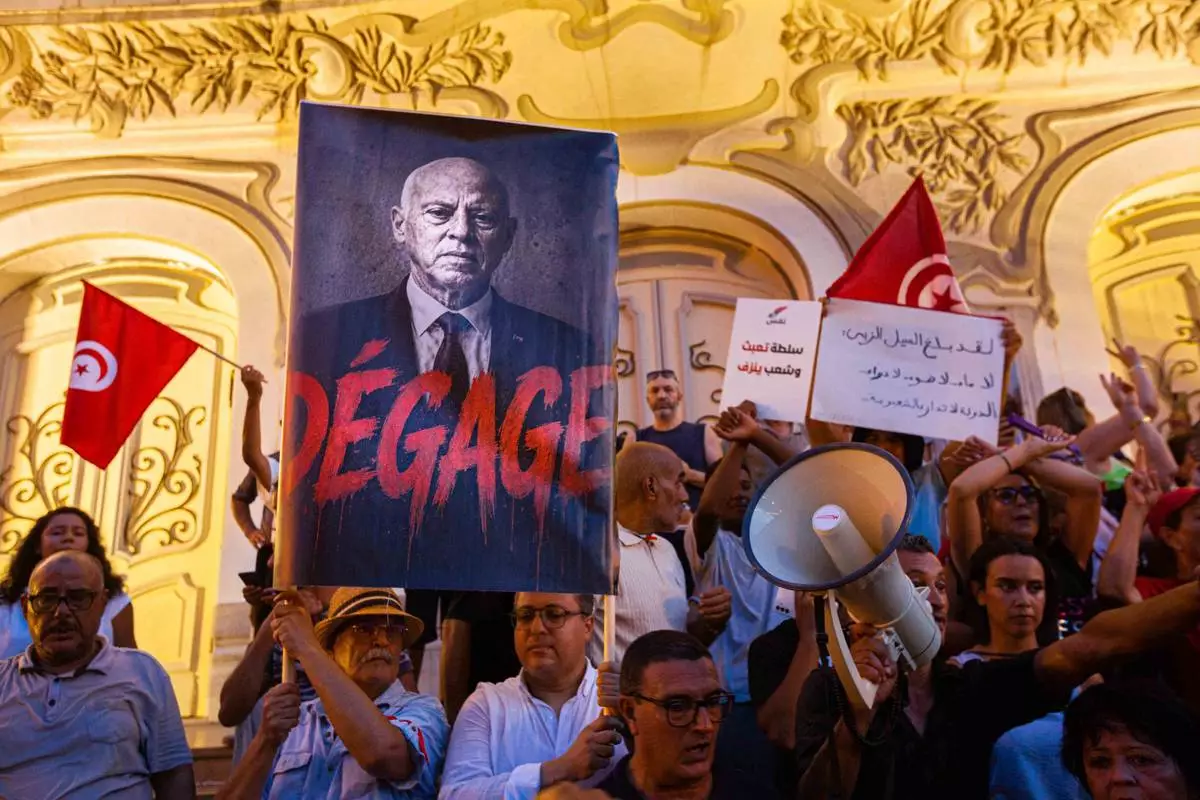
People take part in a protest against rising prices, declining purchasing power and shortages of basic goods in Tunis, Tunisia, Thursday, Aug. 20, 2026. Banner in French showing Preident Kais Saied reads "Leave". (AP Photo/Ons Abid)
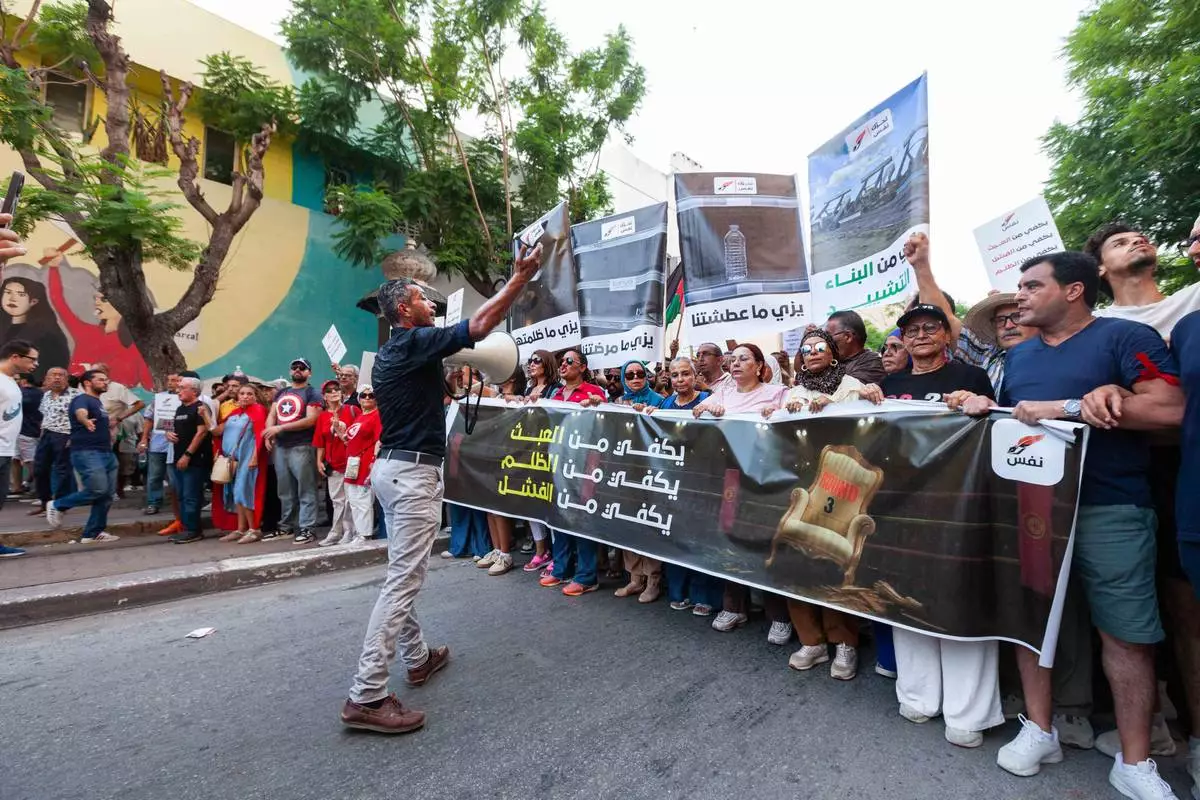
People take part in a protest against rising prices, declining purchasing power and shortages of basic goods in Tunis, Tunisia, Thursday, Aug. 20, 2026. Banner in Arabic reads "Enough injustice, enough failure." (AP Photo/Ons Abid)

People take part in a protest against rising prices, declining purchasing power and shortages of basic goods in Tunis, Tunisia, Thursday, Aug. 20, 2026. Banner in Arabic reads "The country is drowning in debt". (AP Photo/Ons Abid)
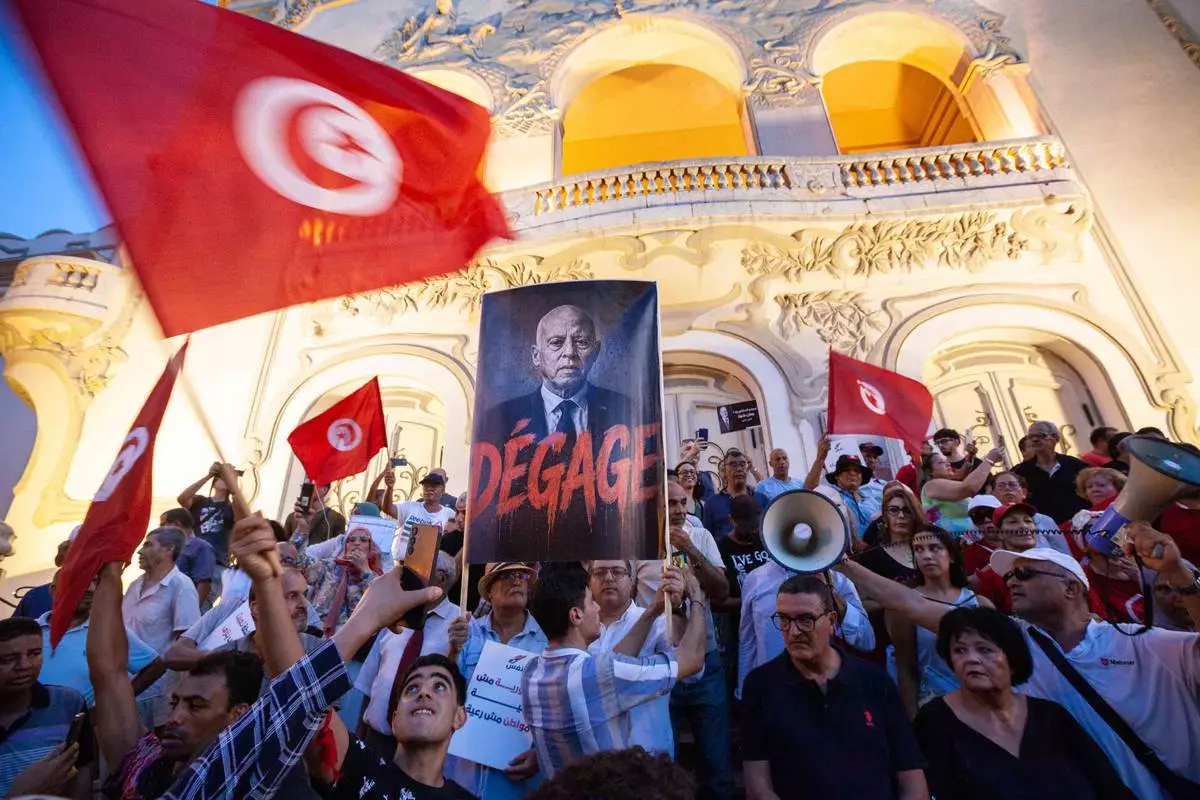
People take part in a protest against rising prices, declining purchasing power and shortages of basic goods in Tunis, Tunisia, Thursday, Aug. 20, 2026. Banner in French showing Preident Kais Saied reads "Leave". (AP Photo/Ons Abid)