CHICAGO--(BUSINESS WIRE)--Aug 21, 2026--
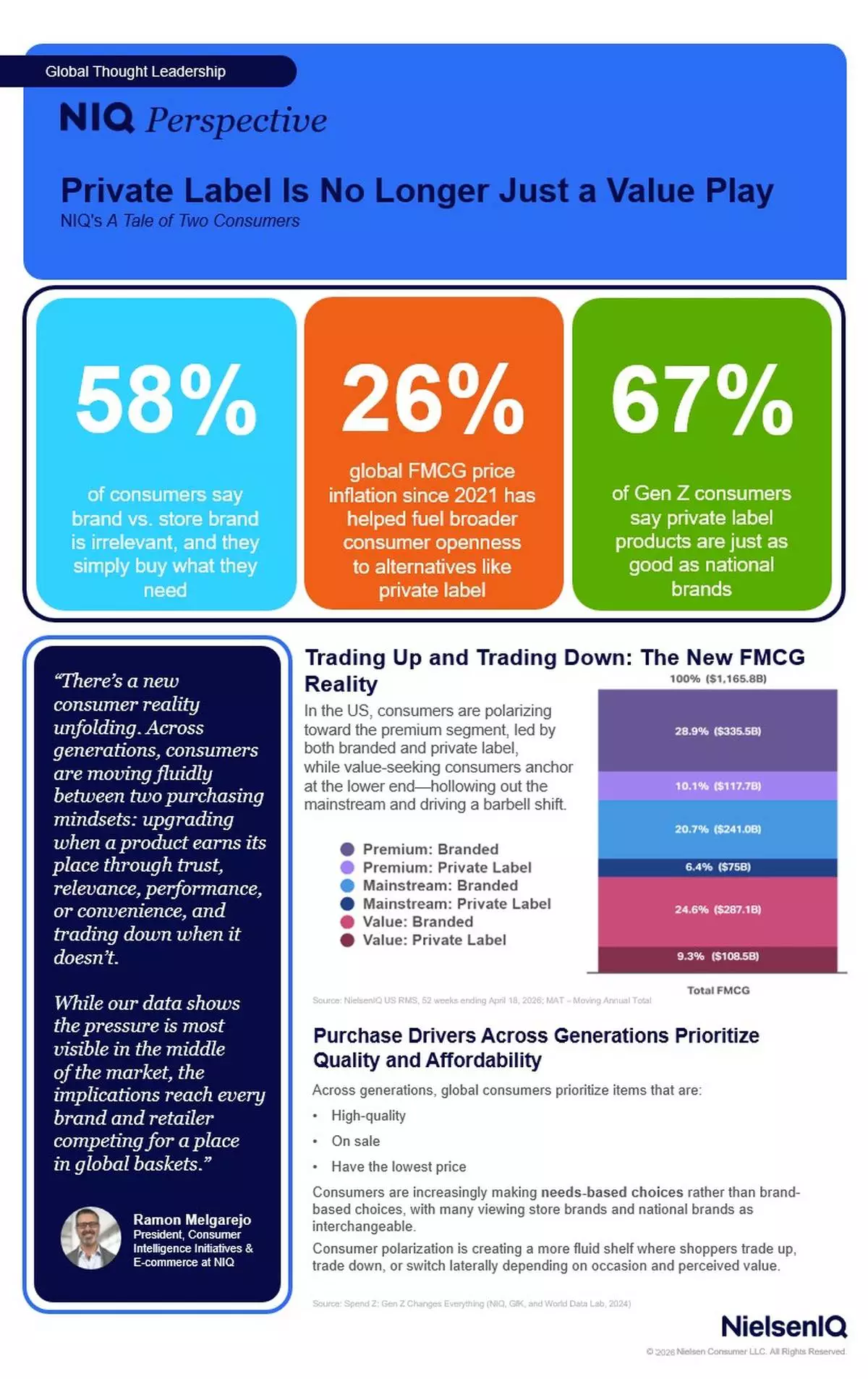
As fast-moving consumer goods (FMCG) prices rose 26% globally between 2021 and 2025, consumers have become more deliberate about where they save and where they spend. NielsenIQ (NYSE: NIQ) has released new findings showing that private label is no longer viewed simply as a lower-cost substitute, but as a credible competitor across value, mainstream, and premium segments.
This press release features multimedia. View the full release here: https://www.businesswire.com/news/home/20260819950224/en/
The findings, published in NIQ’s latest report, A Tale of Two Consumers: The Polarized Mindsets Reshaping Global Consumption, created in collaboration with World Data Lab, show how consumer polarization is redefining value and reshaping competition on the shelf. The report also draws on insights from NIQ's 2025 report Finding Harmony on the Shelf which documented changing perceptions of private label products.
Key findings from these reports include:
For brands and retailers, the shift is significant: shoppers are becoming less loyal to traditional labels and more focused on which products best meet their needs, budget, and expectations in the moment.
The rise of private label is no longer just a trade-down story. Consumers increasingly view private label brands as legitimate value alternatives, premium alternatives, and in many cases equivalent substitutes for national brands.
“This is one of the most significant shifts happening in consumer goods today,” said Ramon Melgarejo, President of E-Commerce at NIQ. “Consumers are no longer evaluating products primarily based on who makes them. They are evaluating whether a product delivers the right mix of quality, value, convenience, and relevance. That has created a much more democratic and competitive shelf than we've seen historically.”
NIQ finds that today's consumers move fluidly between "upgrade" and "price-constrained" mindsets depending on the category, occasion, and perceived value equation. That behavior is creating new opportunities for retailers to grow private label offerings beyond traditional value tiers.
In some categories, private label helps consumers stretch household budgets. In others, retailers are using innovation, packaging, premium ingredients, and stronger product claims to position private label as a desirable upgrade rather than simply a lower-cost substitute. As a result, private label is increasingly competing across value, mainstream, and premium segments alike. To learn more, visit niq.com/tale-of-two-consumers.
FAQs
What is A Tale of Two Consumers?
A Tale of Two Consumers: The Polarized Mindsets Reshaping Global Consumption is a global research report from NielsenIQ and World Data Lab that examines how consumer polarization, spending power, and evolving purchasing behaviors are reshaping retail and consumer goods markets worldwide.
What is the main finding about private label products?
Private label products are increasingly viewed as credible alternatives to national brands across value, mainstream, and premium segments rather than simply lower-cost substitutes.
Why is private label gaining market share?
Consumers are becoming more value-conscious and less focused on brand ownership. Many shoppers now evaluate products based on quality, price, convenience, and relevance rather than whether a product is manufactured by a national brand or retailer.
What does the report reveal about consumer loyalty to brands?
The report finds that 58% of consumers say they do not care whether a product is a national brand or a private label product and instead choose products that best meet their immediate needs.
How does Gen Z view private label products?
67% of Gen Z consumers believe private label products are just as good as national brands, highlighting a significant shift in perceptions among younger shoppers.
Is private label growth only driven by lower prices?
No; while affordability remains important, retailers are increasingly using innovation, premium ingredients, packaging improvements, and differentiated product offerings to position private label products as premium choices.
What are consumers doing when budgets are under pressure?
Many consumers are adopting flexible shopping behaviors that include switching brands, buying products on promotion, trading down in some categories, and trading up in others depending on perceived value.
What does this mean for manufacturers and retailers?
Success increasingly depends on clearly demonstrating value. Both retailers and manufacturers must communicate quality, innovation, affordability, and differentiation in ways that resonate with increasingly selective shoppers.
About NIQ
NielsenIQ (NYSE: NIQ) is a leading consumer intelligence company, delivering the most complete and trusted understanding of consumer buying behavior and revealing new pathways to growth. By combining an unmatched global data footprint and granular consumer and retail measurement with decades of AI modeling expertise, NIQ builds decision systems that help companies turn complex data into confident action.
With operations in more than 90 countries, NIQ covers approximately 82% of the world’s population and more than $7.4 trillion in global consumer spend. Through cloud-based platforms, advanced analytics and AI-driven insights, NIQ delivers The Full View™—helping brands and retailers understand what consumers buy, why they buy it, and what to do next.
For more information, please visit www.niq.com.
© 2026 Nielsen Consumer LLC. All Rights Reserved.
About World Data Lab
World Data Lab is a data science company delivering projections of where global spending power and consumer demand are heading. By combining authoritative demographic and economic data with a proprietary, peer-reviewed forecasting methodology, World Data Lab converts long-term population and spending shifts into a single, forward-looking view of the future consumer, helping organizations identify where growth will emerge before it does.
Modeling consumer trends and demographic change through 2050, World Data Lab covers 99.5% of the world's population across 190+ countries, 9,000+, and 200+ spending categories. Its core methodology, named by Nature among the 50 most influential papers of the decade, underpins both its enterprise platform, World Data Intelligence, and a suite of public tools including the World Poverty Clock.
For more information, visit worlddatalab.com.
Forward Looking Statement
This press release may contain forward-looking statements regarding anticipated consumer behaviors, market trends, and industry developments. These statements reflect current expectations and projections based on available data, historical patterns, and various assumptions. Words such as “expects,” “anticipates,” “projects,” “believes,” “forecasts,” and similar expressions are intended to identify such forward-looking statements.
These statements are not guarantees of future outcomes and are subject to inherent uncertainties, including changes in consumer preferences, economic conditions, technological advancements, and competitive dynamics. Actual results may differ materially from those expressed or implied in these statements. While we strive to base our insights on reliable data and sound methodologies, we undertake no obligation to update any forward-looking statements to reflect future events or circumstances, except to the extent required by applicable law.
#NIQ-General
Private label is no longer just a value play.