Chinese robot manufacturers showcased a full-scale robotics ecosystem at the 2026 World Robot Conference, with independent core component research and multi-robot intelligent collaboration emerging as the highlight of this year's exhibition.
Themed "Human-Robot Symbiosis, Production-Demand Convergence," the 2026 edition of the World Robot Conference kicked off in Beijing on Wednesday.
The five-day event is bringing together more than 300 exhibitors and over 2,000 innovative products, including more than 50 devices demonstrating robotic operations in educational, household, and home settings.
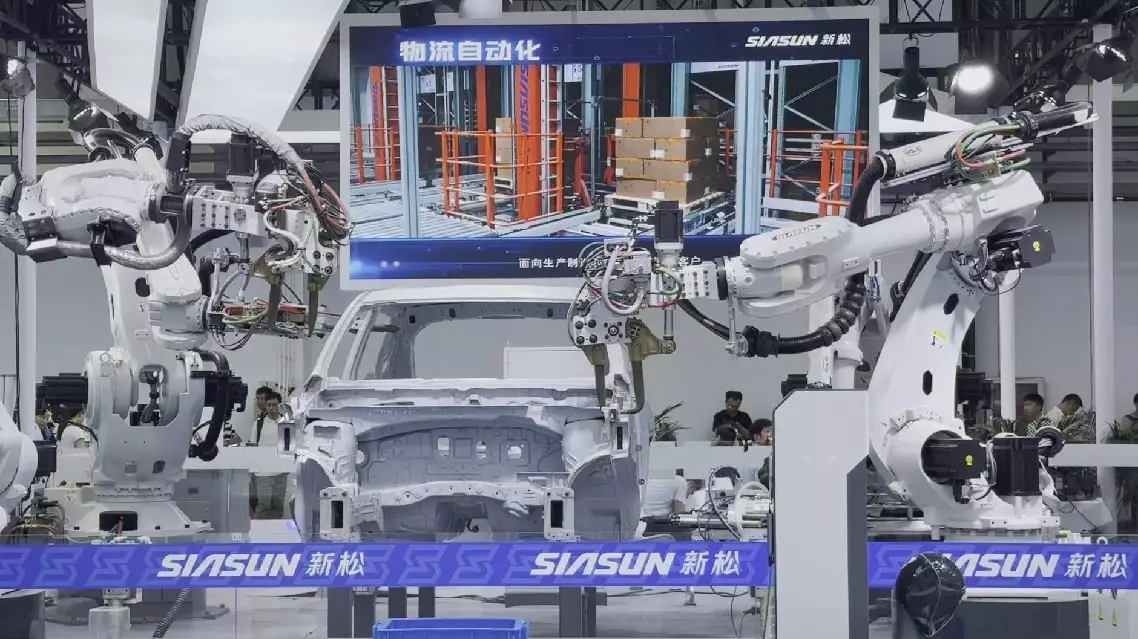
During the event, SIASUN Robot and Automation Co., Ltd. unveiled two new humanoid robots, "Songyi Agile" and "Songyi Power", designed for high-precision flexible operation and heavy-duty work scenarios. The company also unveiled OneHub, an intelligent multi-robot collaboration platform that unifies humanoid robots, mobile robots, and robotic arms.
"More importantly, we have simultaneously launched OneHub, a multi-robot collaboration system. In the past, people focused more on the performance of individual robots, but we believe that future industrial scenarios will involve multiple robots of different types working together. OneHub serves as an intelligent central hub, enabling one input to control multiple robots by decoupling tasks from robotic hardware, allowing various robots to operate in coordinated clusters and truly integrating collective intelligence into real factory production. The greatest value of OneHub lies in solving the problem of multiple robots operating independently by decoupling tasks from hardware. Whether humanoid robots, mobile robots, or robotic arms, all can be integrated into this system in the future. With unified scheduling and centralized control, users no longer need to manage specific devices -- simply set task objectives to achieve collaborative cluster operations," explained Liu Mingmin, Senior Director of the intelligent robotic research center at SIASUN Robot.
The focus on core-component autonomy was equally prominent at the exhibition, with precision sensors and dexterous end-effectors drawing strong attention.
Zhou Yi, head of East China and North America at Hangzhou-based Xynova, demonstrated a robotic hand with tactile sensors and a proximity camera for distance detection.
"You can see here the fingertips, the palm. And there we have all the fingertips for the tactile sensors, also we have a proximity camera here to detect distance between the objects and the hands. And also, in the rest we have a 3D camera here to have a very precise 3D location for the objects. Like overall which is like 1.8 kilo including the hands, it’s only like 400 grams," said Zhou.
The potential uses for robots are also expanding beyond the factory.
Yang Nan, senior business manager of Beijing-based Noetix Robotics explained that humanoid and bionic robots can be deployed in a variety of everyday scenarios.
"The first is education scenarios like the school, the elementary school and also at the home, and another one is the reception. We often use our robots at the museum, the airport and the hospital," she explained.
Independent core tech, multi-robot collaboration highlight 2026 World Robot Conference