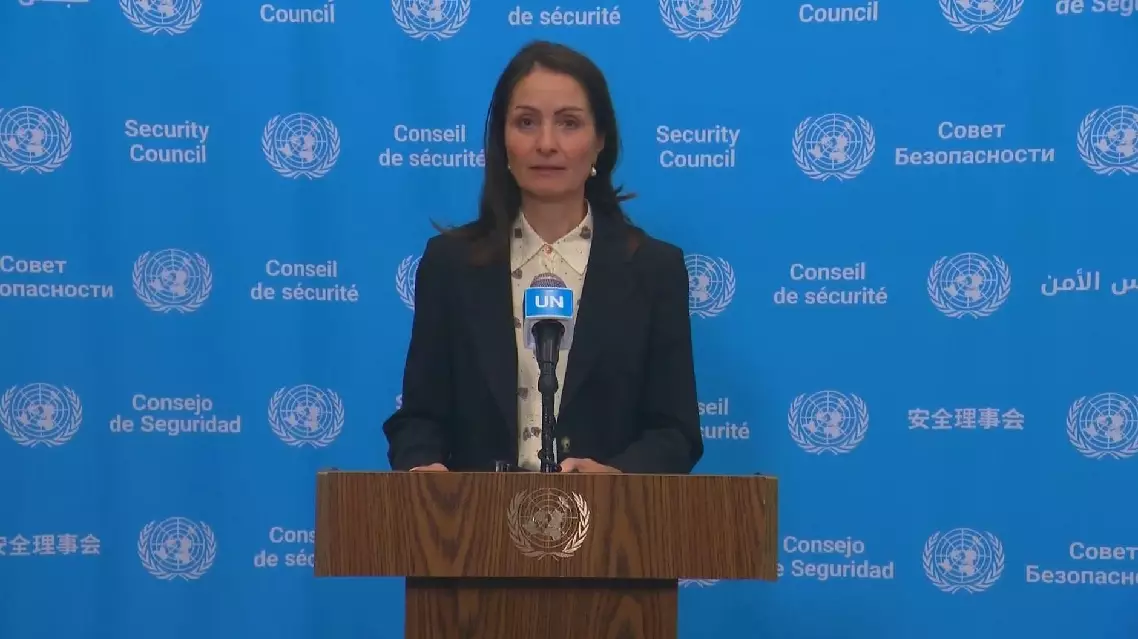
Carolyn Rodrigues Birkett, Guyana's permanent representative to the United Nations (UN), emerged as the top candidate in the second informal straw poll for the next UN secretary-general, held Friday by the Security Council.
Rodrigues Birkett received eight "encourage" votes, edging ahead of Costa Rica's Rebeca Grynspan, according to sources familiar with the closed-door vote.
"The second round of straw polls has taken place," said Christina Markus Lassen, the UN ambassador of Denmark, whose country holds the rotating presidency of the Security Council for the month of August.
Lassen told reporters after the secret vote that "the candidates will be informed of the results through the respective permanent representatives of nominating member states. The President of the General Assembly will also be informed that the straw poll has been concluded."
Through straw polls, the Security Council selects a candidate to recommend to the General Assembly for appointment as the next UN secretary-general.
Security Council straw polls on secretary-general candidates are informal closed-door ballots used to gauge support for the candidates. Their results are not officially released.
Article 97 of the UN Charter states that the secretary-general shall be appointed by the General Assembly upon the recommendation of the Security Council.
Lassen did not provide any details of Friday's vote. However, it is believed that all eight candidates were on the ballot.
The eight candidates currently in the race are: Ivonne A-Baki, former Ecuadorian minister and diplomat; Michelle Bachelet, former Chilean president and former UN high commissioner for human rights; Maria Fernanda Espinosa, former UN General Assembly president and former foreign minister and defense minister of Ecuador; Rafael Grossi of Argentina, current director general of the International Atomic Energy Agency; Rebeca Grynspan, former vice president of Costa Rica and current secretary-general of the UN Conference on Trade and Development; Olara Otunnu of Uganda, former UN under-secretary-general; Carolyn Rodrigues Birkett, Guyana's permanent representative to the United Nations; and Macky Sall, former president of Senegal.
Security Council members were believed to have received one ballot per candidate, containing the candidate's name followed by three options: "encouraged," "discouraged," and "no opinion expressed," according to What's in Blue, which provides insights into evolving Security Council actions.
The term of current UN Secretary-General Antonio Guterres will end on December 31.
Guyana's UN envoy leads in second straw poll for next secretary-general
China's resolve to safeguard its sovereignty and territorial integrity and achieve national reunification remains unwavering, Chinese Foreign Minister Wang Yi said on Tuesday.
During a phone conversation with Philippine Foreign Affairs Secretary Ma. Theresa Lazaro, Wang, also a member of the Political Bureau of the Communist Party of China Central Committee, urged the Philippine side to faithfully implement its one-China policy and exercise prudence in its words and actions on maritime issues.
Noting that China-Philippines relations are facing malicious interference at present, Wang said that a few Philippine politicians, out of political prejudice and self-interest, have repeatedly attacked and smeared China.
Such deeds have crossed China's red lines, politicized normal economic, trade and people-to-people exchanges, and infringed upon the legitimate rights and interests of Chinese personnel and institutions in the Philippines, Wang said.
Such deeds are irrational and intolerable, and damaging to the Philippines' own international image, Wang said, adding that Manila should exercise greater restraint over the individuals concerned and ensure that its policy toward China reflects a rational and unified voice.
For her part, Lazaro said that the Philippines attaches great importance to its relations with China and hopes to develop a stable and predictable bilateral relationship.
Given the challenges that countries currently face in areas such as economy and energy, communication between the Philippines and China is conducive to managing differences, improving bilateral ties, and promoting regional peace and stability, Lazaro said.
The Philippines, she added, remains committed to the one-China policy, a position that will not change, and is also prepared to address maritime and other issues appropriately through dialogue and consultation.
As the ASEAN rotating chair, the Philippines appreciates and looks forward to China playing a greater role in advancing the ASEAN-China Comprehensive Strategic Partnership to achieve further results, she said.
The two sides reached basic consensus on improving and developing China-Philippines relations. They agreed that healthy and stable bilateral relations serve the interests of both sides and meet regional expectations, and they agreed to maintain diplomatic dialogue to that end.
They agreed that the two countries should work together to eliminate all internal and external interference, and oppose any malicious provocation or behavior aimed at undermining their diplomatic engagement.
They also agreed that both sides should responsibly manage their differences, stabilize the situation and seek to expand their shared interests.
Wang and Lazaro also exchanged views on the leaders' meetings on East Asian cooperation to be held in the Philippines, as well as the APEC Economic Leaders' Meeting to be held subsequently in Shenzhen, China.
China's resolve to safeguard sovereignty, territorial integrity remains unwavering, says FM