China's foreign trade has seen balanced development so far this year, with imports growth outpacing exports for five consecutive months, reinforcing the country's dual role as both a global "super seller" and a "super buyer."
From January to July, China's goods imports reached 12.69 trillion yuan (about 1.89 trillion U.S. dollars), an increase of 22 percent year on year, which is 8 percentage points higher than export growth.
Serving as the primary export destination for nearly 80 other countries and regions, China has been the world's second-largest import market for 17 consecutive years, with its imports growing by an average annual rate of 5.1 percent.
The export growth has been driven by the high demand for raw materials and components from its world's largest manufacturing sector, and the rising demand for premier consumer goods from its vast market.
In the first half of 2026, China's imports of metal ore increased by 22.6 percent year on year.
"In the first seven months of this year, 7.08 million tons of iron ore was imported through the Beiliang Port, up 17.3 percent year on year," said Qi Xuesong, deputy head of the customs office at the Beiliang Port in Dalian, northeast China's Liaoning Province.
The city of Dalian hosted the 2026 APEC Customs Business Dialogue on Thursday and Friday, during which China's General Administration of Customs signed six bilateral agreements on the trade of agricultural and food products, and customs cooperation with its counterparts from Peru, Chile and other APEC economies.
"We have a big export table, [which] offers not only fruits but vegetables and fishery goods. Our exportations are increasing deal by deal," said Ingrid Huapaya Puicon, customs and trade facilitation coordinator for the Ministry of Trade and Tourism of Peru.
China has expanded its import sources for agricultural and food products to more than 150 countries and regions, further driving up imports.
The country has also established numerous platforms such as the China International Import Expo (CIIE) to help global specialty products enter the Chinese market.
The 9th CIIE will take place from Nov 5 to 11 in Shanghai. So far, more than 1,300 companies from 104 countries and regions have already signed up for the exhibition at this year's expo, which is expected to cover an area of over 350,000 square meters.
China has also launched "Big Market for All: Export to China," a major trade promotion initiative to boost imports and foster balanced trade growth. It features over 100 matchmaking and promotional events aimed at helping overseas exporters sell goods and services directly to Chinese consumers.
On Wednesday, the Ethiopia Session of the series was held in Addis Ababa, bringing together around 200 representatives and entrepreneurs from both countries.
The event witnessed the signing of multiple trade agreements, with the total contract value exceeding 2.2 billion yuan (about 327 million U.S. dollars).
"China is having a new policy of making zero tariffs, which is giving us a very big advantage to continuously increase our market destination and connections with Chinese coffee importers. Today, I signed a coffee supply agreement with one of the largest coffee importing companies in China. I hope the future is bright with the Chinese market," said Abel, an Ethiopian coffee exporter.
On May 1, China expanded its zero-tariff treatment to cover all 53 African countries with which it has established diplomatic ties. In the following two months, China's imports from Africa rose by 23.5 percent to 193.8 billion yuan (about 28.83 billion U.S. dollars).
"Zero tariff market access initiatives for African exporters, the doors to the world's most dynamic market of 1.4 billion consumers, are cast wide open for Ethiopian businesses," said Kassahun Gofe, Minister of Trade and Regional Integration of Ethiopia.
To date, China has offered zero-tariff treatment to 63 countries, with its overall tariff level reduced to 7.3 percent, one of the lowest globally.
Since 2022, the General Administration of Customs has granted import permits for durians from five other countries, including Vietnam and Malaysia.
Customs data showed that China's fresh durian imports reached 1.868 million tons in 2025, doubling from 2022 levels.
In the first seven months of 2026, the country's fresh durian imports grew by 31.4 percent year on year, with the total value rising by 26.5 percent year on year.
In Shenzhen City of south China's Guangdong Province, durian arrivals at the local Haijixing agricultural products wholesale market reached 400 tons from Aug 1 to 18, a surge of 50 percent from July, leading to price drops of some varieties by nearly 30 percent.
Aside from consumer goods, China's high-end manufacturing sector has continued to demonstrate robust demand for global quality products.
In the first seven months, imports of mechanical and electrical products accounted for over 40 percent of the country's total imports, making them the largest import category by value.
As a bellwether for foreign trade, Shenzhen's imports of mechanical and electrical products reached 1.28 trillion yuan (190.4 billion U.S. dollars) in the first seven months, marking an increase of 53 percent and accounting for 77.7 percent of the city's total import.
Economists from multiple international institutions have pointed out that the sustained vitality of China's imports is offering strong momentum for stable operations of the global supply chain and the growth of world trade.
"As China is the world's second-largest economy, the country's enormous imports are a major driving force for global trade. Many Asian economies are export-oriented. For example, Singapore and Malaysia have seen year-on-year export growth to China of about 20 to 40 percent. When global trade is unstable, China's demand provides a great buffer for them," said Samuel Tse, a senior economist of DBS Bank.
"The growth in imports of production materials, including mechanical and electrical products and high-tech products, reflects that China is the world's largest buyer of intermediate and capital goods. I think for the global supply chain, China is not only a product exporter, but also a barometer of global demand," said Zerlina Zeng, head of APAC credit strategy at CreditSights, a financial research firm.
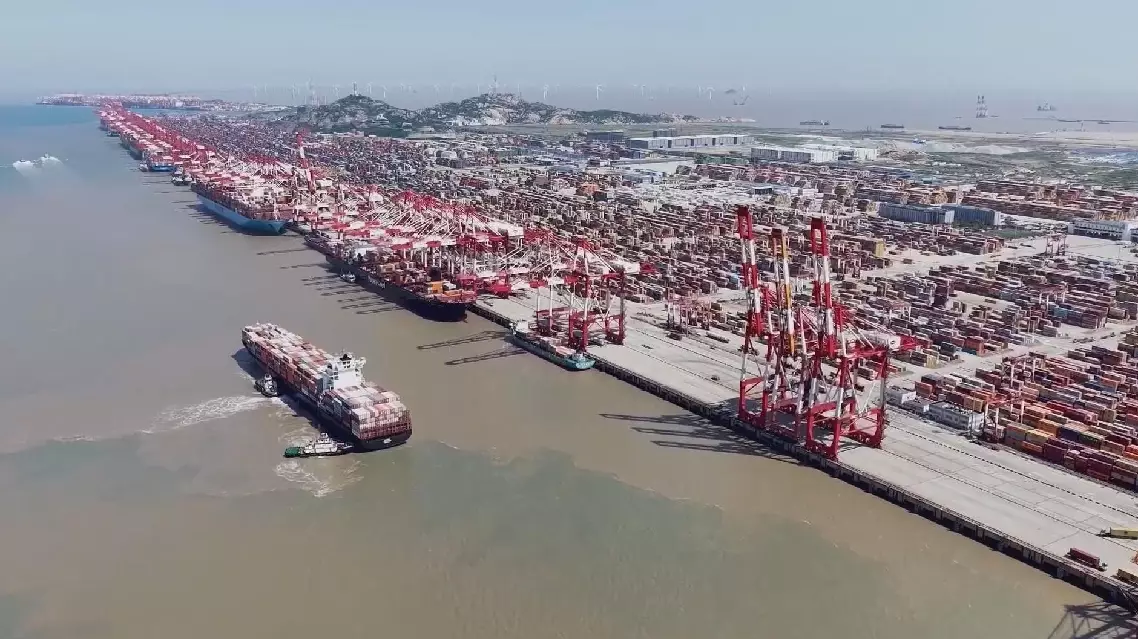
China's foreign trade secures balanced growth as imports outpace exports