Early Motown songwriter Janie Bradford Hobbs, who helped pen hits including “Money (That’s What I Want)” and “Too Busy Thinking About My Baby," has died following an extended illness at a Los Angeles hospital, her family said Saturday. She was 87.
Bradford Hobbs was born in Charleston, Missouri, and later moved to Detroit.
She was introduced in the late 1950s to Motown founder Berry Gordy by neighbor and singer Jackie Wilson. She joined Motown as a receptionist in 1958 and like many of the company's employees took part in the creative process that helped make Motown a music industry powerhouse.
She and Gordy co-wrote “Money (That's What I Want)." The song was recorded in 1959 by Barrett Strong and became an early hit. It was covered by The Beatles and also became one of that group's hits.
“Too Busy Thinking About My Baby” first was recorded by The Temptations and later became a hit for Marvin Gaye. Bradford Hobbs also wrote songs for Stevie Wonder, The Supremes, Martha & The Vandellas and others.
“Janie was there with me from the very beginning, before there was even a Motown, and she will always hold a very special place in my heart and in the Motown family,” Gordy said in a statement.
“Janie was one of a special group I have always thought of as the original Motown family — the unsung heroes who believed in the dream before anyone knew what Motown would become,” Gordy continued. “She was one of the people who helped make Motown what it became.”
Bradford Hobbs later became head of Writer Relations for Jobete, Motown's publishing company. After leaving Motown, she founded the annual Heroes and Legends Awards. The event spanned about 30 years, honoring music icons and awarding scholarships, according to her family.
She is survived by her husband, Wardean Hobbs; daughter, Nicole Hobbs; son, Lance Finney; and two grandsons. Funeral services have not been completed.

FILE - Janie Bradford, left, and George Clinton attend a ceremony honoring Clinton with a star on the Hollywood Walk of Fame, Jan. 19, 2024, in Los Angeles. (Photo by Richard Shotwell/Invision/AP, File)
Hand grip strength. Balance tests. Standing up from a seated position on the floor. These physical challenges are often touted as measurements of healthy aging and even predictors of longevity.
They can provide valuable indications of your stamina and strength. They can estimate the risk of falls, which increase older adults ' risk of death. And they're useful to doctors who work to address aging or people with injuries.
But they're no crystal ball.
“A poor or declining result is a reason for a health professional to investigate why function is changing, rather than gauging how long someone will live,” said Auriel Willette, an expert on brain aging at Rutgers University.
Here's a look at what mobility tests entail and how to apply the results to your health.
“Sit-to-stand” tests come in several forms. The U.S. Centers for Disease Control and Prevention's 30-second chair-stand test is designed for patients older than 60, to see how many times they can stand up in that time period.
Another test, popularized on social media, asks someone to move from standing, to sitting cross-legged on the ground, and then back up to standing. Making your way down to the floor is worth 5 points, as is standing up, for a total score of 10. You lose a point for each support you use (such as a hand or knee) and half a point if you're unsteady. The score is zero if you're unable to sit or stand without external help.
Doctors said they haven’t seen the test used with older U.S. adults, but researchers in Brazil published studies in 2020 and 2025 that concluded middle-aged people who scored higher were less likely to die within about a decade.
Many American doctors use a test called “Timed Up and Go,” or TUG. It requires the patient to get up from a chair, walk 10 feet (3 meters) and come back to their seat. That allows doctors to evaluate a person's balance, mobility and lower extremity strength all at once.
Dr. George Hennawi, who treats older adults at MedStar Health in Baltimore, said all the tests are meant to pinpoint specific weaknesses and narrow down their underlying cause, whether that's knee pain, slow reflexes, poor balance or feeling winded or dizzy because of cardiovascular issues.
“The key to react to it is to understand where did we not do well,” he said.
Tests like the viral sit-to-stand one are what doctors call screening tools. They're helpful in narrowing down issues, but they don't provide enough information for a full diagnosis.
Other popular tests for a person's “physiological age,” or how your body is aging, include tests of grip strength, walking speed, gait steadiness and balance. Such tests look at how hard your hand can squeeze something, whether you favor one side while walking, how long and well can you stand on one leg and how far forward can you reach without becoming unsteady.
Many doctors also use these challenges to understand a person’s risk for “frailty,” a medical condition that means the body is less able to handle strain from illness or injury.
Doctors sometimes use a 10-minute assessment called the Short Physical Performance Battery, which includes several tests including gait, balance and strength. It was developed by the National Institute on Aging and large clinical trials have shown it predicts mortality, disability and more.
At the University of California, Los Angeles' Multidisciplinary Falls Clinic, Dr. David Lee said it's important to look across multiple tests in combination. Grip strength, for example, is predictive of many different things, but it can be affected by arthritis, stroke or even simply not conditioning those muscles.
“It’s one measure of many,” Lee said.
Experts note that strength and mobility are just one part of healthy aging. Tests of cognition, memory, hearing, eyesight and many other measures are key to evaluating how someone is aging.
They also cautioned against training to pass a test. Instead, keep the big picture in mind. Exercise your whole body. Eat nutritious meals. Address stress in a healthy way. Prioritize your sleep. Take care of your heart.
Finally, experts said it’s important to know the context in which a test has been studied and verified. If it’s shown to predict an outcome for one age group, the performance standards won’t necessarily apply to others.
If you score poorly in a mobility test and are concerned about your fall risk, or have recently fallen, talk to your doctor. The test results are the first step in determining if you need an assistive device, physical therapy, a change in medications or something else, said Emily Nabors, a falls prevention expert with The National Council on Aging.
She cited one estimate that more than a quarter of older adults fall each year, but most of them don't tell their doctor about it.
“If you've fallen, you might feel fine,” she said, “but you might not be fine at all.”
The Associated Press Health and Science Department receives support from the Howard Hughes Medical Institute’s Department of Science Education and the Robert Wood Johnson Foundation. The AP is solely responsible for all content.
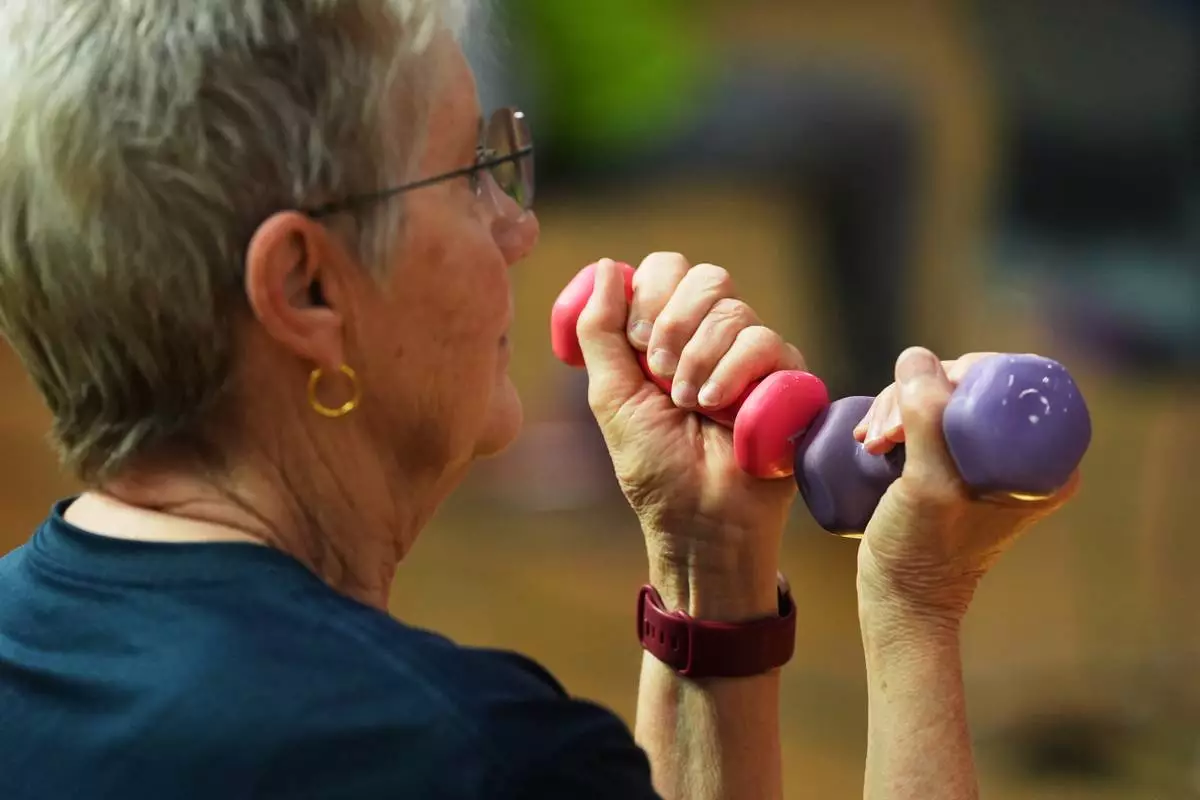
FILE - A participant uses light weights during a class for older adults at the Dale Turner Family YMCA in Shoreline, Wash., April 30, 2026. (AP Photo/Lindsey Wasson, File)