A Palestinian political figure has called for internal unity and support from the international community to counter Israel's accelerating settlement expansion in the West Bank.
Israel on Tuesday advanced plans for the controversial E1 settlement project in the West Bank, publishing a tender for 1,234 housing units. The tender, published online by the Ministry of Construction and Housing, covers part of a wider plan for 3,401 housing units in E1, an area east of Jerusalem.
"The Israeli establishment is expanding settlements in the West Bank at a rate that is unprecedented, because their goal is to destroy any potential for a Palestinian state," said Mustafa Barghouti, member of the Palestine Liberation Organization's Central Council and Secretary-General of Palestinian National Initiative, in an interview with China Global Television Network (CGTN).
"The only solution for Palestinians is to be unified immediately, to put away all kinds of internal differences and have a new strategy against this terrible process of land appropriation, land annexation," he said.
Mustafa Barghouti called on the international community to support the establishment of an independent State of Palestine, and advance the two-State solution.
"The Palestinian Authority is absolutely incapable of responding to all of that, and it will not be able to do anything unless we unify all Palestinians together in one unified leadership around one specific goal: how strategically to encounter the settlers' terror and the settlers' expansion through consolidating the utmost possible steadfastness of the Palestinian people on the land," he said.
"So, the international community has to answer one question here: Do they still believe in international law or not? Palestine is the indicator. If Israel is allowed to continue, this would mean the end of the so-called international law, and the end of all arrangements that were created after the Second World War to create peace in the world," Barghouti said.

Palestinian political figure calls for unity to counter Israel's settlement in West Bank
New Zealand's ruling National-led coalition has secured a parliamentary majority in the general election, preliminary results showed early Sunday, putting Prime Minister Christopher Luxon on course to retain power for a second term.
The Election Commission's tally of all voting places has resulted in 11 "overhang" seats, increasing to 131 the total number of seats in parliament, which normally has 120.
Among the seats, the National Party, ACT New Zealand and New Zealand First collectively secured 67, giving the three-party coalition a narrow majority to continue governing, while the opposition bloc of the Labor Party, the Green Party and the Maori Party garnered 57 in total.
The contest between the National and the Labor, led by former prime minister Chris Hipkins, remained exceptionally close, with each securing over 29 percent, according to preliminary figures.
Addressing supporters in Auckland, Luxon said the election was "too close to call," with the final outcome hinging on special votes to be counted. He acknowledged that negotiations and compromise would be needed to form the next government.
The outcome could still change when 700,000 special votes are counted days later. These include ballots cast by overseas voters and people voting outside their electorates, and are not included in the preliminary results, according to the Electoral Commission, which is scheduled to release the final official results, including special votes, on Nov. 27.
The Green Party has won a record 16 seats in parliament. The centrist Opportunity Party has also made a parliamentary breakthrough, projected to win seven seats, preliminary results showed.
The country has nearly 3.8 million provisionally enrolled voters for the 2026 general election, representing 93.6 percent of the estimated eligible population, below the final enrolment rates of 94.7 percent in 2023 and 94.1 percent in 2020, the commission said.
New Zealand uses the mixed-member proportional voting system to elect its parliament. Under this system, voters cast two ballots, one for a political party and another for their local electorate candidate. The government is usually formed by two or more parliamentary political parties.
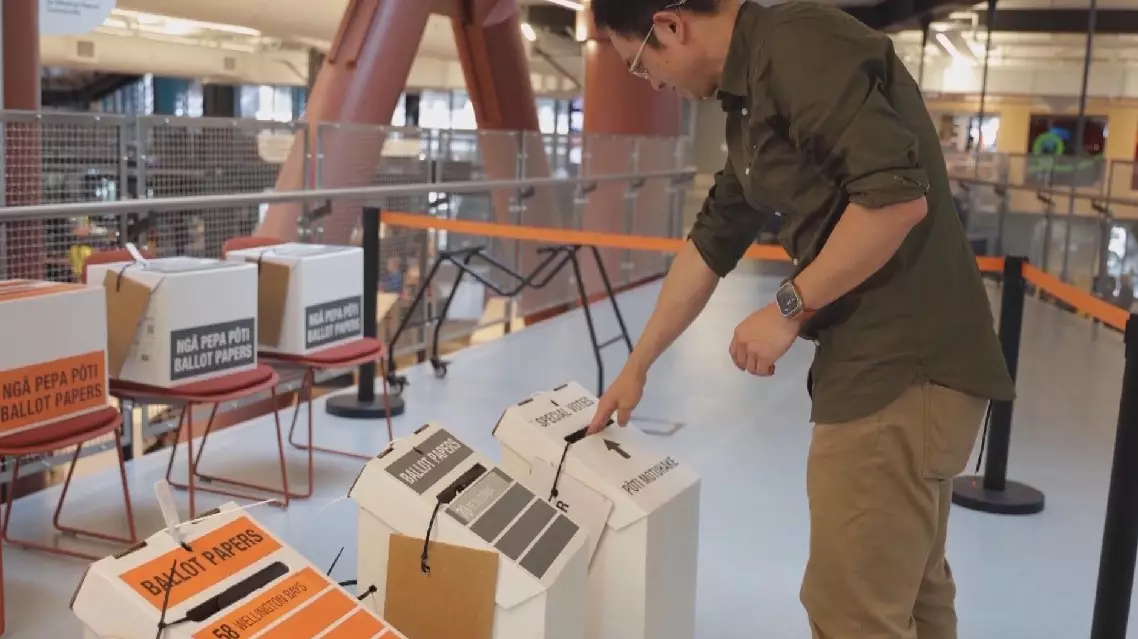
New Zealand's National-led coalition wins majority parliamentary seats: preliminary results