Skip to Content Facebook Feature Image

Mexican governor indicted by the US seeks leave again after contentious return to office

News

Mexican governor indicted by the US seeks leave again after contentious return to office
News

News

Mexican governor indicted by the US seeks leave again after contentious return to office

2026-08-24 03:13 Last Updated At:03:20

MEXICO CITY (AP) — The embattled governor of Mexico’s Sinaloa state has reversed his decision to return to his post, bowing to an extraordinary backlash from his own ruling party over accusations by U.S. prosecutors he conspired with a powerful cartel to smuggle drugs into the United States.

State lawmakers were expected Sunday to approve Gov. Rubén Rocha Moya’s request for an indefinite leave of absence, about a day and a half after he announced his return by claiming Mexican prosecutors had cleared him of the drug trafficking charges leveled against him by the U.S. Department of Justice in late April.

The rapid reversal demonstrated the authority Mexican President Claudia Sheinbaum wields over her Morena party as she walks a fine line between placating U.S. President Donald Trump, who says cartels control Mexico and has repeatedly offered U.S. military help to fight them, and her progressive movement deeply wary of U.S. intervention.

After nearly four months on leave, Rocha Moya announced Friday that he was returning to office, claiming Mexico’s Attorney General’s Office had found “no evidence to support our participation in any criminal conduct.” He declared that he was back “as governor of Sinaloa with my head held high.”

That defiance lasted barely a day, as his return unleashed a torrent of criticism from governors, senators and other prominent figures in Morena, including Sheinbaum.

“No personal interest can ever come before the interests of the people and the nation,” she wrote Saturday in an apparent rebuke of Rocha Moya, without mentioning him by name. “Mexico deserves public servants who understand that positions are temporary, but responsibility to the nation is eternal.”

Morena said its national leadership had no prior knowledge of Rocha Moya’s return, calling it his “personal decision.” The party’s Senate bloc urged respect for the ongoing investigation, while Morena governors declared in a joint statement that “personal or group political projects have no place” when the country’s interests are at stake.

Ricardo Monreal, Morena’s leader in the lower house of Congress, publicly urged Rocha Moya, his longtime ally, to reconsider and remain on leave.

The coordinated response left Rocha Moya isolated. He announced later Saturday that he had asked the state legislature to allow him to step aside indefinitely. “Sinaloa, the nation and the transformation movement come first,” he wrote.

Rocha Moya had been on leave since early May, days after federal prosecutors in New York unsealed a bombshell indictment accusing him and nine other current and former Mexican officials of protecting Sinaloa cartel members in exchange for bribes as they trafficked fentanyl, heroin, cocaine and methamphetamine into the U.S.

The indictment marked the Trump administration’s most significant public action against what it calls official corruption enabling Mexico’s cartels, fueling new tension between the U.S. and Mexican governments. Sheinbaum has denied shielding Rocha Moya but rejected Washington’s request to arrest and extradite the defendants without credible evidence, insisting that any prosecution take place in Mexico.

Rocha Moya, 77, a staunch ally of Sheinbaum’s mentor, former President Andrés Manuel López Obrador, denied wrongdoing and described the charges as a politically motivated attack. He initially stepped aside so he could cooperate with the Mexican investigation without relying on the constitutional immunity attached to his office. Whether taking leave stripped him of that protection — and whether his latest request to step aside indefinitely would do so again — remains disputed among Mexican legal scholars.

After the indictment, the mayor of Culiacán, Sinaloa’s capital, and the state’s deputy attorney general also stepped down from their posts, while two former senior state officials surrendered to U.S. authorities.

Sinaloa has been engulfed for nearly two years in a bloody conflict between rival factions of the cartel that bears the state’s name.
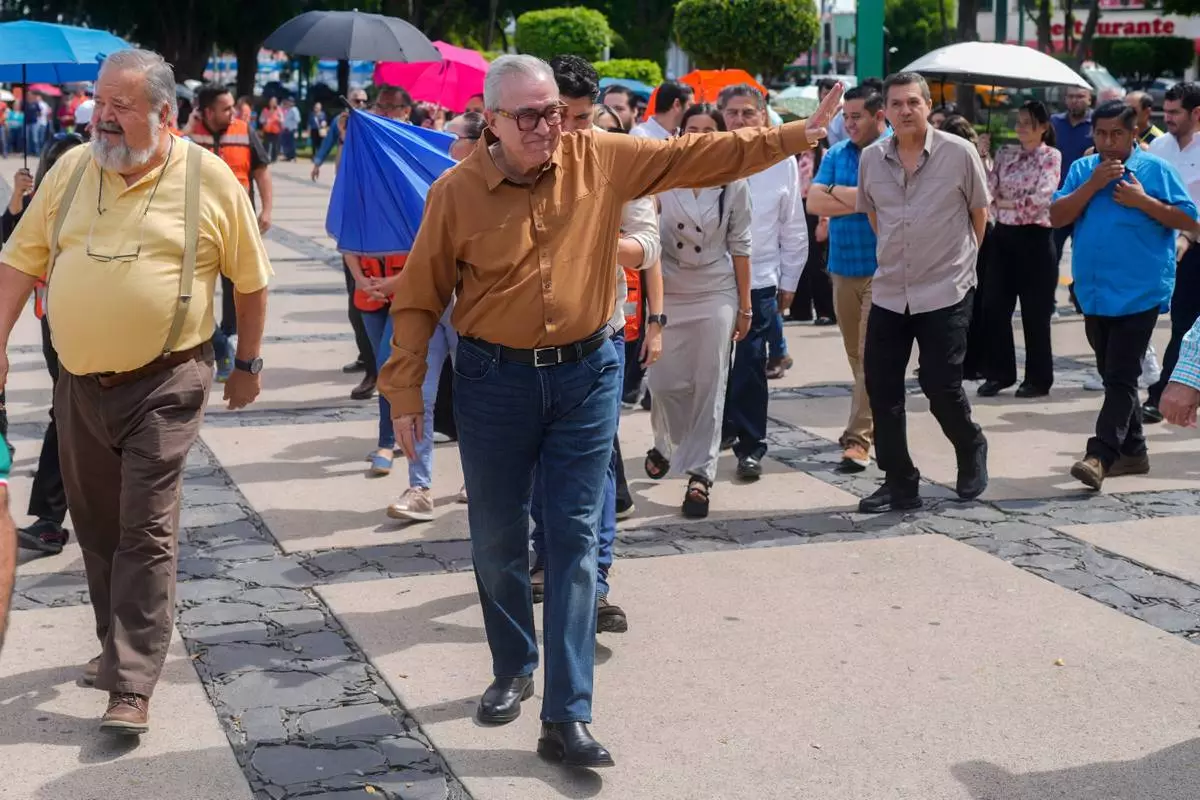
FILE - Sinaloa state Gov. Ruben Rocha waves as he takes part in an annual earthquake drill in Culiacan, Mexico, Sept. 19, 2024. (AP Photo/Eduardo Verdugo, File)

FILE - Sinaloa state Gov. Ruben Rocha waves as he takes part in an annual earthquake drill in Culiacan, Mexico, Sept. 19, 2024. (AP Photo/Eduardo Verdugo, File)
BEIRUT (AP) — The U.S. special envoy to Syria and ambassador to Turkey on Sunday walked back his comments from two days ago that Israel "still” occupies the Golan Heights in violation of U.N. resolutions, remarks that went against U.S. President Donald Trump 's position on the disputed territory.

Israel captured the Golan Heights from Syria in the 1967 Mideast war and annexed it in 1981. The United Nations and most of the international community consider the territory occupied Syrian land and does not recognize Israel’s annexation of it.

In 2019, Trump recognized Israeli sovereignty over the territory, reversing decades of U.S. policy.

Ambassador Tom Barrack on Friday said that Israel “still” occupies the territory in an interview with Lebanese-Australian entrepreneur Mario Nawfal.

Barrack now says that was a description of the territory’s historical status, “not an endorsement of the United Nations’ position” on the Golan.

"United States policy on the Golan was set by President Trump in 2019 and is unchanged,” he said in a statement to The Associated Press on Sunday.

He said he intended to explain why he does not anticipate annexation in Lebanon, where Israeli forces are occupying parts of the south after the latest Israel-Hezbollah war, and to argue that negotiated agreements, rather than territorial maps, are more durable and that he had cited the Golan as an example that “territory taken by force remains contested for generations.”

In the Friday interview, Barrack had also criticized Israel’s strikes on an airbase in northern Syria earlier last week. Israeli officials said the strikes intended to prevent Turkey from establishing a presence at the base.

Israeli Defense Minister Israel Katz defended the strikes, saying on X on Sunday that critics who initially called it “unnecessary and politically motivated” changed their position after the government said they were based on “clear intelligence” and at the recommendation of the Israeli army. He added that Israel would not allow Turkey “to establish itself in Syria and threaten Israeli security.”

The strikes last Tuesday have highlighted growing tensions between Israel and Turkey over Ankara’s increased influence in Syria following the fall of Bashar Assad. Turkey and Syria have denied that Turkish forces were due to be deployed at the Abu Duhur base.

Barrack’s comments on the Golan also sparked a backlash in Washington.

Florida Republican Sen. Rick Scott wrote on X that the ambassador appears to have “forgotten” Trump’s recognition of Israeli sovereignty over the territory.

Barrack went further on the defensive on Sunday, responding to criticism of his assessment of ongoing negotiations between Israel and Lebanon over Israeli withdrawal and the disarmament of the militant group.

He had said “there are two people missing from that (negotiating) table – Hezbollah and Iran.” That remark prompted speculation Barrack meant Tehran and Hezbollah should join the U.S.-backed negotiations.

On Sunday, Barrack stressed that the U.S. does not negotiate with Hezbollah, but said he was pointing out that “the weapons in question are supplied and financed by Iran," which complicates negotiations over their fate.

“I was describing the difficulty of the problem, not proposing a new table,” Barrack told the AP. “Hezbollah is a designated foreign terrorist organization. We do not negotiate with it, and nothing I said suggests otherwise.”

He also defended his remarks questioning who would replace Tehran’s financial support for Shiite communities in southern Lebanon, saying that raising those questions was “not conferring standing on anyone.”

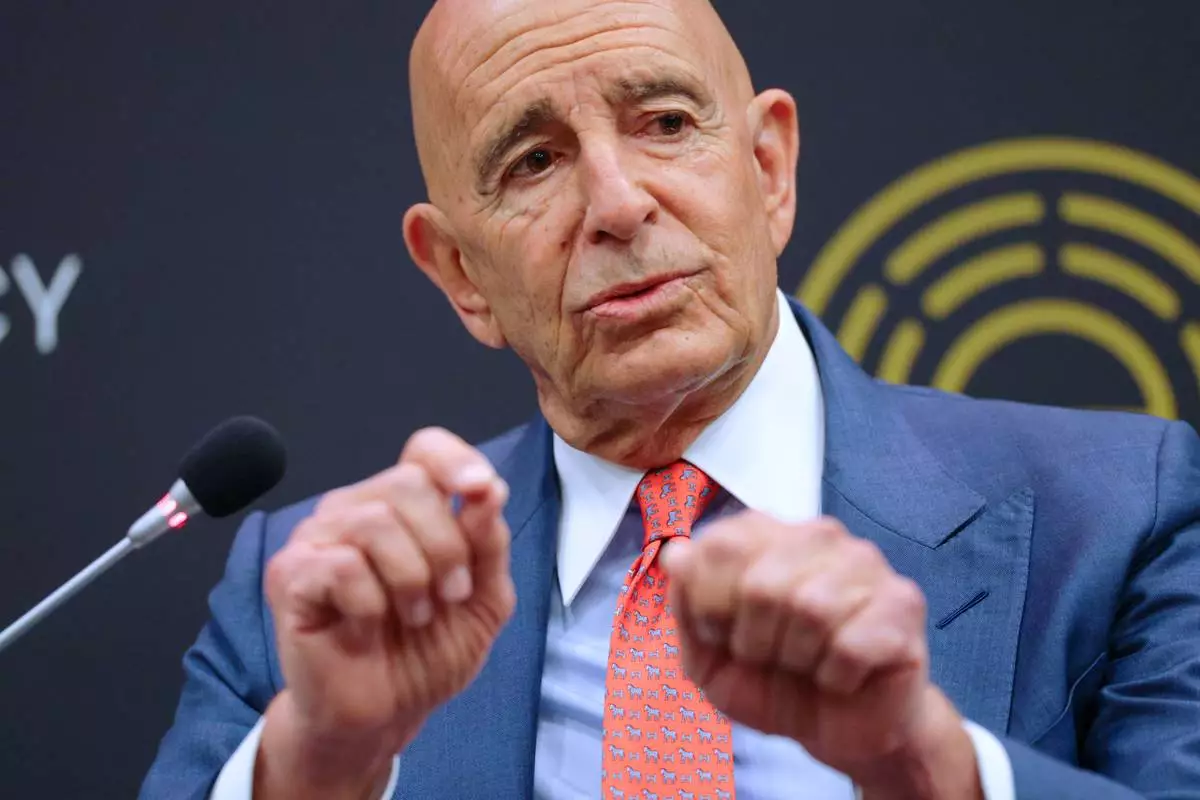
FILE - U.S. Ambassador to Turkey and Special Envoy to Syria Tom Barrack speaks in a panel during the Antalya Diplomacy Forum in Antalya, southern Turkey, April 17, 2026. (AP Photo/Riza Ozel, File)

FILE - U.S. Ambassador to Turkey and Special Envoy to Syria Tom Barrack speaks in a panel during the Antalya Diplomacy Forum in Antalya, southern Turkey, April 17, 2026. (AP Photo/Riza Ozel, File)

Recommended Articles