The unfolding Second World Humanoid Robot Games in Beijing is showcasing not only high-profile feats of robotic athleticism but also practical skills that could see humanoids being widely adopted in real-world homes and workplaces.
The Second World Humanoid Robot Games officially kicked off on Saturday at the National Speed Skating Oval, or "Ice Ribbon," in Beijing.
For five days, a total of 2,056 robots of 666 teams representing 16 countries and regions will compete in 51 challenges, including 30 competitive events and 21 scenario-based contests spanning nine fields, to push the boundaries of embodied AI and robotic capability.
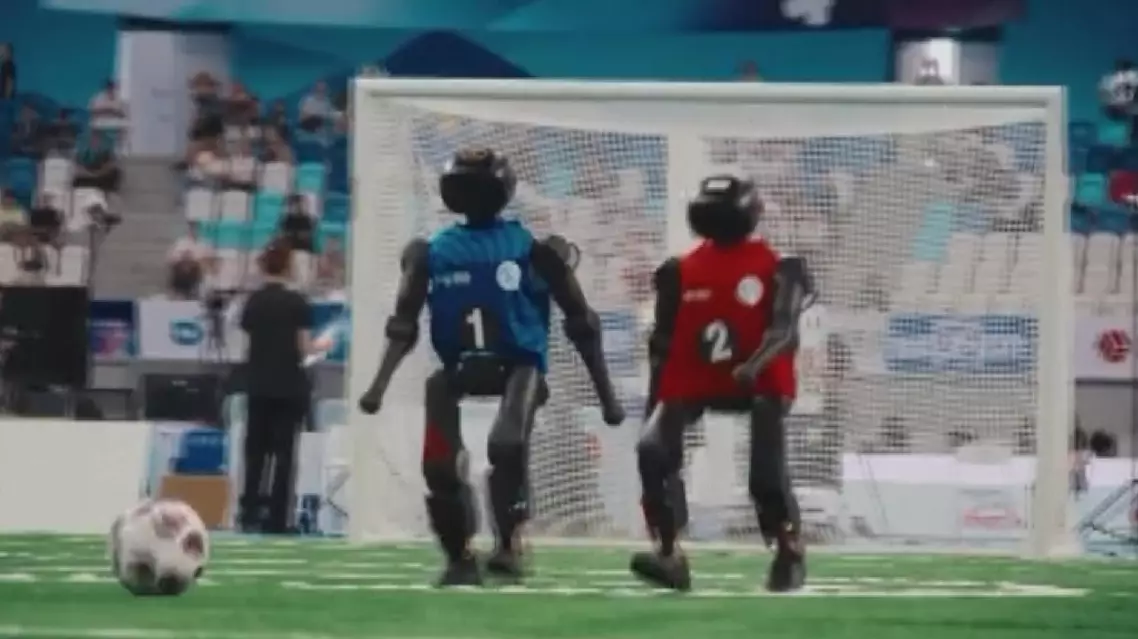
Competitive events include athletics, football, gymnastics, weightlifting, table tennis, wushu (martial arts), street dance, kickboxing, and more.
For the games, the Beijing Innovation Center of Humanoid Robotics (X-Humanoid) fielded several teams and secured championship titles in a number of disciplines.
Meng Xiang, a motion control algorithm specialist at the center, explained the technological logic behind their victories.
"We rely on real-time positioning, navigation and route planning systems to achieve fully autonomous high-speed running, pushing our hardware to its absolute limits and maximize its speed," he said.
In addition to powerful mobility capabilities, the Games also test a comprehensive set of the participating robots' fine-motors, dexterous manipulation skills. Only through the synergy of these two abilities can they truly enter production and everyday life.
A number of disciplines were specifically designed for testing dexterous hand skills this year, including power tool assembly, powder weighing, building block assembly, nail hammering, bottle and cap opening, box unpacking, bean picking with tweezers, and cable connection.
Yan Jiale, a Chinese contestant from the team representing Beijing-based AI startup DeepCybo, demonstrated the human-machine interaction technological approach for tasks such as bean picking with tweezers.
"Using the equipment worn on my body, I can capture my movements and transmit the corresponding signals to the robot. I believe the robot's hands are very powerful. I didn't train each task separately. If I can pick up beans with tweezers myself, then the robot can do it too. I simply perform the task, and the robot replicates it. It achieves about 80 to 90 percent of my level of precision," he explained.
The Games has become not only a technology showcase, but also a platform for international exchange.
Guilherme Escudeiro from Brazil's Centro Universitario FEI expressed the sentiments shared by many foreign participants.
"Coming to China is very exciting. We all were excited when we heard that we got the invite to come here. It's a great opportunity to represent our country, to show our skills here. We are a special team from Brazil: five different universities joining in one team to represent Brazil. So, it's a very good opportunity," he said.
Also traveling from afar to compete was Valerio Spagnoli, a graduate student from the Sapienza University of Rome. He said he was deeply impressed by the scale of this year's Games and the atmosphere at the venue.
"I think that is amazing because this event is like, wow! So, we are very happy and I'm proud to be here. I think that it was a bit confusing at the beginning but then I think that the robots find their way and we won, so we are happy. To prepare a game we need more or less one hour but we are testing and modifying the code and improving the code for the last five years, so it's a very long journey," he said.
The enthusiasm of international participants is driven not only by the spirit of competition but also by interest in the rapid development of China's robotics industry. In the first half of 2026, China shipped out more than 40,000 humanoid robots in the first half of 2026, capturing 97 percent of the global market shares, according to official data.
Dr. Timothy Wiley, a senior lecturer at the RMIT University in Melbourne, Australia, shared his observations from an industry development perspective. "The robotics industry in Australia is growing quite a lot. We have something like 15 billion U.S. dollars of investment across a range of technology areas and Australia has a national AI plan. However, of course, the Chinese industry is quite mature, so it's interesting to see it grow very rapidly and what's going to come in the next few years," he said.
World Humanoid Robot Games showcases droids' athletic prowess, practical skills