Skip to Content Facebook Feature Image

Weightlifting debuts as humanoids show strength at Robot Games in Beijing

China

China

China

Weightlifting debuts as humanoids show strength at Robot Games in Beijing

2026-08-25 19:37 Last Updated At:08-26 00:30

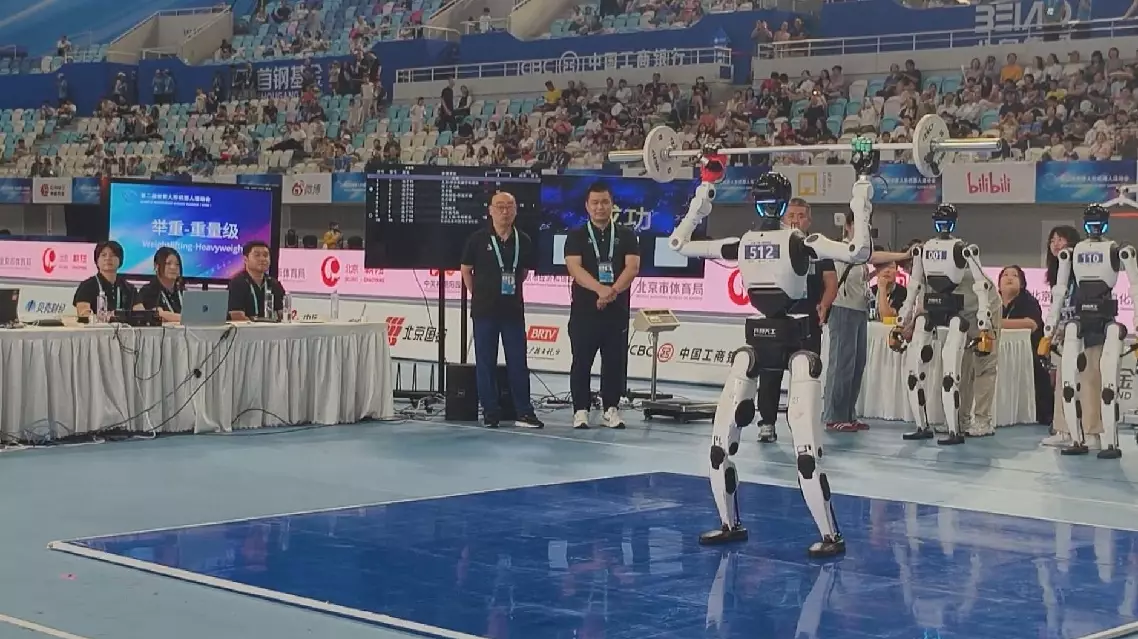
Humanoid robots flexed their muscles on Monday as weightlifting made its debut at the second World Humanoid Robot Games in Beijing, with the event testing bots' balance, stability and coordination and showing how these machines could soon work in factories and homes.

The five-day Games got underway at the National Speed Skating Oval in the Chinese capital on Saturday, with over 2,000 robots developed by more than 600 teams from 16 countries and regions battling it out in 51 competitive events.

Under the rules for the weightlifting contest, robots must grasp the barbell with both hands and lift it along a strictly vertical path, holding it steadily above their heads for at least two seconds for the attempt to count.

To create an even playing field, every competing robot must have a complete humanoid structure, and only its feet may touch the platform during the lift, while any contact from their torso, arms or knees results in a failed attempt. Rankings are based on the heaviest weight successfully lifted in a single try.

The distinctive structural requirement which sees the bots mimic the movements of their human weightlifting counterparts is central to the event's appeal, according to one competitor.

"The reason why we focus on humanoid structures is that many robots with [thicker] bases [instead of legs] can't lift such heavy weights, while humanoid robots can utilize the full-body torque to lift, giving them a higher potential limit," said Wen Han, a member of the joint team from the Beijing Innovation Center of Humanoid Robotics and Huazhong University of Science and Technology.

The participating teams are aware that grip strength matters just as much as raw power and have developed their robots to have dexterous hands with at least three fingers, while some even wrapped their humanoid's hands in tape to give them a tighter grasp of the barbell.

"We specifically selected such agile hands and reinforced them so they can carry heavier loads," said Wen.

The hard-work and meticulous preparation paid off for Wen and his team, who were crowned champions after their robot successfully lifted 16 kilograms to clinch the inaugural title.

Though it may appear like a simple test of strength, the weightlifting challenge actually provides a much sterner assessment of the overall prowess of the current generation of humanoid machines, measuring their load-bearing capacity, balance under pressure, and joint coordination. Insiders say these are the core abilities needed for the robots to succeed in real-world roles like industrial logistics, sorting and the domestic service sector.
Weightlifting debuts as humanoids show strength at Robot Games in Beijing


Weightlifting debuts as humanoids show strength at Robot Games in Beijing

Retired American teacher Ronald Sakolsky has shared his emotions at being able to enjoy a "dream" reunion with Chinese desert-control pioneer Yin Yuzhen, after the pair met to reflect on their desertification-control efforts a whole 27 years after their first encounter.

The remarkable story stretches all the way back to 1999, when Sakolsky was teaching English at a school in central China's Henan Province under a teachers' exchange program between the U.S. and China.

After watching a television news report featuring the tireless work of Yin, he was deeply moved and raised 5,000 U.S. dollars to help Yin and her husband in their afforestation efforts against desertification in north China's Inner Mongolia Autonomous Region.

Months later, at the invitation of local officials, Sakolsky traveled to the desert to meet Yin in person. In a symbolic gesture, Yin kept one dollar as a souvenir of Sakolsky's kindness, while she also bought 50,000 saplings to plant.

After that brief visit deep in the heart of the expansive Mu Us Desert, the two lost touch and their transcontinental friendship faded with time.

But, in an incredible twist, that all changed earlier this year, when a public campaign across Chinese social media successfully tracked down the now 69-year-old Sakolsky in the United States.

The renewed connection quickly led to an online clamor for the pair to have a long-overdue reunion, and finally Sakolsky arrived in Ordos City on Sunday to once again meet Yin in person.

In a touching interview with the China Global Television Network (CGTN), Sakolsky could not hide his joy at this dream meeting becoming a reality, as he said the unexpected get together felt very different to how he had imagined it.

"It's definitely different, because I can touch her. In my imagination, it is just in my head. But I can touch her, I can hug her, and I can watch her cry and cry with her. I say it's a miracle because nobody could tell me that I would ever come to China in 1999. Definitely nobody could tell me that I would be back in China in 2026. But when you can touch your dream, it becomes a reality. It's not a dream anymore. So these last two days have been reality for me," said Sakolsky.

Seated next to him, Yin highlighted the importance of always keeping one's promises, no matter how long has passed.

"I believe that first, you have to be a good person, and then you can do things well," she said.

The passage of time between their first meeting is poignantly seen in the land cultivated by Yin. The small swathe of green she started over a quarter of a century ago has now expanded to more than 8 million trees, covering more than 11,000 acres of once-barren land.

US teacher shares emotion at "dream" reunion with Chinese desert-control pioneer

US teacher shares emotion at "dream" reunion with Chinese desert-control pioneer

Recommended Articles