Humanoid robots broke into street‑dance moves and waltzed in pairs Tuesday night at a Beijing competition, turning the floor into a test bed for balance, power and coordination.
The performances were part of the second World Humanoid Robot Games, held from Aug. 22 to 26 at Beijing's National Speed Skating Oval. The event brought together 2,056 robots from 666 teams for 51 competitions, ranging from track and field to industrial and service tasks, according to organizers.
Dance events were among the additions to this year's program, putting the spotlight on the rapid, finely coordinated movements that remain difficult for bipedal robots.
In the street-dance competition, robots went head-to-head on a 10-meter-by-10-meter stage, performing routines that mixed hip-hop, popping and other styles. The machines executed one-legged balances, jumps and demanding floor work while keeping time with the music.
"What we value is a robot's ability to perform more difficult dance moves. Where humans use their wrists and elbows for support, robots use their elbows and shoulders, drawing on a different kind of explosive power. I find that remarkable," said Li Jun, a judge in the street-dance event.
Behind the showmanship, the routines tested a robot's physical design and control systems, including the power and responsiveness of its joint modules, real-time balance control and motion-planning software.
"Robots are built from linkages that form something like a human musculoskeletal system, with the joint modules serving as muscles. To perform a complex floor move, a robot needs a strong body and enough power and speed in every joint module," said Sun Tao, head of a robot competition team.
Lumos Robotics won the street-dance title with a breaking routine combining high-difficulty moves and acrobatic floor work.
The dance events also included a new dancesport competition, in which pairs of humanoid robots performed waltz and samba routines lasting from 90 seconds to three minutes.
The robots, dressed in dance costumes, had to complete turns, rises, falls and swaying movements while maintaining their spacing and avoiding collisions. Judges assessed technical quality, musicality, movement stability, coordination between partners and choreographic originality.
One robot that performed in the samba event had 27 movable joints across its shoulders, elbows and legs. Its waist and hip joints had been reinforced to meet the dance's high demands for rhythmic movement.
Unlike solo routines, the paired format required robots to continuously detect each other's positions, adjust their posture and rebalance dynamically without colliding -- capabilities with applications beyond the stage.
A joint team from the Beijing Dance Academy and AgiBot won the dancesport event.
"Maintaining balance during high-speed movements and readjusting the center of gravity after a collision reflect improvements in robots' movement and stability-control capabilities. I believe robot dance and human-robot dance will eventually complement cultural tourism performances and stage productions," said Gao Qian, deputy director of the Academic Affairs Office at the Beijing Dance Academy.
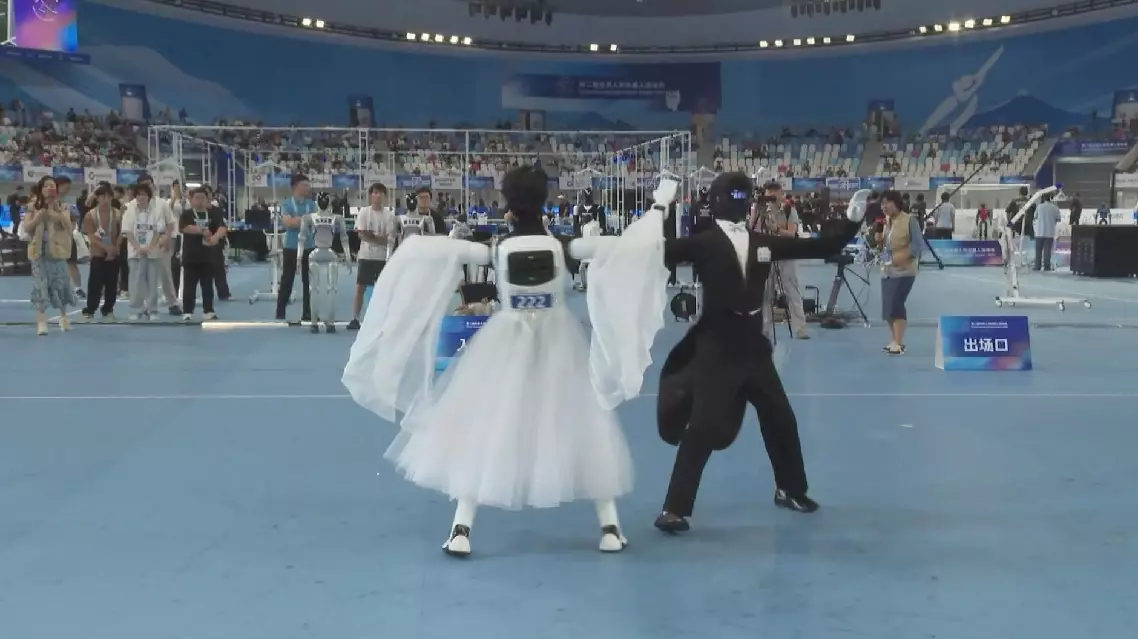
Humanoid robots breakdance, waltz at Beijing tech competition