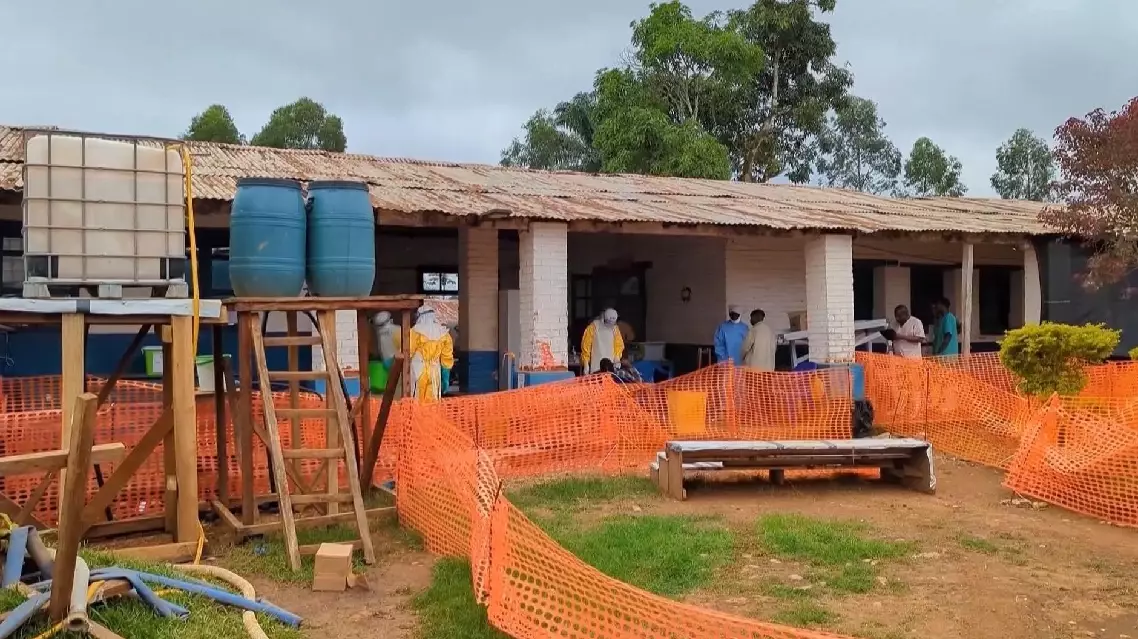
The World Health Organization (WHO) on Wednesday urged African countries to strengthen regional response efforts as Ebola cases in the Democratic Republic of the Congo (DRC) have surpassed 5,600.
At the 76th session of the WHO Regional Committee for Africa held in Addis Ababa, Ethiopia, officials and health authorities reviewed the response to the DRC Ebola outbreak.
They urged stronger regional action, warning that insecurity, population movement and community mistrust are heightening the risk of cross‑border transmission.
Officials from across Africa stressed that the outbreak cannot be contained by any one country alone, and called for accelerated information sharing, improved cross‑border monitoring, and ongoing support for response teams and affected communities.
As of Monday, the DRC had recorded 5,656 confirmed cases and 2,715 deaths, putting the case fatality ratio at about 48 percent, according to WHO expert, adding that a total of 58 health zones across six provinces have been affected, while 1,245 patients have recovered.
WHO calls for regional action as DRC Ebola cases exceed 5,600
China has made substantial progress in consolidating its poverty elimination achievements and advancing comprehensive rural revitalization, according to a State Council report submitted to the country's top legislative body.
The report was presented for review at the 24th session of the Standing Committee of the 14th National People's Congress, which is ongoing in Beijing from August 25 to 28.
The report highlights significant improvements in rural infrastructure and public services over five consecutive years of sustained assistance. The development gap between former poverty-stricken areas and other regions continues to narrow, authorities said.
According to the report, per capita disposable income for rural residents in the counties that have been lifted out of poverty increased from 12,588 yuan (about 1872.5 U.S. dollars) in 2020 to 18,627 yuan in 2025, achieving an average annual growth rate of 8.2 percent. This figure outpaced the national rural average by 0.8 percentage points during the same period.
"During the 14th Five-Year Plan period (2021-2025), central fiscal funding for rural revitalization increased by 320 billion yuan compared to the 13th Five-Year Plan period. For households facing sudden risks of returning to poverty or falling into poverty due to disasters and other causes, assistance measures are implemented first, with supplementary procedures and paperwork completed afterward," said Maierdan Mugaiti, Vice Minister of Agriculture and Rural Affairs.
In the healthcare sector, a national dynamic monitoring system have been established to prevent impoverishment caused by medical expenses. The basic medical insurance participation rate among the formerly impoverished population and monitored households at risk of returning to poverty has remained stable at over 99 percent annually. Policies such as "treatment first, payment later" and "one-stop" settlement have been implemented to effectively guard against the risk of medical impoverishment.
Regarding social security, the government has improved subsistence allowances and special hardship support systems. All eligible rural residents facing difficulties will receive necessary social insurance and emergency assistance without exception.

China consolidates poverty alleviation gains as rural incomes climb steadily