LONDON--(BUSINESS WIRE)--Aug 27, 2026--
Global TV shipments grew 3.6% year-on-year (YoY) to 48.8 million units in 2Q26, supported by demand around the FIFA World Cup and Amazon Prime day timing, despite increasingly challenging market conditions, according to the latest research from Omdia. Persistent consumer inflation and tightening memory supply are increasing cost pressures across the industry, although these factors had a limited impact on TV shipment growth during the quarter.
This press release features multimedia. View the full release here: https://www.businesswire.com/news/home/20260827594897/en/
Western Europe and North America support global TV shipment growth
China remains the largest drag on global TV shipment growth, with shipments falling 15.1% YoY following the ending of local stimulus programs. In contrast, major developed markets performed strongly during the quarter. Western Europe recorded 9.5% growth, while North America, home to two of the three World Cup host countries, grew 4.7%.
Emerging markets recorded some of the strongest growth rates. Shipments increased 14.5% in Eastern Europe and 12.8% in Latin America and the Caribbean, continuing the trend of Chinese TV brands expanding shipments into overseas markets as domestic demand remains subdued.
Memory supply pressures reshape the TV market outlook
Memory supply constraints had only a limited impact on TV shipment volumes in 2Q26, partly because brands continue to promote older product lines and draw on existing inventories of lower-cost memory. However, with memory supply expected to remain constrained and prices continuing to rise, TV prices are likely to face upward pressure this year.
Omdia also expects brands to shift further away from lower-resolution TVs toward 4K models, as lower-capacity memory products face particularly tight supply constraints.
Mini LED TV competition intensifies as more brands expand portfolios
Mini LED adoption accelerated significantly in 2Q26, accounting for 13% of global TV shipments. Samsung and LG Electronics expanded their Mini LED line-ups, while lowering entry price points, increasing competition with TCL and Hisense, which had previously led the market.
TCL held a 30.2% share of global Mini LED TV shipments in 1Q26. By 2Q26, Samsung had moved from third place to become the market leader, reaching a 28.2% shipment share.
Competition intensifies in the RGB LED TV market
Competition is also increasing rapidly in the RGB LED market, where shipments reached 295,000 units in 2Q26. Hisense held a dominant position at the beginning of the year, accounting for 77.2% of shipments, while China represented 88.8% of the market amid limited competition.
By 2Q26, Hisense’s share had declined to 42.9%, as Samsung and Sony gained significant market share.
“Prominent promotion of RGB LED TVs during the World Cup has undoubtedly helped increase consumer awareness of the technology,” said Matthew Rubin, Research Manager, TV Set Research, Omdia. “As adoption grows, RGB LED will increasingly compete with OLED in the premium segment. Consumer preferences are likely to be shaped by pricing and how clearly consumers can evaluate the differences between the two technologies.”
ABOUT OMDIA
Omdia, part of TechTarget, Inc. d/b/a Informa TechTarget (Nasdaq: TTGT), is a technology research and advisory group. Our deep knowledge of tech markets grounded in real conversations with industry leaders and hundreds of thousands of data points, make our market intelligence our clients’ strategic advantage. From R&D to ROI, we identify the greatest opportunities and move the industry forward.
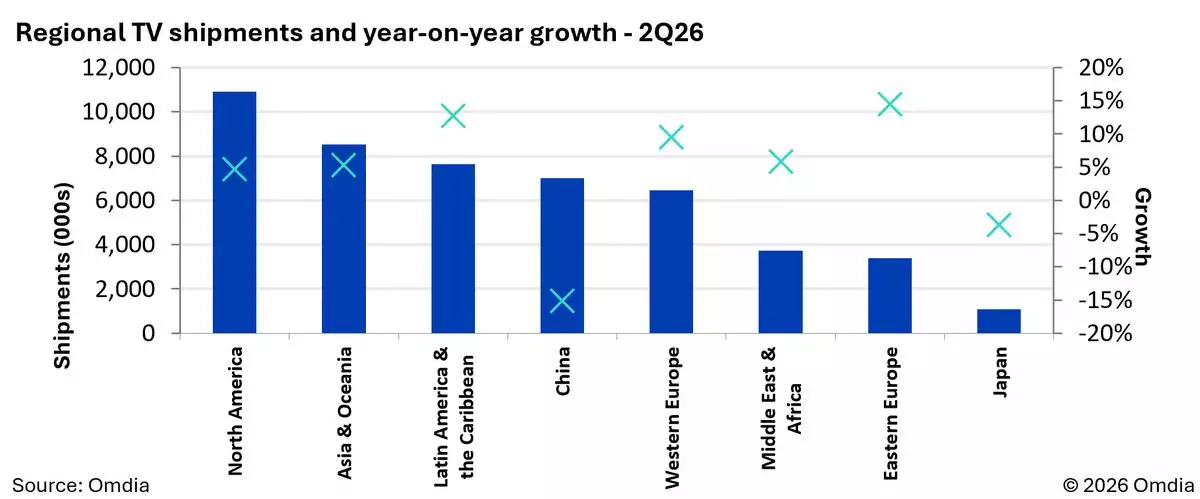
Regional TV shipments and year-on-year growth, 2Q26