The Second World Humanoid Robot Games in China is more than a competition, serving as a window into the robotics industry and a platform for international collaboration that embodies the country's belief that technology should be open, inclusive, and serve the common good, a China Media Group commentary said on Wednesday.
An edited English version of the commentary is as follows:
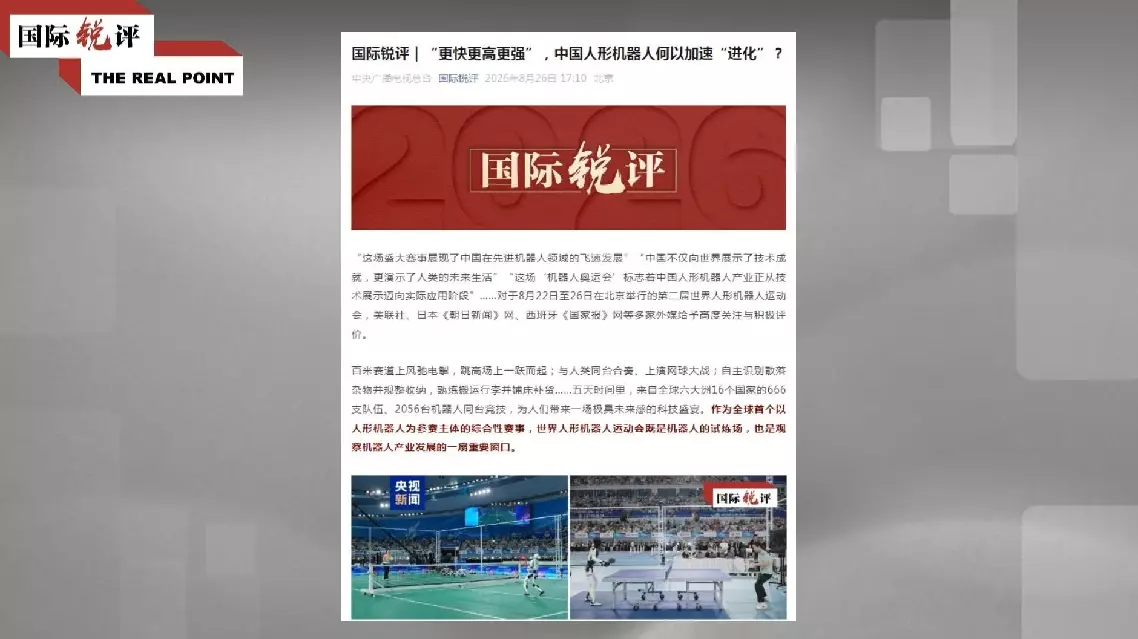
International media outlets have heaped praise on the games, held in Beijing from August 22 to 26. The Associated Press, Japan's Asahi Shimbun, and Spain's El Pais were among the outlets covering the event, highlighting China's fast‑moving robotics sector and describing the games as a milestone that moves humanoid robots from the lab toward practical use, as well as a preview of how humans may live in the future.
Over five days, 666 teams and 2,056 robots from 16 countries and regions across six continents took part in the competition. They sprinted down tracks, jumped, played tennis alongside humans, and performed music together. Some robots autonomously sorted scattered objects, while others carried luggage, made beds, and restocked shelves, offering a glimpse of a highly futuristic tech spectacle.
The Second World Humanoid Robot Games is the first global competition dedicated solely to humanoid robots. It serves not only as a testing ground for the machines, but also a vital lens for observing the evolution of the robotics industry.
This year, several events ditched manual remote controls to ran fully autonomously, thoroughly testing the robots' ability to perceive their surroundings and make independent decisions. Among the 51 competitions, 21 were designed to mimic real‑life settings, including homes, hotels, and logistics operations, bringing test scenarios straight into the real world. From assembly and domestic chores to fire rescue and precision tasks like powder weighing, the challenges focused on jobs that are tough, dirty, dangerous, or difficult.
This year's games placed greater emphasis on practical tasks to test how well humanoid robots perform real‑world jobs. The goal is to push these machines beyond the arena and onto factory floors and into homes, accelerating the industrial application of humanoid robots.
Chinese robots delivered a standout performance at the games. From breaking human speed records on the track to autonomously navigating hospital wards for delivery and patient guidance, they completed a wide range of tasks with impressive efficiency.
The Beijing Humanoid Robot Innovation Center, for instance, fielded four robots across more than 40 events and scored multiple victories. The company said its focus on refining joint motors and mechanical design has equipped the robots with exceptional strength and coordination for high‑intensity competitions.
Behind every breakthrough lies relentless refinement and years of accumulated effort. In recent years, Chinese robots have accelerated their transition from laboratories to large‑scale applications, injecting new momentum into high‑quality development.
Humanoid robots are now helping manage traffic at city intersections and sorting medicine in pharmacies to support overnight staff.
Data shows that Chinese‑brand industrial robots are used across 253 industry categories. In the first half of this year, China's humanoid robot shipments topped 40,000 units, making up 97 percent of the global total, while exports in the first quarter jumped 210 percent from a year earlier.
Analysts attribute the accelerated evolution of Chinese humanoid robots to multiple factors, such as increased policy support, complete industrial system, strong manufacturing capabilities, significant cost advantages, and diverse application scenarios.
China's 15th Five‑Year Plan (2026–2030) outline has included embodied intelligence as a key strategic priority for future industries, injecting further momentum into China's robotics sector.
For China, hosting the Second World Humanoid Robot Games is not only about enabling robots to "run faster, jump higher and be more practical", but also about building an open and cooperative platform to promote the progress of global robot technology and the development of the industry.
Collaboration among teams from different regions and cultural backgrounds is key to advancing humanoid robotics, said Flavio Tonidandel, who led the Brazilian team, adding that China has offered an excellent platform for that.
In recent years, China has hosted a series of international events, including the World Artificial Intelligence Conference, the World Robot Conference, and the World Humanoid Robot Games, building bridges for global tech exchange and industry‑demand alignment, and accelerating the practical application of new technologies.
At the same time, China has strongly advocated open source and openness, actively providing low‑cost open‑source large models to the world, effectively lowering the barriers to global innovation and supporting the development of the Global South.
International media have noted that China has consistently acted as a provider of international public goods, helping developing countries participate more equally in the "intelligent era."
At its core, China's approach to tech innovation is rooted in openness, cooperation, mutual benefit and win-win results, with a focus on steering technology toward positive ends and ensuring its advantages reach everyone.
China's robot games foster global cooperation, innovation: commentary