The Islamic Revolutionary Guard Corps (IRGC) Navy announced on Friday that no unauthorized vessels are permitted to pass through the Strait of Hormuz, reaffirming its control over the strategic waterway amid escalating tensions and conflicting claims over the region's maritime access.
The U.S. statements regarding the Strait of Hormuz remaining open are "a lie designed to control oil prices," the IRGC Navy said in its statement.
The statement emphasized that the IRGC's control over this strategic waterway is absolutely secure. Iran has ordered that all vessels attempting to pass through the Strait of Hormuz without Iran's coordination are prohibited from passage. This operation will continue until the U.S. military's criminal acts against Iran completely cease and its due obligations are fulfilled.
Meanwhile, Iran's President Masoud Pezeshkian said on Friday that Iran and Oman had agreed to reopen the Strait of Hormuz under a coordinated plan.
He said that Oman initially supported Iran's stance but later adopted a more cautious approach. However, recent meetings have led both nations to reach the consensus to work toward reopening the shipping routes through the Strait of Hormuz under mutually agreed terms, the president added.
Pezeshkian stressed that Iran is committed to ensuring that, should the strait be reopened within a specific framework, the United States must honor its commitments, including lifting sanctions, unfreezing Iranian assets, and halting Israel's hostile activities in Lebanon.
Pezeshkian also said that Iran is engaging with neighboring countries to establish a shared regional vision for cooperation and stability.

IRGC declares no unauthorized vessels allowed in Strait of Hormuz
Electric heavy truck makers in China are improving their supporting service system to better meet the increasing demands of international customers amid a fast export growth driven by volatile international oil prices and the global need for pursing green transformation.
Customs data showed that China exported over 2,500 electric tractors in the first seven months this year, increasing by more than 870 percent year over year.
Inside the workshop of a heavy truck manufacturer in Changsha, capital of central China's Hunan Province, engineers were making adjustments to electric trucks' body length and wheelbase to meet the specific needs of their South African customers.
"In South Africa, some of these trucks need to pull trailers. For this reason, we need to make adaptations according to the requirements in different situations," said Liang Chen, director of the overseas product research institute of the heavy truck enterprise.
In June this year, the enterprise exported 883 electric heavy electric trucks in one batch. The head of the company's overseas marketing said the negotiations lasted for nearly two years as the international customer was very concerned about supporting services.
"The customer kept asking how we could guarantee vehicle operation and after sales services, and what we could do if the trucks break down or fail to start? This was a recurring question from our customers. So we developed targeted solutions to address these concerns. We have built a strong local service team to guarantee vehicle operation. We have prepared adequate stocks of spare parts for electric vehicles in the host country. We also provide backup vehicles, so our customers can use our electric heavy trucks without worries," said Yue Zhaoting, deputy general manager of overseas marketing of the heavy truck enterprise.
The firm also provides solutions for charging electric heavy trucks in remote areas such as mines where stable power supply is rare.
"Because we have mature photovoltaic module and micro grid technologies, we are able to form a closed loop solution, including generating energy by photovoltaic panels, battery energy storage, and battery swap stations to power electric trucks. These fundamentally address the difficulties of customers with limited access or no access to power supply," said Yue.
The enterprise has set up more than 1,700 overseas service centers and employed over 7,000 professional service personnel abroad.
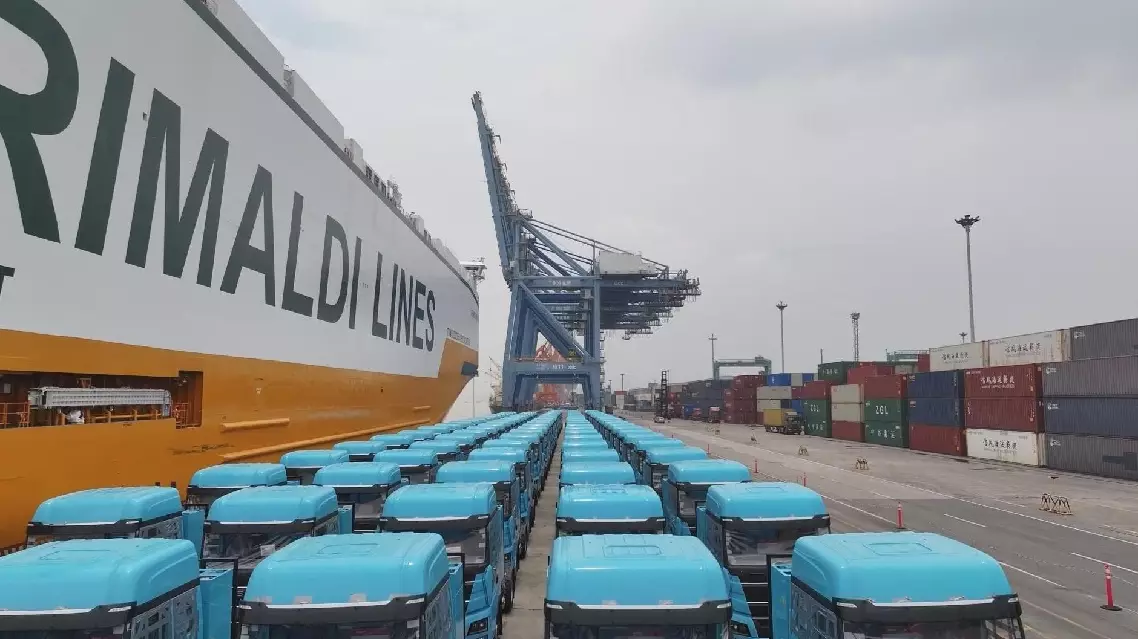
Chinese electric heavy truck manufacturer improves supporting services to drive export growth