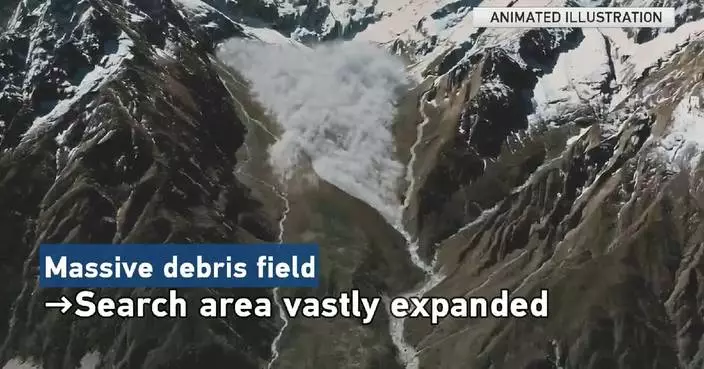
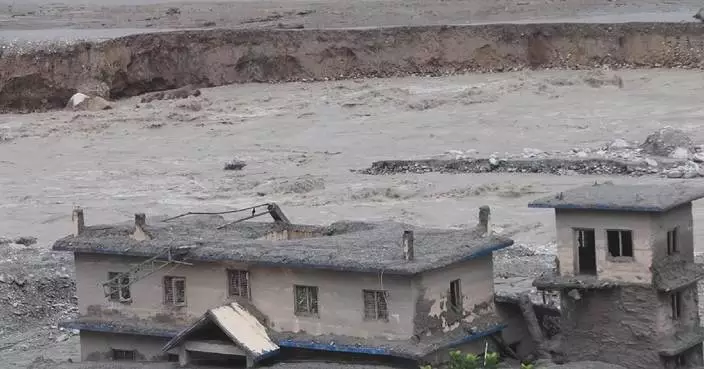
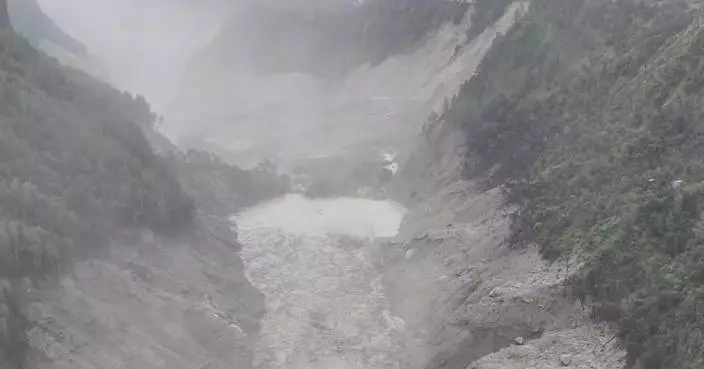
The massive mudslide triggered by a glacier collapse on the Nepalese side, striking Gyirong Port in southwest China's Xizang Autonomous Region on August 26, has severely hampered rescue operations due to the vast search area, destroyed roads, narrow mountain ravines, and persistent harsh weather, as revealed in an exclusive animated illustration by China Media Group.
In the wake of the disaster, multiple rescue teams rushed to the site around the clock, racing against time to open lifelines. However, relief efforts continue to face formidable challenges.
First, the affected area is extremely vast, making the search like "finding a needle in a haystack."
An ice avalanche, carrying enormous volumes of rock and debris, plunged down at high speed, traveling 20 kilometers with a vertical drop of nearly 3,300 meters. This rare combination of extreme elevation difference and ultra-high flow velocity turned the mudslide into a devastating torrent. The search-and-rescue area expanded exponentially, dramatically increasing the difficulty of locating survivors.
Second, two access roads were washed away, disrupting traffic.
The two main roads leading to Gyirong Port wind through narrow canyons. One road from Gyirong Port to the upstream reaches of the Gyirong Zangbo River has been completely washed away. The other from Gyirong Port along the Donglin Zangbo River to Sale Township has also been destroyed. As a result, personnel, machinery, and supplies cannot quickly enter the affected area in the short term.
Third, heavy equipment couldn't enter because of the narrow canyon terrain.
The disaster-stricken area features steep terrain, with some sections of the ravines only about 3 meters wide, which limits the space for personnel and equipment deployment, makes it difficult to bring in large machinery, and greatly hinders search and rescue operations.
Third, severe weather conditions grounded air operations.
The high-mountain canyon is prone to complex airflow hazards, including high-altitude ice and snow avalanches, strong crosswinds, and wind shear. Persistent rain and fog further reduce visibility. In addition, the complex ground conditions at potential landing sites constrain aerial rescue operations.
On the Chinese side, 16 people have been confirmed dead and 546 others remain missing as of 18:00 Saturday, according to the regional government.
Nepal's National Disaster Risk Reduction and Management Authority said that 734 bodies had been recovered from mudslide-hit areas as of 09:00 local time on Sunday, with 2,498 people still missing.
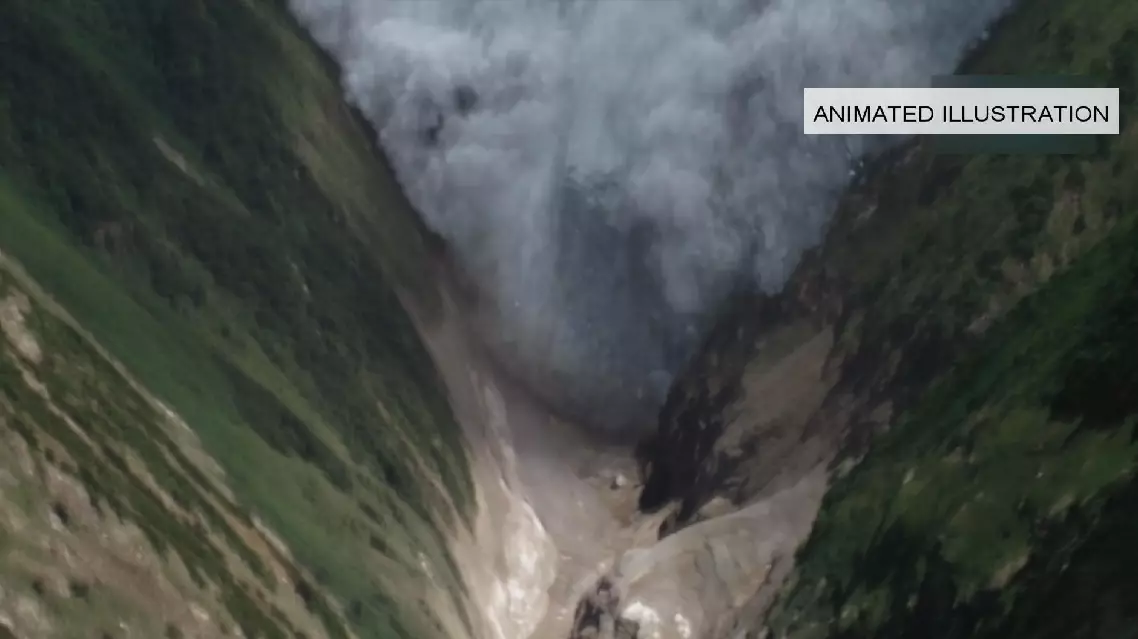
Massive mudslide at China-Nepal Border severely hampers rescue operations amid challenging conditions
Grief-stricken families in Nepal are anxiously waiting for news of their loved ones as rescue crews race to find more survivors buried among the debris from the catastrophic flash floods the resulting mudslide that swept through the north of the country on Wednesday.
The flash floods, triggered by the collapse of a glacier at a higher elevation, tore through Nepal's Bhote Koshi river in a matter of minutes. The disaster swept the Rasuwa, Nuwakot and Dhading districts, causing widespread destruction and mass casualties.
Nepali authorities confirmed Sunday that the death toll has risen to 734, with nearly 2,500 people still missing.
The disasters has devastated entire communities, leaving towns and villages utterly shell-shocked. For Tara Tamang, a survivor from Trishuli Bazaar in the Nuwakot district, the loss is almost unimaginable as she is now the lone surviving member of her family.
"I have lost my parents, my brother, my sister-in-law, my nieces and nephews, my siblings. I was rescued, but I can't contact my family. Now what will happen?" said Tamang, her voice shaking with grief.
Search and rescue teams are working around the clock in the valleys and hillsides lost under thick layers of debris. Helicopters have been deployed to reach inaccessible terrain, while ground crews struggle to clear the only major trade route between Nepal and China, which has been completely buried by landslides and mud.
For many survivors, the wait for news is agonizing. Krishna Bahadur Bhujel, who has come out to search for a missing loved one, expressed the frustration felt by countless families.
"Mobile messages say that the person you are trying to reach cannot be contacted and it's been an hour since the phones have been switched off. So, we have come here to find my son-in-law," he said.
The disaster has reduced entire villages to rubble, and with roads cut off, some survivors are making the arduous journey on foot to see what remains of their homes.
"I am saddened to see that many have lost their loved ones. I have been crying for their loss. For me, my house is gone. A shelter we worked hard to build," said Saraswati Silwal, another survivor.
The challenging conditions are hindering the search and rescue progress, with one rescue worker describing the difficulties they are facing on the ground.
"Since the debris is slushy and loose, it is becoming difficult to operate the bulldozers. If it was dry, we would have carried out our operation efficiently. I was stuck for a long time in the sludge," said Pawan Koirala, the rescue team member.
With each passing hour, hope is fading for those still unaccounted for, as the nation mourns the immense loss of life and livelihoods in one of its deadliest natural disasters in years.

Grief-stricken families await news as Nepali flood death toll rises

Grief-stricken families await news as Nepali flood death toll rises