The company says CookingMuse is the world's first multimodal AI foundation model trained on real kitchen data. Its cooking robots already operate in 13,000 stores across nearly 350 cities.
BEIJING, CHINA – Media OutReach Newswire – 31 August 2026 – XiangLu Robotics on Sunday unveiled three major new cooking products at the 2026 World Robot Conference, headlined by what it said is the world's first multimodal AI foundation model trained on data gathered from real kitchens.
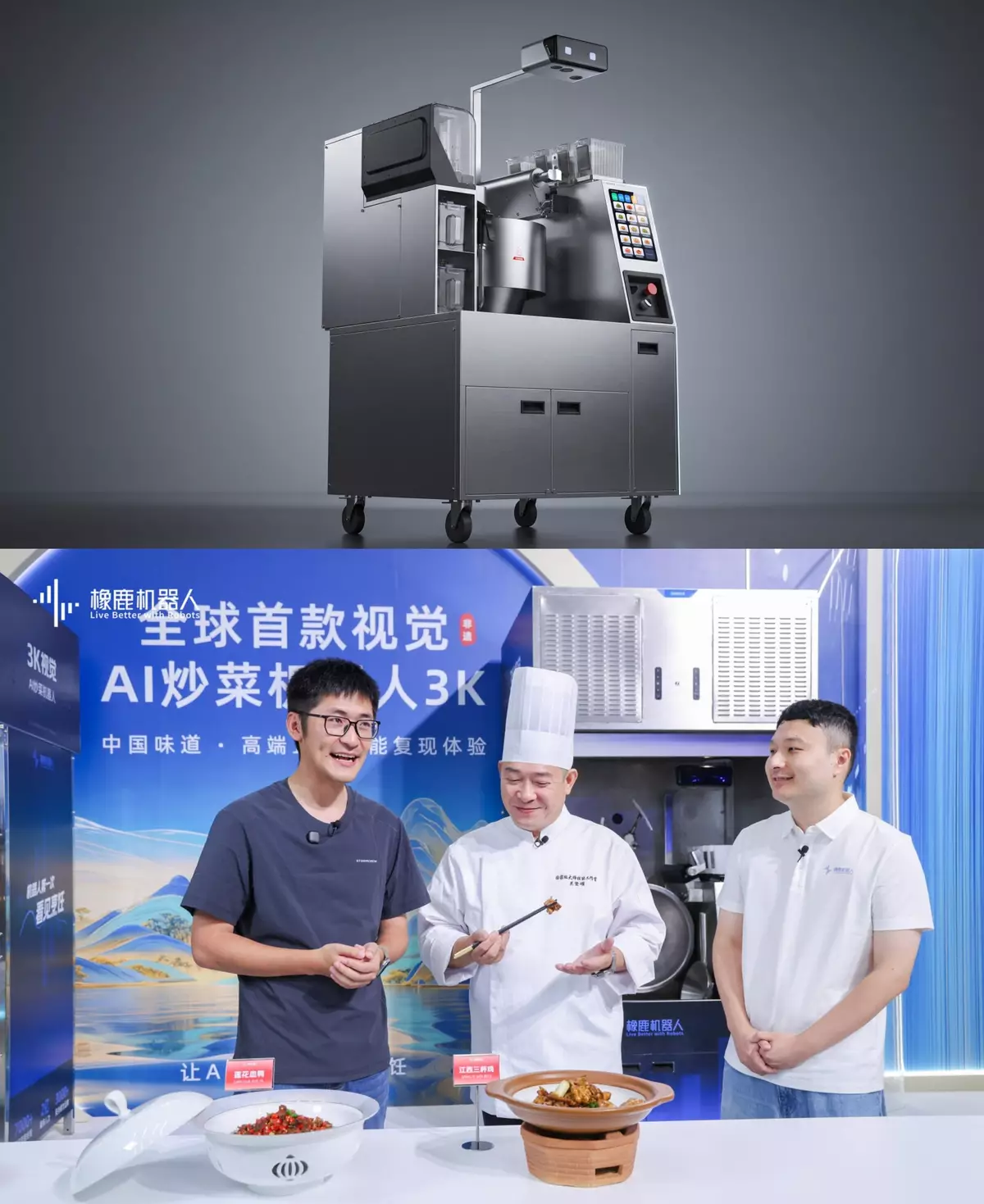
XiangLu Robotics Unveils Cooking AI 'Brain' and Robot Chefs at Beijing Conference
The Aug. 23 launch pairs the model — called CookingMuse, or Chuqi — with the 3K Vision Cooking Robot and an embodied cooking robot named RoboCook, the company said. Spanning the understanding of cooking, sensory judgment and embodied execution, the three products lay out a complete technological path for AI to enter real kitchens and solve real problems, pushing robots from "demonstrating capabilities" toward "creating real value" — or, as the company put it, moving AI from "following recipes" to "understanding cooking." Each represents Xianglu's latest breakthrough in one of three fields: cooking AI, intelligent robots and embodied intelligence.
The machines already operate at scale. Xianglu said its AI cooking robots cover nearly 350 cities in China and more than 20 countries and regions overseas, deployed with 3,000 brands, covering 13,000 stores, with nearly 600 million customer visits served to date. Its in-house AI recipe-generation system has accumulated nearly one million digital recipes of Chinese cuisine — and entering real kitchens at scale, the company said, has gradually formed its continuously evolving "robot — data — model — robot" loop.
A foundation model for the kitchen
Yang Jiancheng, Xianglu's founder and chairman, described the multimodal cooking AI foundation as the underlying artificial intelligence system the company built for future kitchens — and the first multimodal cooking AI foundation model anywhere trained on real kitchen data, taking AI from "recognizing cooking" to "understanding cooking."
By fusing vision, cooking-process data and intelligent decision-making, the system means AI cooking robots no longer merely complete actions under preset programs but begin to understand what is happening to a dish and decide what to do next, Yang said. Xianglu called that a capability leap from "automation" to "intelligence."
Older machines relied on fixed timing, fixed heat levels, fixed ingredient loading and fixed procedures. But a real kitchen is no standard laboratory: the freshness, moisture content, size and temperature of ingredients — and the state inside the wok — are in constant flux. The truly scarce ability of great chefs, the company argued, is not repeating motions but continuously observing, judging and adjusting as conditions change.
The real problem cooking intelligence must solve, Xianglu said, is not "how to make movements more precise" but whether, when reality changes, the machine still knows what it should be doing now.
On that premise, CookingMuse connects multimodal perception, cooking understanding and dynamic decision-making, so robots look beyond "what dish is this" to understand "what state is this dish in, why did that state appear, and what should happen next." Judgments once reserved to chef experience — whether sugar has caramelized properly, whether sauce has reduced to the target, whether meat has reached the right doneness — are being converted into capabilities AI can learn, understand and execute, the company said.
More importantly, Xianglu is turning real kitchens themselves into the arena of AI's continuous learning: robots enter working kitchens and generate real cooking data; the data trains the model; the model's capabilities return to the robots, which enter still more real kitchens for continuous iteration. The resulting "robot — data — model — robot" loop means Xianglu's edge no longer comes from any single piece of hardware alone, but from a cooking-intelligence system capable of continuously evolving in the real world.
"Cooking has no standard answer"
"Cooking has no standard answer — children need nutrition, the elderly need less salt, and people away from home miss the taste of their mother's cooking," Yang said. "So we let AI walk into real kitchens: to see every second of change in the ingredients, to see master chefs' decades of experience, and ultimately to see each person's needs."
The company hopes, he said, to use technology to break through the limits of space, time, social class and manpower — so that good food is no longer bound by geography, the flavors of generations past can be passed down digitally, and master-level dishes can reach ordinary households. "We hope that one day, no matter where a person is, how old they are, or where they come from, they can more easily get a truly suitable good meal," Yang said. "Because what robots truly need to see has never been just a dish, but every person."
The 3K: a cooking robot with eyes
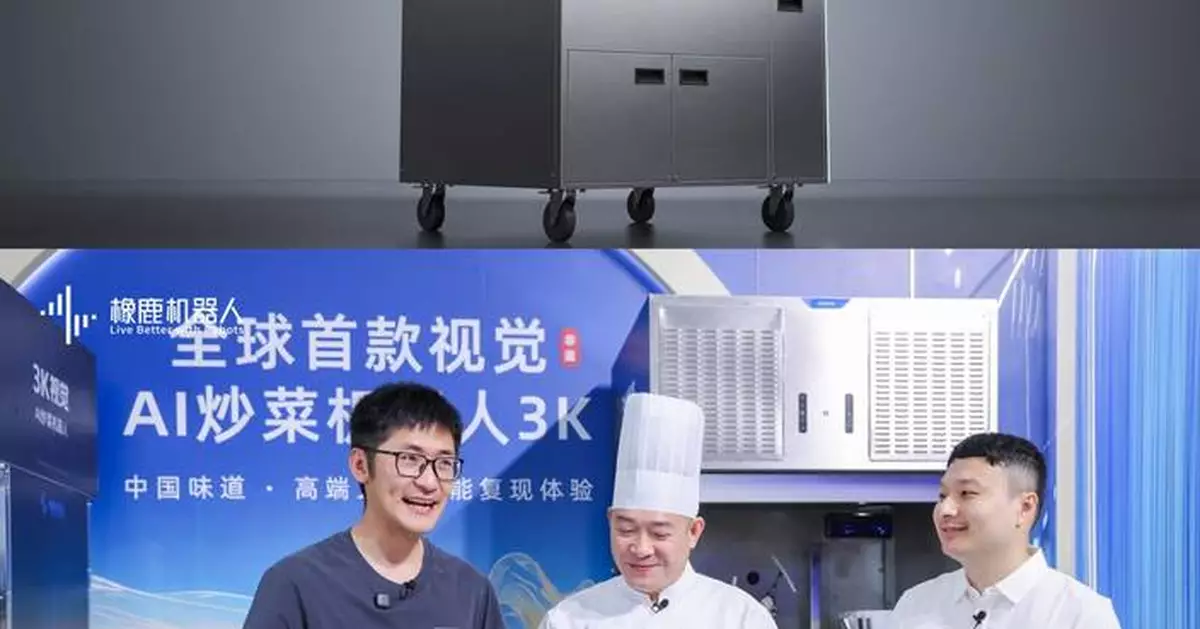
The 3K Vision Cooking Robot, the second of the three products Xianglu globally debuted during the WRC, is the world's first intelligent AI cooking robot to fuse AI vision with what Xianglu calls its "cooking brain" — in the company's words, an AI chef that truly understands cooking. It is also the first product equipped with Xianglu's multimodal cooking AI foundation.
Beyond its intelligent brain, the 3K carries three 40-megapixel global-shutter industrial cameras that capture the wok at 30 frames per second, feeding a large AI model trained on data from millions of dishes, which judges the state of ingredients in real time. With the world-first foundation model and the newly added vision hardware, the company said, an AI cooking robot can for the first time both "see" the changes inside the wok and make autonomous decisions on that basis.
The result, Xianglu said: a sharply lower cooking "failure rate" on complex dishes and lower ingredient costs for restaurant operators. The 3K moves dish quality control from after-the-fact inspection to in-process adjustment, substantially improving back-of-house efficiency and cost control at branded restaurant locations through a higher degree of unmanned operation — which the company called the biggest change the product brings to the industry.
Legacy AI cooking robots ran on preset programs; whenever ingredient size, moisture content or thawing state deviated from the defaults, dish quality fluctuated, and problems often surfaced only once the dish left the wok. The 3K dynamically adjusts heating power, stir-fry duration, stirring speed and seasoning quantities at the millisecond level, intervening in real time during the cook — so that even inconsistent ingredients or a misplaced tray still produce a good dish. Its AI-supervision capability monitors store-level operational anomalies in real time, from ingredient cutting specifications, thawing state and actual quantities loaded, to tray position, calibration and dispensing anomalies, automatically identifying issues, generating reports and pushing them to operations to help stores standardize operations.
In Xianglu's product evolution, the 3K can smoothly complete a three-step leap: getting eyes, becoming an AI supervisor, and becoming an AI chef.
The company put those capabilities on public display at the WRC, where — on camera — the 3K cleared two live challenges that, it said, traditional AI cooking robots cannot overcome. In the first, "The Disappearing Cup of Water," two 3K machines stir-fried the same mapo tofu side by side; 100 grams of water not in the recipe was poured in mid-cook, and the system, detecting the change in the wok, re-assessed the sauce-reduction state and held until the wok's state returned to target before moving to the next step. In the second, "The Wok Hei Is Back," two machines cooked chili-pepper stir-fried pork side by side — one using meat that had not fully thawed, the other normal ingredients; the 3K recalculated its cooking plan in real time and closed the gap in heat control.
Where people are, hot meals follow
While the foundation model and the 3K are "invisible" technologies hidden in restaurant back-of-houses or built into the products themselves, the third launch of this event from XiangLu Robotics — RoboCook — is a new category consumers can see and touch.
Built around embodied intelligent robots, it pairs a humanoid robot with dedicated cooking robots to link the entire chain from picking and placing ingredients to cooking to serving, letting AI not only understand cooking but enter the real world and deliver a complete meal. The product is a mobile, miniature unmanned back-of-house system: an end-to-end unmanned closed loop running from chilled storage of prepped vegetables through fresh cooking, bowl dispensing and serving, oil-fume treatment and equipment self-cleaning. It supports high-heat stir-fried Chinese dishes, Western pasta and fried rice, among other categories — effectively a small mobile unmanned restaurant that needs no chef, no exhaust ductwork installation and no fixed storefront.
For the first time, RoboCook takes AI from a single piece of back-of-house equipment to the entire arc of commercial operation, with core features including genuinely unmanned running, dual-wok parallel cooking, end-to-end digitization and mobile deployment. For restaurant operators, end-to-end digital management no longer depends on store managers' rounds or human experience.
More importantly, the company said, dual-wok parallel cooking plus mobile deployment can absorb demand surges in peak dining hours while making real the idea that "wherever people queue for food, a RoboCook can be placed": ready to use the moment it is towed into position at high-traffic events such as exhibitions, music festivals and sports events; freshly cooked hot meals inside tech parks, office-building clusters and university towns, with employees never needing to leave the premises; ready to sell wherever it stops at scenic spots, campsites and night markets. Compared with manned food trucks and automated food vending machines, Xianglu argued, RoboCook delivers not one AI cooking robot but a complete, mobile back-of-house capability that can rapidly replicate diverse, complex menus.
The launch extends a push that began earlier this month: in early August, Xianglu's fully automated AI beverage workstation, Xianka Fangzhou, made its appearance inside JD.com's Seven Fresh Kitchen (Qixian Xiaochu) "24-hour end-to-end robot store," bringing end-to-end intelligent production into beverage preparation for the first time. RoboCook now carries the same end-to-end unmanned capability from beverages to fresh stir-frying, and from fixed stores to more places, opening what the company calls a new product category — the mobile unmanned foodservice workstation.
From Chinese kitchens to global kitchens, from understanding a dish to seeing every person
What Xianglu presented at this year's WRC was not just three new products but a cooking-intelligence system that keeps evolving from understanding to sensing to execution, the company said.
"Robots enter real kitchens and produce data; real data enters the model, and the model begins to understand cooking; new capabilities return to the robots; smarter robots enter more kitchens and produce more, and more valuable, data," Yang said.
On top of that continuously evolving cooking intelligence, Xianglu's products and use cases keep growing — from commercial AI cooking robots to the 3K and RoboCook, and on to future home AI cooking robots. Product forms and use cases will change, the company said, but the underlying cooking intelligence will not: understanding each brand's dish-quality standards in restaurants, and different people's taste, nutrition and dietary needs at home.
At the same time, Xianglu is taking the capability into real kitchens in more countries and regions, where different ingredients, climates, cooking methods and eating habits will become new variables for the AI's continuous learning. From understanding Chinese kitchens to understanding kitchens around the world, the company said it ultimately hopes to build a cooking intelligence that can continuously learn and understand global cuisine.
But however many dishes robots come to understand or kitchens they enter, technology ultimately still faces real, individual people.
At the launch, Xianglu screened its brand vision film "Seeing": a middle-aged father who spent years away from home studying and building businesses, years after his mother's death, uses AI digital technology to recreate, before his own son, the braised pork belly the boy's grandmother once made. What the machine reconstructed was not just a dish, but a family memory that spans time.
Hashtag: #XiangLuRobotics
The issuer is solely responsible for the content of this announcement.
** This press release is distributed by Media OutReach Newswire through automated distribution system, for which the client assumes full responsibility. **