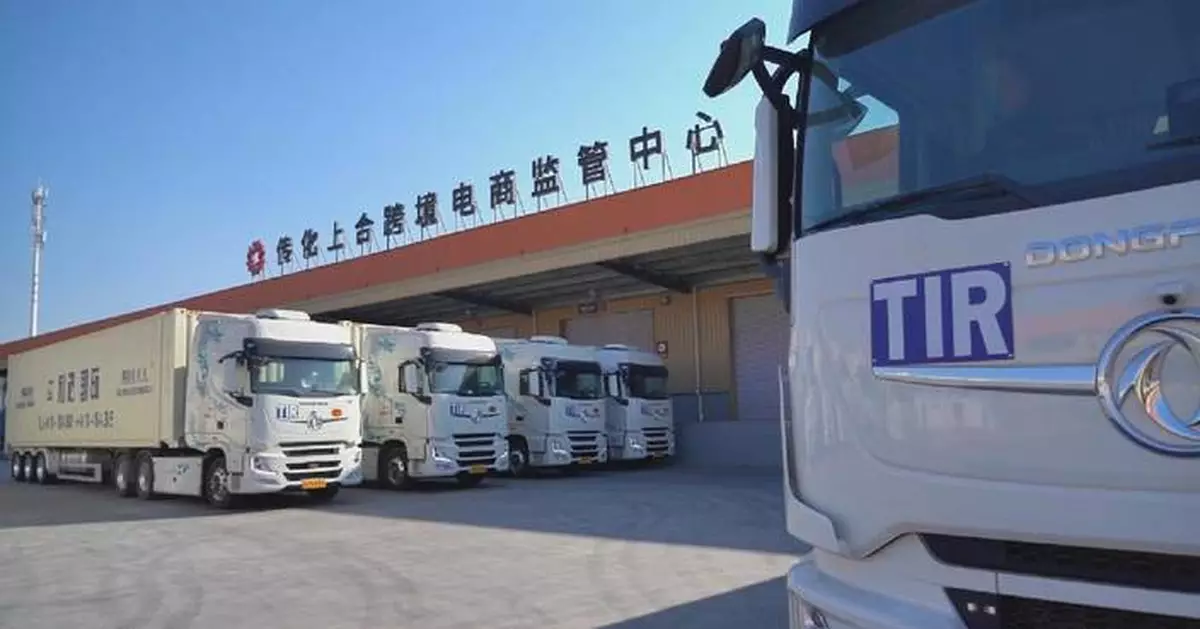
A demonstration zone for regional economic and trade cooperation between China and other Shanghai Cooperation Organization (SCO) members has handled more than 15,000 tons of cargo via international road transport since the first TIR route was launched in September 2023, as it continues to expand cross-border logistics networks over the years.
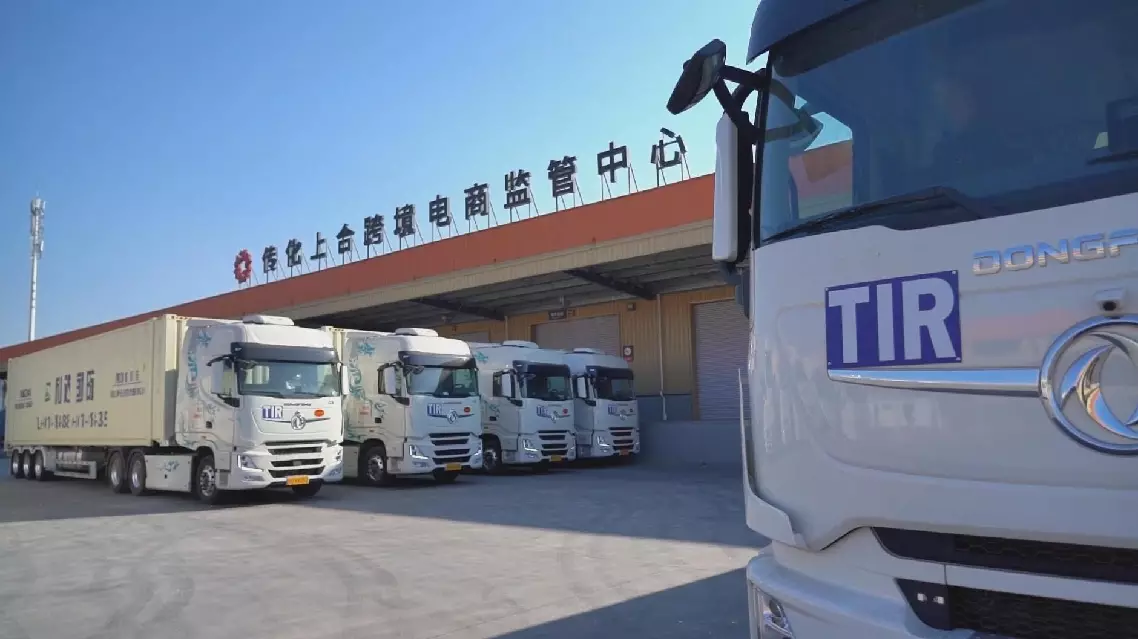
A convoy of TIR trucks loaded with fresh fruits, vegetables, daily necessities and light industrial products recently departed from the China-SCO Local Economic and Trade Cooperation Demonstration Area in China's eastern coastal city of Qingdao and will arrive in Uzbekistan and Kazakhstan via Khorgos Port in northwest China's Xinjiang Uyghur Autonomous Region in about seven days, offering a faster alternative to rail freight.
"On the return trip, they brought back honey from Kyrgyzstan and nuts from Uzbekistan. Compared to rail transport, TIR international road transport can save approximately half the time," said Zhang Quanwen, general-manager of Transfar SCO (Qingdao) International Trade Co., Ltd. The TIR offers an efficient door-to-door service, which significantly reduces transit times and administrative delays for short-haul cross-border shipments and time-sensitive cargo. It is particularly well-suited for fresh agricultural produce and high-value small-parcel goods.
"Previously, import and export goods mainly relied on sea freight, which was not only time-consuming but also prone to damage due to loading and container transfer. Now, with international road transport routes, goods are sealed in their original containers and transported in their original vehicles, greatly improving logistics efficiency," said Liang Tianxiao, operations director of Qingdao Shangkong Cross-border E-commerce Operations Co., Ltd.
Currently, the SCO demonstration zone operates eight international road transport routes, connecting eight countries including Azerbaijan, Uzbekistan, Laos and Thailand.
"We have set up a dedicated fast-track clearance window offering 24/7 appointment-based customs services. Since the first TIR route was launched in September 2023, the zone has dispatched a total of 973 TIR vehicles, with a cumulative freight volume exceeding 15,000 tons and a total value of nearly 700 million yuan (103 million U.S. dollars)," said Yang Liu, head of the cross-border e-commerce supervision section at Jiaozhou Customs, Qingdao Province.
In 2025, China's trade with other SCO members reached 523.5 billion dollars and accounted for 8 percent of the country's total foreign trade, up from 12.1 billion dollars in 2001 when the inter-governmental organization was founded.
SCO demonstration zone handles 15,000 tons of cargo via road transport
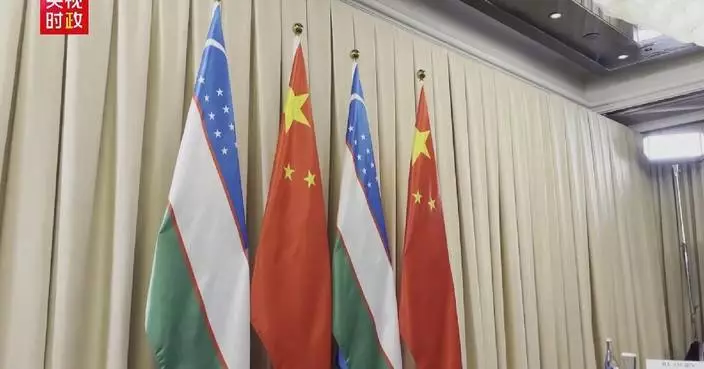
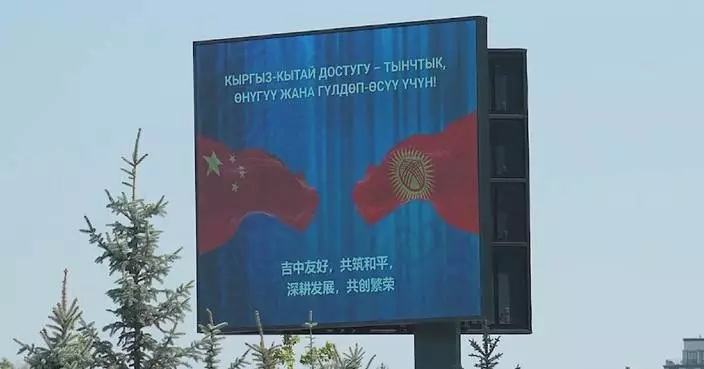
China and Kyrgyzstan are broadening their cooperation and deepening their economic ties to transform a relationship traditionally built on trade and infrastructure into a future-focused partnership that embraces emerging technologies.
Bilateral trade has surged from 53 million U.S. dollars when the two countries established diplomatic relations in 1992 to 27.2 billion dollars in 2025, an increase of more than 400 folds.
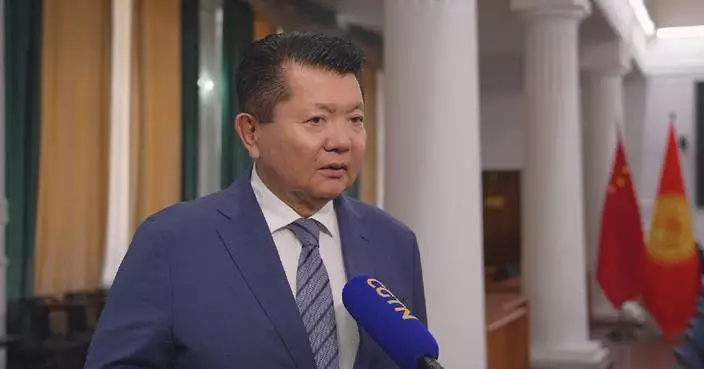
"The two countries signed agreement on Comprehensive Strategic Partnership for the New Era. Both sides are trying to find a new model to make a breakthrough in their traditional cooperation, almost in every field," said Xu Wenhong, deputy secretary-general of the One Belt One Road Center at the Chinese Academy of Social Sciences.
Infrastructure and connectivity have emerged as major pillars of cooperation. New roads and border crossings are improving links between the two countries.
"In the past, transporting a truckload of goods from Kyrgyzstan to China or vise versa could take about a week. And now, it takes only one or two days to deliver the cargo," said Hou Huxiang, general manager of Kyrgyzstan Office at the China Road and Bridge Corporation.
The long-awaited China-Kyrgyzstan-Uzbekistan railway is moving from years of planning into construction. For Kyrgyzstan, which has no direct access to the sea, experts said these expanding transport links could be transformative to give the country new routes to regional and international markets and help it move beyond the limitations of being landlocked.
"Now, Kyrgyzstan is becoming a land-linked country. Its agricultural products, mineral products, all these things can be shipped out," said Xu.
Beyond traditional sectors, China and Kyrgyzstan are exploring cooperation in the digital economy and frontier technologies, including artificial intelligence, in line with broader regional efforts to expand access to technological development.
Temir Sariyev, chairman of the Chamber of Commerce and Industry of the Kyrgyz Republic, highlighted the importance of education and talent development as cooperation moves into high-tech areas.
"We need to encourage more students to study in China, as China is a global leader in science and technology, industry, artificial intelligence, and digital technology," said Sariyev.
From infrastructure and trade to agriculture and artificial intelligence, China and Kyrgyzstan are broadening cooperation across both established and emerging sectors. That growing partnership also reflects the broader spirit of the Shanghai Cooperation Organization to promote shared development, respect each country's own development path, and pursue practical cooperation that can create opportunities for countries across the region.

China, Kyrgyzstan expand trade, cooperation

China, Kyrgyzstan expand trade, cooperation