Nepalese authorities have deployed military helicopters to expedite aerial rescue and relief operations in the regions devastated by a mudslide on Wednesday morning.
In Batar, about 65 kilometers from Kathmandu, the Nepalese military has set up a main command post, transforming the area into the central hub for relief supplies headed to mudslide-hit districts.
On the route to hard-hit Nuwakot, helicopters constantly take off and land at an emergency distribution point, flying water, bread, and other essentials into areas that road vehicles cannot reach. The airlifts have become a lifeline for survivors in isolated locations.
As relief crew members are pushing deeper into the disaster zone, they find that some mudslide-affected areas look flat but are as boggy and unstable as swamps. The road ahead is completely ruined, and no vehicles can get through.
Chinese tunnel experts were scheduled to carry out rescue operations locally in Trisuli on Sunday. It is understood that the Chinese tunnel experts heading to the front line encountered road blockages there and were subsequently forced to take helicopters to the worst-hit area. On Sunday afternoon, Zhao Bo, one of the experts who had just returned from a field survey at a project site, said that despite the challenging conditions and difficulties in transporting equipment, the team would never give up even the slightest chance of rescue.
"All our transportation is now cut off. We have no way to transport our equipment and demolition tools up to the site. We're wondering if we could procure some lighter materials to speed up our excavation progress and push a little further forward," said Zhao.
The death toll from the devastating mudslide in Nepal had risen to 907 as of 10:30 local time on Monday, according to the latest figures released by the Nepali Police.

Nepal deploys military helicopters to expedite rescue, relief operations after deadly mudslide
A demonstration zone for regional economic and trade cooperation between China and other Shanghai Cooperation Organization (SCO) members has handled more than 15,000 tons of cargo via international road transport since the first TIR route was launched in September 2023, as it continues to expand cross-border logistics networks over the years.
A convoy of TIR trucks loaded with fresh fruits, vegetables, daily necessities and light industrial products recently departed from the China-SCO Local Economic and Trade Cooperation Demonstration Area in China's eastern coastal city of Qingdao and will arrive in Uzbekistan and Kazakhstan via Khorgos Port in northwest China's Xinjiang Uyghur Autonomous Region in about seven days, offering a faster alternative to rail freight.
"On the return trip, they brought back honey from Kyrgyzstan and nuts from Uzbekistan. Compared to rail transport, TIR international road transport can save approximately half the time," said Zhang Quanwen, general-manager of Transfar SCO (Qingdao) International Trade Co., Ltd. The TIR offers an efficient door-to-door service, which significantly reduces transit times and administrative delays for short-haul cross-border shipments and time-sensitive cargo. It is particularly well-suited for fresh agricultural produce and high-value small-parcel goods.
"Previously, import and export goods mainly relied on sea freight, which was not only time-consuming but also prone to damage due to loading and container transfer. Now, with international road transport routes, goods are sealed in their original containers and transported in their original vehicles, greatly improving logistics efficiency," said Liang Tianxiao, operations director of Qingdao Shangkong Cross-border E-commerce Operations Co., Ltd.
Currently, the SCO demonstration zone operates eight international road transport routes, connecting eight countries including Azerbaijan, Uzbekistan, Laos and Thailand.
"We have set up a dedicated fast-track clearance window offering 24/7 appointment-based customs services. Since the first TIR route was launched in September 2023, the zone has dispatched a total of 973 TIR vehicles, with a cumulative freight volume exceeding 15,000 tons and a total value of nearly 700 million yuan (103 million U.S. dollars)," said Yang Liu, head of the cross-border e-commerce supervision section at Jiaozhou Customs, Qingdao Province.
In 2025, China's trade with other SCO members reached 523.5 billion dollars and accounted for 8 percent of the country's total foreign trade, up from 12.1 billion dollars in 2001 when the inter-governmental organization was founded.
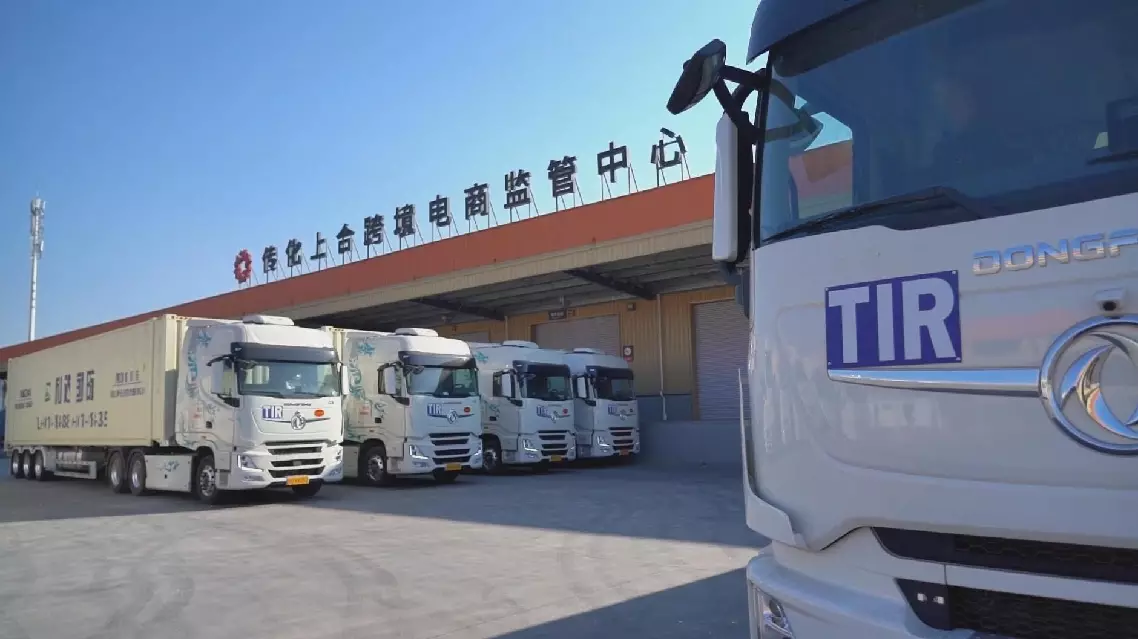
SCO demonstration zone handles 15,000 tons of cargo via road transport