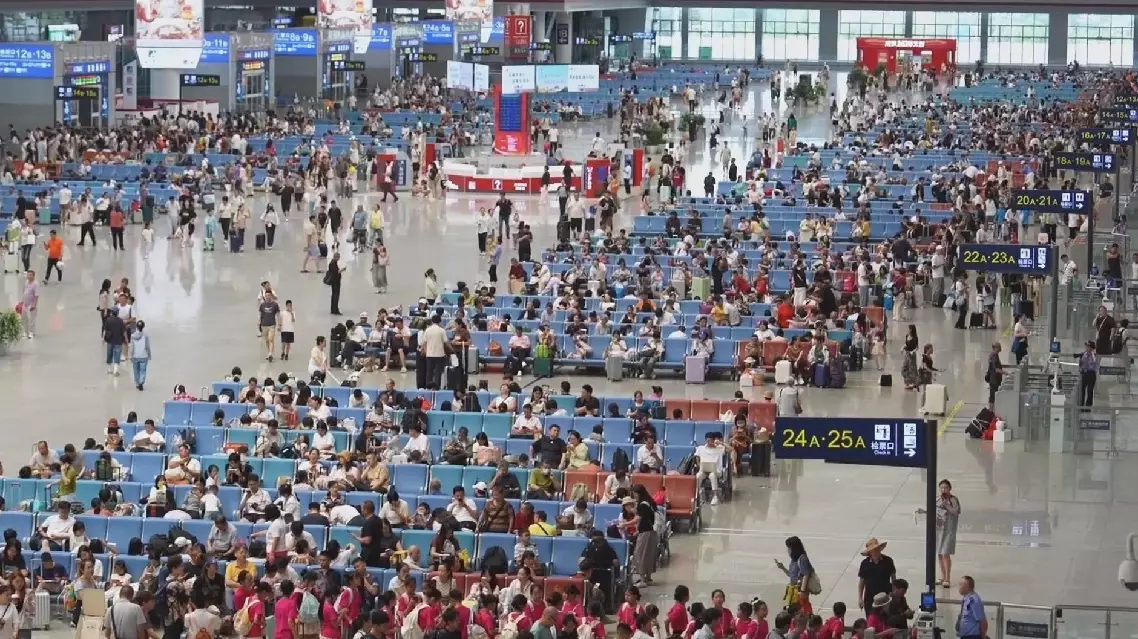
China's national railway service concluded its busy two-month summer travel season on Monday, after transporting 954 million passengers across the country and seeing trips by foreign nationals up nearly one-third compared to the previous year amid the popular "China Travel" trend.
The China State Railway Group said Tuesday it had operated an average of more than 11,600 passenger trains per day during the period between July 1 and Aug. 31, with additional train services having been arranged to meet the surging travel demand.
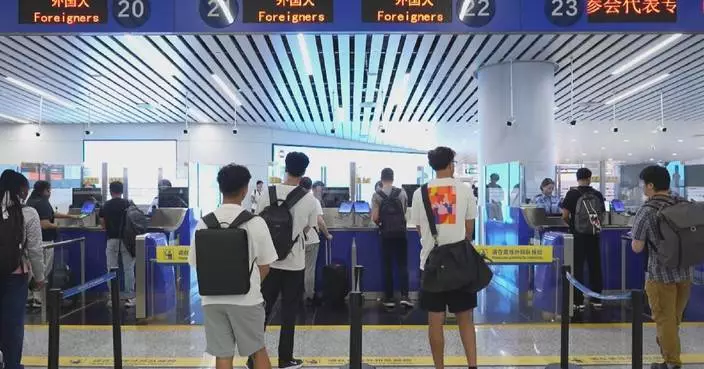
Foreign nationals made more 4.4 million rail trips during this time, which comes as China has been welcoming more international visitors with the expansion of visa-free policies in recent months.
The Guangzhou-Shenzhen-Hong Kong high-speed railway handled over 6.2 million cross-border passenger trips, a more than 3 percent increase from a year earlier, while the cross-border China-Laos Railway carried some 56,000 passengers during this period, representing a nearly 56-percent year-on-year rise.
Meanwhile, other international passenger routes linking China with Mongolia, Russia, Vietnam and the Democratic People's Republic of Korea (DPRK) also continued to transport tourists during the 62-day summer travel period.
Strong demand for family vacations and educational travel prompted rail authorities to run almost 700 specific tourist trains, along with more than 350 customized services designed for concertgoers and sports fans. Operators said these bespoke services helped support cultural and tourism spending along their routes. Among them was the 18-carriage "Southern Train Baiyun", which began trial operations in late August on a four-day itinerary linking Guangzhou in southern Guangdong Province to key destinations in the central Hunan Province, including the popular scenic tourist spot of Zhangjiajie and the provincial capital Changsha.
Customized fan trains have also served the "Minchao", or the Fujian City Football League of east China's coastal Fujian Province, enabling supporters to make same-day trips to matches and linking sports events with local cultural and tourism consumption.
China Railway also piloted ticket-reservation services on the Beijing-Shanghai high-speed railway and the conventional Beijing-Shanghai Railway and also introduced a nationwide reservation service for incoming university students, selling over 25.3 million discounted student tickets during the two-month summer travel season.
China's summer railway travel rush concludes with 954 million passenger trips

A joint Egyptian-Chinese archaeological mission has uncovered cultural relics and archaeological remains at the Temple of Sekhmet site in Mit Rahina, Giza Province, west of Cairo, according to Shanghai Museum at a press conference on Tuesday.
The discoveries provide new evidence of how the area surrounding the temple was used and inhabited across successive periods of ancient Egyptian history.
The mission is jointly conducted by Egypt's Supreme Council of Antiquities and the Shanghai Museum in east China, and is co-led by Reham Zaki of Supreme Council of Antiquities and Chen Jie, deputy director of the Shanghai Museum.
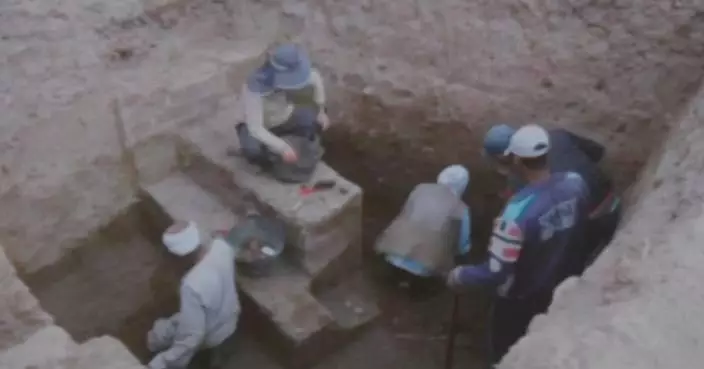
The mission found a residential complex near the temple, along with stone blocks and fragments of statues. Archaeologists also uncovered a limestone structure believed to have been used for wine production.
Other finds include stone blocks, statue fragments and pottery. Some of the stone artifacts date to the New Kingdom period (1550 BC-1069 BC).
Egyptian Minister of Tourism and Antiquities Sherif Fathy praised the fruitful archaeological cooperation between Egypt and China, describing the two countries as home to two ancient civilizations with rich cultural heritages.
The latest discoveries demonstrate the close and growing cooperation between the two countries in archaeology, following a number of joint archaeological projects in recent years, according to Fathy.
Chen said that the two sides had already begun in-depth cooperation as early as during the exhibition "On Top of the Pyramid: the Civilization of Ancient Egypt," jointly held by the Shanghai Museum and Egypt's Supreme Council of Antiquities.
Chen said the joint archaeological mission will continue to conduct surface surveys and archaeological excavations of the Temple of Sekhmet and its surrounding areas over the coming quarters, with the aim of further determining and reconstructing the architectural layout, construction process, history of use, landscape changes and evolution of civilization of the temple and even the Memphis area.
The Shanghai Museum will work with Egypt's Supreme Council of Antiquities to establish a long-term cooperation system covering archaeological excavation, research, conservation, exhibition and utilization, and further promote academic exchanges and mutual learning between the two countries in the field of archaeology, said Chen.
The Sekhmet Temple, discovered by chance in 1959, formed part of the Great Temple of Ptah, the main religious complex of ancient Memphis.
The ancient city of Memphis, founded around 3100 BC, served as the capital of Egypt during the Old Kingdom period and remained an important religious and cultural center for centuries.
Egyptian-Chinese archaeological team announces new discoveries at ancient Memphis site