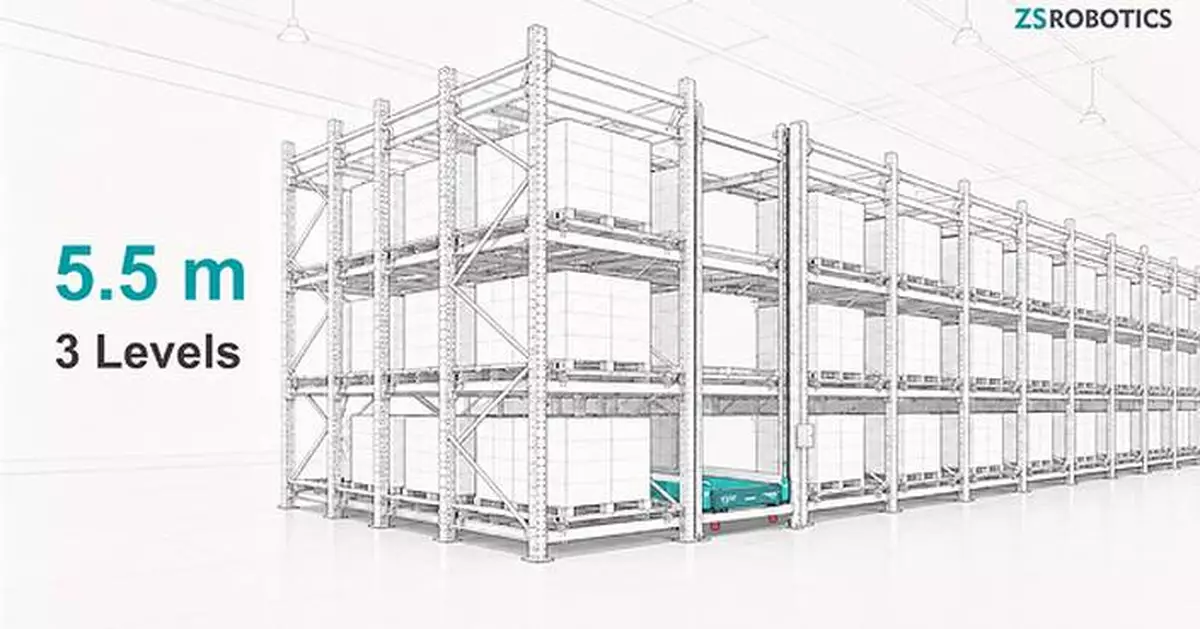
Three-level pallet storage combined with a single-position lift unlocks greater storage value within limited building height
TOKYO, Sept. 2, 2026 /PRNewswire/ -- As land costs continue to rise and demand for warehouse automation grows, making better use of limited building height has become an increasingly important consideration for warehouse operators.
ZS Robotics, a smart warehousing robotics company, introduces a high-density storage solution designed for warehouses with a building height of approximately 5.5 meters in Japan. Through space optimization, safety-focused engineering and local service support, the solution is designed to help existing warehouses overcome the constraints of limited vertical space.
Three-Level Storage: Unlocking More Potential from Limited Height
Many existing warehouses in Japan operate within building heights of around 5.5 meters. Under such height constraints, conventional configurations may allow only one or two levels of pallet storage, making higher storage density a key challenge for warehouse upgrades.
To address this, ZS Robotics has optimized its core equipment and rack-level configuration to enable three-level pallet storage, maximizing the use of available vertical space. The solution also incorporates seismic-resistant racking to meet the requirements of the Japanese market.
At the core of the solution are two pieces of equipment working together.
The first is the ZS-H125 four-way pallet shuttle, which features an ultra-low 125 mm profile for height-constrained warehouses. Its 15 sensing elements support precise positioning, proactive alerts and dynamic obstacle avoidance, while the 20-wheel drive system reduces rack-rail stress by 30% and improves stability across rail transitions. A 50 Ah battery provides 10–12 hours of continuous operation, with reliable performance in temperatures down to -25°C.
The second is the single-position lift, which occupies just one pallet position per level and can save approximately eight pallet positions per level compared with conventional lift configurations. The lift supports no-pit installation, reducing the first-level height requirement by more than 100 mm. Its self-developed mechanical blocking module prevents the shuttle from falling even in the event of a power or network failure.
Both pieces of equipment feature a 90% modular design, allowing core components to be replaced in as little as five minutes. This enables on-site personnel to carry out routine maintenance without relying on specialized engineers. ZS Robotics has also established a local spare-parts warehouse and professional service team in Japan, providing standard SLA-based response services and after-sales support of up to 10 years.
Japan Market: 10 Projects Completed and Nearly 80 Units Deployed
To date, ZS Robotics has completed 10 projects in Japan, deploying nearly 80 units of equipment across Honshu and Kyushu, with a total operating area exceeding 7,565 square meters. These deployments span industries including automotive, food and seasonings, printed products, cleaning supplies and daily consumer goods, making Japan one of ZS Robotics' most established overseas markets.
Globally, ZS Robotics has completed more than 250 projects across Asia, South America, North America and Oceania, with over 1,000 four-way pallet shuttles deployed. Since the beginning of 2026, overseas projects have accounted for 50% of the company's total projects.
LTT 2026: Three Core Products Make Their Joint Debut
At Logis-Tech Tokyo 2026, taking place from September 8 to 11, ZS Robotics will showcase its latest technologies at Booth E7-W23. The exhibition will feature the global debut of the single-position lift and the complete high-density storage solution for 5.5m-high warehouses, alongside the Asia debut of the ZS-H125 four-way pallet shuttle.
The ZSmart intelligent software platform will also be on display, demonstrating how hardware and software work together to support high-density automation in height-constrained warehouses.
** This press release is distributed by PR Newswire through automated distribution system, for which the client assumes full responsibility. **
ZS Robotics Launches 5.5m Low-Height Warehouse Solution, Overcoming Height Constraints with Four-Way Shuttle Technology
New developer platform connects AI applications to Binance trading, market data, wallets, payments and on-chain tools across crypto
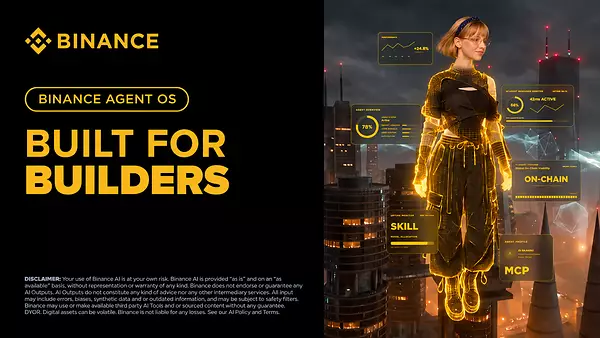
ABU DHABI, UAE, Sept. 2, 2026 /PRNewswire/ -- Binance today introduced Agent OS, a developer platform and standardized access layer connecting AI applications to Binance's trading, market data, wallet, payment and on-chain capabilities across crypto.
Built as part of Binance Intelligence, the largest cryptocurrency exchange's strategic initiative for AI-powered products and experiences, Agent OS gives AI builders, fintech developers and quantitative trading teams a controlled foundation for creating applications and agents that interact with Binance's financial infrastructure. The platform supports both ready-made integrations and users' own AI agents.
Through supported AI tools, such as ChatGPT, Claude Code, Codex and Cursor, users can authorize agents to access market data, view account information and perform supported trading activities, subject to the permissions and limits they configure. Users can also assign each agent to a dedicated subaccount to segregate funds and trading activity.
"Binance Agent OS addresses the fragmentation developers face when building agentic finance applications across crypto and traditional markets," said Jeff Li, VP of Product at Binance. "It gives everyone from developers to quantitative traders the reliable data, low–latency infrastructure, and standardized interfaces they need to deploy AI–driven strategies."
A standardized developer layer
Agent OS brings together Binance APIs, Binance Wallet Agentic Hub, Binance x402 (programmable payments), Binance Skill Hub and newly introduced support for the Model Context Protocol (MCP). Together, these capabilities give developers the components they need to build connected financial applications and AI agents.
MCP is an open standard that enables compatible AI applications to connect to and use external tools. Its integration into Agent OS gives developers and partners a standardized way to connect their applications and agents to Binance, reducing the need to create separate integrations for each product or use case.
User-controlled access
User-controlled permissions determine the Binance data and trading capabilities available to an AI agent. Binance can monitor resulting trading activity, including orders, but not the agent's broader workflow or reasoning, which runs within the user's selected AI application.
Binance's initial MCP implementation lets compatible AI applications access market data, view read-only account information and place trades. Through the MCP server, users can assign an agent to a dedicated subaccount, configure its permissions, and revoke access at any time.
Agents can view balances, portfolio information and transaction history of a designated subaccount, as well as balance and portfolio information for the user's main account. They cannot access non-trading personal account information, including email address or KYC data.
Binance monitors and applies applicable controls to trading activity initiated through the platform, including the resulting orders. The agent's external information sources, interpretation and decision-making are managed within the user's selected AI application and are not visible to Binance.
Find out more about Agent OS here: https://binance.com/agent-os
Compatible clients that support MCP over Streamable HTTP can connect using:
https://agent.binance.com/mcp/agentic
Detailed setup instructions are available in the Binance MCP Server documentation:
https://developers.binance.com/en/docs/agent-native/mcp-server
Disclaimer: Your use of Binance AI, including any Binance AI Service, is at your own risk. It is provided to you on an "as is" and "as available" basis, without representation or warranty of any kind. You are solely responsible for all of your Prompts. Prompts may be used for training purposes. AI Inputs may include various unvetted third party sourced content. Any sourced content is provided "as is" without any guarantee. Binance may restrict or alter sourced content based on various compliance safety filters, however this is not absolute. Binance does not endorse or guarantee any AI Outputs. AI Outputs may include or reflect content, positions, views and opinions of third parties unknown to Binance, which may also include errors, biases, synthetic data and or outdated information. Any AI Output should not be solely relied on for decision making. AI Outputs do not constitute any kind of advice by Binance nor any other intermediary services. Binance AI may use or make available third party AI Tools without any guarantee and subject to third party terms. Where AI Tools are configured by yourself or a third-party, you indemnify Binance against all liability. Binance does not guarantee any AI Tools. Binance AI may respond to your requests, but without any guarantee that your request will be fulfilled satisfactorily or at all. Digital asset prices can be volatile. You are solely responsible for your investment decisions and Binance is not liable for any losses. Digital asset prices can be volatile. DYOR. Use of Binance AI may be subject to additional Binance Product Terms, where applicable. For more information, see our Terms of Use, Risk Warning and AI Policy and Terms.
** This press release is distributed by PR Newswire through automated distribution system, for which the client assumes full responsibility. **
Binance Introduces Agent OS to Connect AI Applications to Financial Infrastructure