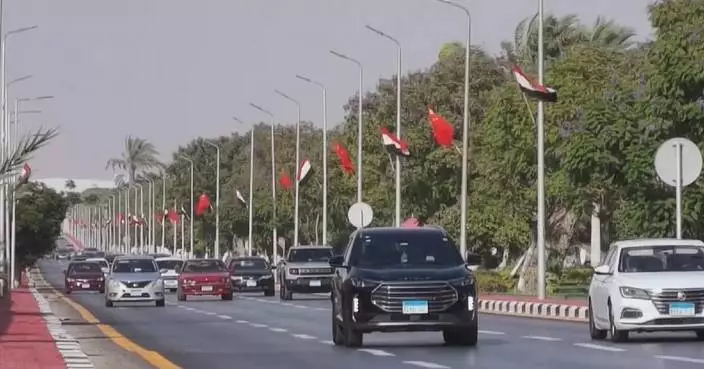
As China and Egypt mark 70 years of diplomatic relations, a former Egyptian cabinet minister has commended China's extraordinary development achievements and Belt and Road cooperation outcomes in Egypt, voicing high hopes for deepening industrial partnership between the two nations.
In an exclusive interview with China Global Television Network (CGTN), former Egyptian Minister of Trade and Industry Mounir Fakhry Abdel‑Nour said he was struck by the scale and speed of China's transformation.
"What I've seen in China during the several trips I took when I was Minister of Industry is impressive. I mean, the whole country is impressive, and the development and the rapidity of this development is extremely impressive. And our industrial relations with China have grown tremendously, especially since 2013 with the Belt and Road Initiative, where the Suez Canal has a very important presence within the structure of that initiative," he said.
The former minister said bilateral cooperation extends beyond strategic consensus, producing landmark results on the ground. Flagship industrial projects, he noted, have provided clear gains and added momentum to Egypt's economic growth.
"The physical proof of the cooperation is in the development of the industrial zone, the Chinese industrial zone, in the Suez Canal area near Sukhna. And the developer is the Chinese company called TEDA that is now, that has grown over a plot of land of approximately 10 square kilometers, where direct Chinese investments have invested approximately 4 billion U.S. dollars, 200 companies, mainly industrial and service companies," he stated.
Against the backdrop of Egypt's push to upgrade its industrial system and optimize economic structure, Mounir Fakhry Abdel-Nour stressed the significance of continued Chinese support, especially technological empowerment, to help the country hit its industrial development targets.
"Today, industry represents approximately 17, 18 percent of the GDP. We have to increase that percentage to become 24, 25, 26 percent of GDP. And we will never be able to reach that percentage unless we have the support of major industrial countries. And in fact, China is extremely generous in this respect. In fact, we're very hopeful that as a result of the visit of President Xi Jinping, we will be able to sign a few agreements that will allow us to benefit from the transfer of technology," he said.
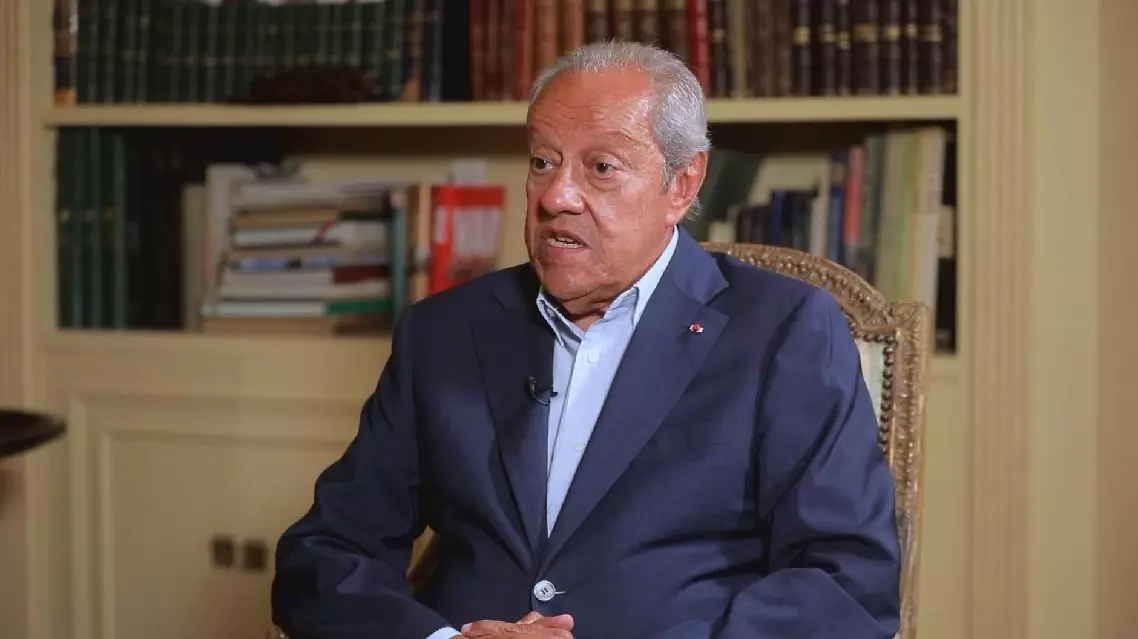
Former Egyptian minister hails China’s rapid development, BRI gains
A joint Egyptian-Chinese archaeological mission has uncovered cultural relics and archaeological remains at the Temple of Sekhmet site in Mit Rahina, Giza Province, west of Cairo, according to Shanghai Museum at a press conference on Tuesday.
The discoveries provide new evidence of how the area surrounding the temple was used and inhabited across successive periods of ancient Egyptian history.
The mission is jointly conducted by Egypt's Supreme Council of Antiquities and the Shanghai Museum in east China, and is co-led by Reham Zaki of Supreme Council of Antiquities and Chen Jie, deputy director of the Shanghai Museum.
The mission found a residential complex near the temple, along with stone blocks and fragments of statues. Archaeologists also uncovered a limestone structure believed to have been used for wine production.
Other finds include stone blocks, statue fragments and pottery. Some of the stone artifacts date to the New Kingdom period (1550 BC-1069 BC).
Egyptian Minister of Tourism and Antiquities Sherif Fathy praised the fruitful archaeological cooperation between Egypt and China, describing the two countries as home to two ancient civilizations with rich cultural heritages.
The latest discoveries demonstrate the close and growing cooperation between the two countries in archaeology, following a number of joint archaeological projects in recent years, according to Fathy.
Chen said that the two sides had already begun in-depth cooperation as early as during the exhibition "On Top of the Pyramid: the Civilization of Ancient Egypt," jointly held by the Shanghai Museum and Egypt's Supreme Council of Antiquities.
Chen said the joint archaeological mission will continue to conduct surface surveys and archaeological excavations of the Temple of Sekhmet and its surrounding areas over the coming quarters, with the aim of further determining and reconstructing the architectural layout, construction process, history of use, landscape changes and evolution of civilization of the temple and even the Memphis area.
The Shanghai Museum will work with Egypt's Supreme Council of Antiquities to establish a long-term cooperation system covering archaeological excavation, research, conservation, exhibition and utilization, and further promote academic exchanges and mutual learning between the two countries in the field of archaeology, said Chen.
The Sekhmet Temple, discovered by chance in 1959, formed part of the Great Temple of Ptah, the main religious complex of ancient Memphis.
The ancient city of Memphis, founded around 3100 BC, served as the capital of Egypt during the Old Kingdom period and remained an important religious and cultural center for centuries.
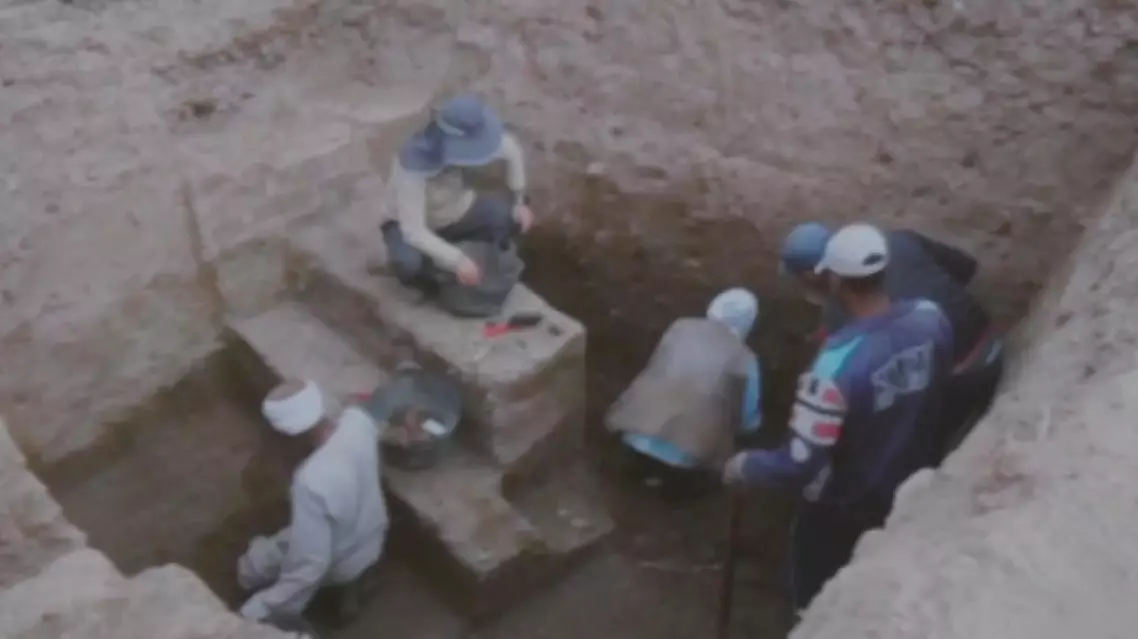
Egyptian-Chinese archaeological team announces new discoveries at ancient Memphis site