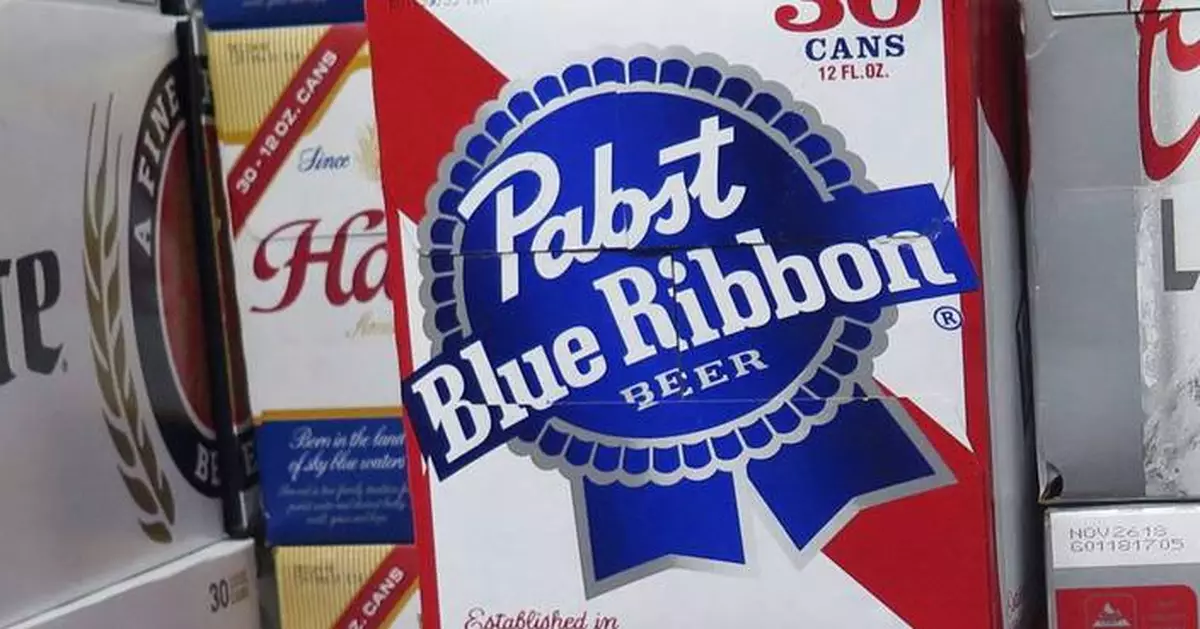
Pabst Blue Ribbon wants its beer back, and it's offering a reward to help that happen.
Greig DeBow, the CEO of Pabst Brewing Co., said Wednesday that the company will pay up to $20,000 to anyone who provides new information that leads to the recovery of 1,602 cases of Pabst Blue Ribbon and non-alcoholic Old Milwaukee beer. The beer went missing Aug. 17 in Southern California.
“I'm sure they look cool with a garage full of PBR,” DeBow said in a post on TikTok. “That's actually not cool though. We want it back."
Police in Montclair, California, said the beer was stolen from a warehouse in two separate incidents on the same day.
In the first heist, about $45,000 worth of beer headed to Tucson, Arizona, was picked up but never delivered, according to police. An hour later, a “purported subcontracting company” submitted fake documents to pick up another $25,000 worth of beer, Montclair police said. Both thefts occurred on Aug. 17 at an Anheuser-Busch distribution center about 40 miles (65 kilometers) east of Los Angeles.
All told, the thieves made off with 40,000 pounds of beer, Pabst said. Police estimated that the stolen beer was worth $70,000.
DeBow said the company wants the beer to be returned by Sept. 9. Anyone with information is asked to email hotline@pabst.com.
The theft was one of several recent high-profile food heists.
Late last year, 40,000 oysters, lobster worth $400,000 and a cache of crabmeat all were stolen in separate incidents within weeks of each other in New England.
And in March, Swiss food giant Nestlé said 413,793 KitKat brand chocolate bars bound for Poland were stolen after leaving its production site in Italy.
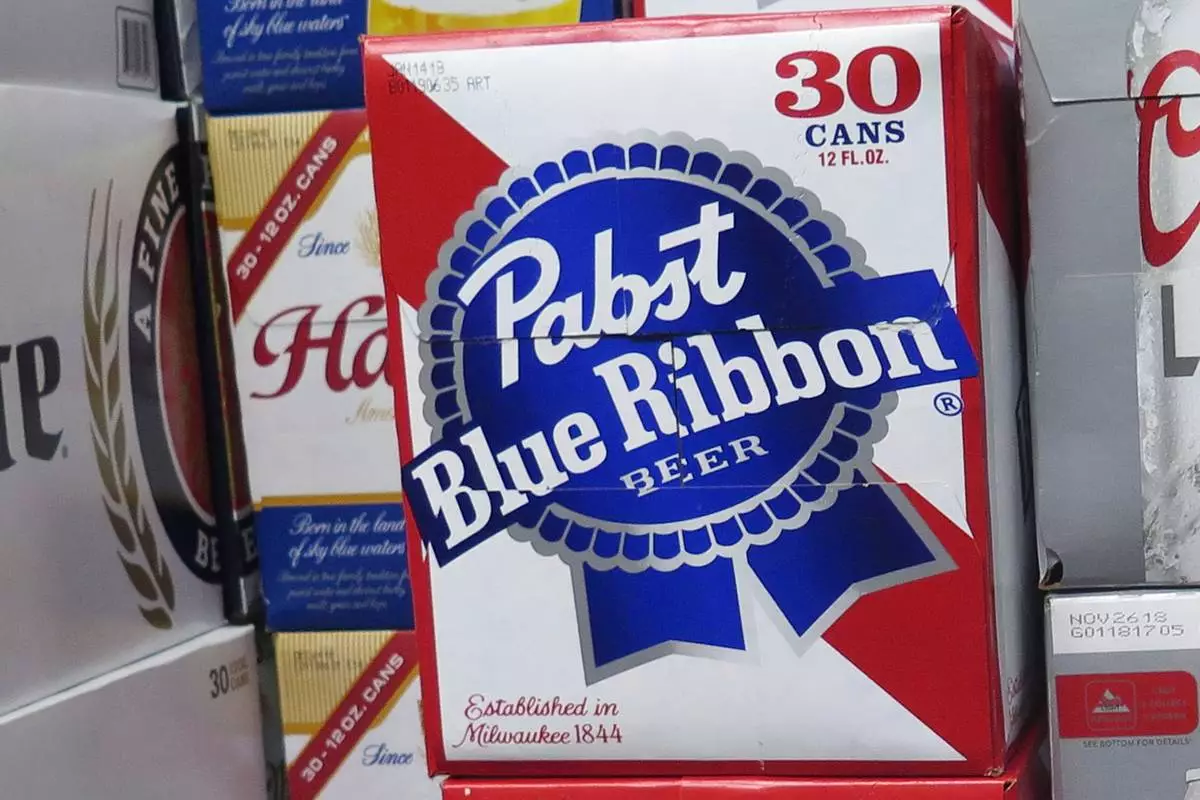
FILE - Cases of Pabst Blue Ribbon beer are stacked in a liquor store, Nov. 8, 2018, in Milwaukee. (AP Photo/Ivan Moreno, File)
LOS ANGELES (AP) — The new Lucas Museum of Narrative Art will serve “Star Wars” fans what they crave, but the saga George Lucas spawned represents just one small corner of the galaxy of creative work within the walls of the Los Angeles institution he calls a "temple to the people’s art.”
The purpose of the palace that has become his life's work since he sold Lucasfilm to Disney in 2012 is to take the work of populist painters, commercial illustrators, comic artists and paperback cover-creators and treat it with a reverence normally reserved for Rembrandts.
“That’s really what the mission is, that there’s these incredibly familiar pieces that have not had the opportunity to be platformed in this manner, to be placed like this, to be curated in this way, for people to really see the genius behind it,” museum CEO Tracey Bates said in an interview with The Associated Press inside the museum.
The building opens to the public Sept. 22.
The 82-year-old Lucas made an unannounced appearance at a media preview day at the museum on Wednesday with his wife, businesswoman Mellody Hobson, the museum's co-founder. He said he couldn't believe the place now exists after being conceived 17 years ago and having been “kicked out of” proposed locations in cities including San Francisco and Chicago, places where previous sites fell through.
"Part of the problem is that I’m a contrarian. I don’t like to do things people think can be done," he said, wearing a T-shirt that read “Dedicated to the people's art.”
“I’m used to doing the impossible," he said. "This one almost broke me.”
Visitors to the new museum will be greeted by a bright yellow Naboo N-1 Starfighter from 1999's “The Phantom Menace” that hangs in the lobby of the public research library. The opening exhibit, “Star Wars in Motion,” shows production versions of Luke Skywalker's landspeeder from the original film and speeder bikes from 1983's “Return of the Jedi.”
But Bates points out that “'Star Wars' only occupies 7% of the museum, actually.” And chief among the tasks of the CEO and her staff in the final days before opening is spreading the word about all it has to offer.
Nearly everything in the vast museum's 100,000 square feet of galleries comes from the personal collection of Lucas or Hobson, a major collector of African-American art.
The filmmaker began collecting original comic art from newspaper strips like “Alley Oop” when he was in college and it could be had for pocket change. When blockbuster money started rolling in, he started buying paintings from commercial artists, including Norman Rockwell and Maxfield Parrish, that were deemed the height of uncool at the time. He joked at a San Diego Comic-Con panel last year that he needed a museum just to have somewhere to put it all.
Bates, who joined the project in 2020, spoke to the AP while sitting in the gallery devoted to Rockwell, the 20th century painter and illustrator who embodies the spirit of the museum more than Luke Skywalker or C-3PO.
“He’s one of the greatest storytellers of our lifetime, really,” she said. “I mean the level of nuance and depth in a Rockwell, I get lost in them constantly.”
Best known for his weekly covers of “The Saturday Evening Post,” with images of Boy Scouts and family Thanksgiving dinners, Rockwell's paintings were quintessential small-town Americana, which made them wildly popular but brought them scorn for their squareness.
Senior curator Ryan Linkof told the AP that when he joined the museum in 2018, he knew only the consensus view of the painter.
“Working here I really just grew to absolutely love the work and find him as an image-maker, him as an artist, him as the figure, the cultural icon, just to be incredibly sophisticated,” Linkof said.
The Rockwell gallery gives special prominence to a painting that shows he had greater depth than many realize: his rendering of Ruby Bridges, a 6-year-old Black girl who is surrounded by marshals as she walks into an all-white New Orleans school in 1960. It's titled “The Problem We All Live With.”
The gallery also has a sculpture of the artist, newly commissioned for the museum, that recreates a famous comic portrait of him painting himself.
Lucas also stockpiled the work of Parrish, another painter and commercial illustrator whose imagery helped define the 20th century but who could be dismissed as cloudy fluff. His work is ethereal and angelic, marked by a signature shade of blue, and the paintings' luminosity gives them a glow that feels made for a museum, even though one of the most ornate paintings in the collection was made for a chocolate box.
Linkof walked with the AP through the Parrish gallery, a favorite of many early visitors, calling it “a little sanctuary, a little chapel in some ways, dedicated to the work.”
“He was known for these really gorgeous light effects and creating these atmospheric landscapes,” the curator said. "We wanted to respect that and create a space that really let the paintings create that sense of tranquility.”
Many galleries are organized not by artist, era or genre but by aspects of everyday life, merging eras and styles. One examines sports. Another civic activism.
“We’re interested in the stories that they’re telling, rather than these kind of somewhat artificial categories defined by discipline,” Linkof said. “The gorgeous idea of these myths, myths of everyday life, the stories that we tell ourselves.”
The museum has its share of higher-brow artists too, with work from Frida Kahlo, Diego Rivera and Andy Warhol. If it tells a story, it has a place.
Visitors will walk through the museum designed by architect Ma Yansong eight years after its groundbreaking in Exposition Park, next to Lucas' alma mater: the University of Southern California.
Ma and his firm wesre chosen in 2014, and an architecture gallery in the museum shows his proposed models for San Francisco and Chicago along with the origins of the Los Angeles project.
Given the name outside, it’s hard not to think of a spacecraft when looking at the building. The architect acknowledges this, and says visitors will especially feel it when standing in front of broad oval windows that give views of Los Angeles from spaces spread throughout the galleries.
But Ma's style is more organic than mechanical, and the museum gives the feeling that it hovers above the neighboring Los Angeles Memorial Coliseum and surrounding buildings like the California Science Center.
“For me it’s like a cloud or like a tree canopy that’s floating above you,” Ma told the AP. “It feels formless almost. But you want to discover. So you have to start a journey. You have to start to walk around.”
As he looked around inside the museum, he said he couldn't wait to see people flowing through it.
“We designed an architectural space with emotion,” he said. “We want to see people’s reaction to those spaces.”
The museum has as much sci-fi and fantasy from Lucas' collection as from his own work. The sword-and-sandal comic book and paperback art of artist Frank Frazetta has a dedicated space. Nearby are huge, heavy-metal-epic paintings of images from J.R.R. Tolkien by Paul Raymond Gregory, complete with skull-studded frames.
A children's section includes a painting of Eloise of “Eloise at the Plaza” fame by illustrator Hilary Knight, a painting of Pikachu modeled on a Van Gogh self-portrait from Pokemon illustrator Naoyo Kimura, and rooms full of anime and manga images.
And the comic art that started Lucas' collecting has several halls dedicated to it, with some of the earliest drawings of “Star Wars” inspiration Flash Gordon on display, along with Flash Gordon's own inspiration, Buck Rogers, and proto-“Peanuts” panels from Charles Schulz, along with edgier alt-comic work from artists including Robert Crumb.

A Naboo N-1 Starfighter from the film "Star Wars: Episode I - The Phantom Menace" is suspended above the entrance to the Education Lobby of the Lucas Museum of Narrative Art during a preview on Monday, Aug. 31, 2026, in Los Angeles. (AP Photo/Chris Pizzello)
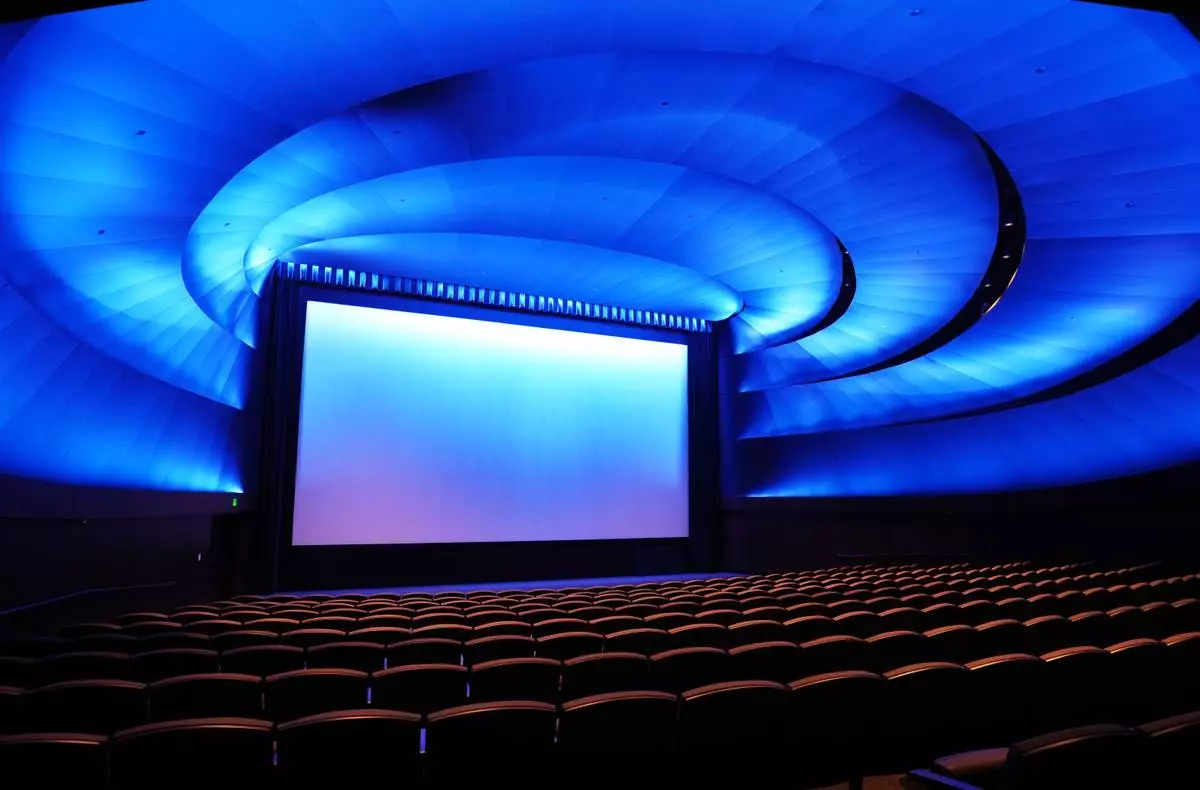
The 299-seat Slavko Vorkapich Theater is pictured inside the Lucas Museum of Narrative Art during a preview of the museum on Monday, Aug. 31, 2026, in Los Angeles. (AP Photo/Chris Pizzello)
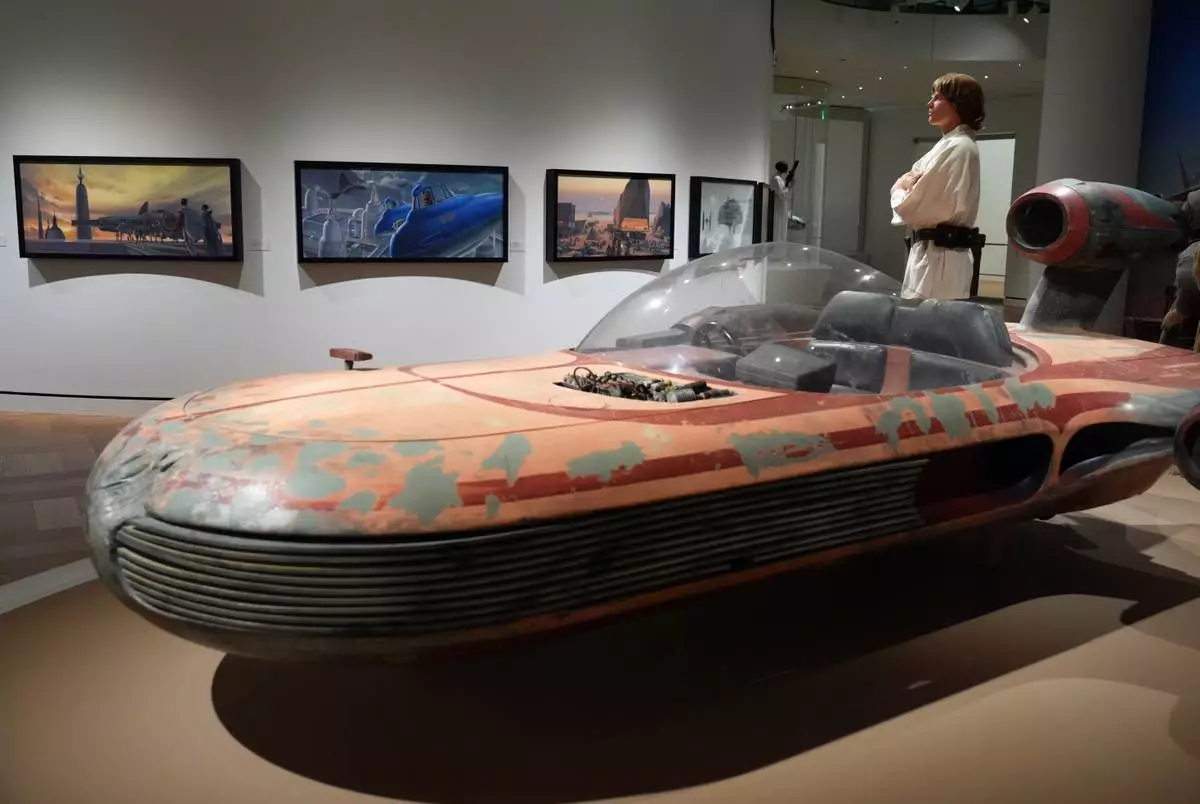
Luke Skywalker's landspeeder from the 1977 film "Star Wars: Episode IV - A New Hope" is pictured in the Cinema Gallery during a preview of the Lucas Museum of Narrative Art on Monday, Aug. 31, 2026, in Los Angeles. (AP Photo/Chris Pizzello)

A sculpture of the "Star Wars" character Yoda is displayed along a walking path in the garden area of the the Lucas Museum of Narrative Art during a preview of the museum on Monday, Aug. 31, 2026, in Los Angeles. (AP Photo/Chris Pizzello)

Production designer Norman Reynolds' robot R2-D2, left, and John Mollo's costume for the C-3PO character from the "Star Wars" franchise are displayed in the Cinema Gallery during a preview of the Lucas Museum of Narrative Art on Monday, Aug. 31, 2026, in Los Angeles. (AP Photo/Chris Pizzello)